


Platform
Company
Resources
Blog
Hidden Costs of Rework in Construction: How Collaborative Design Helps Prevent Them
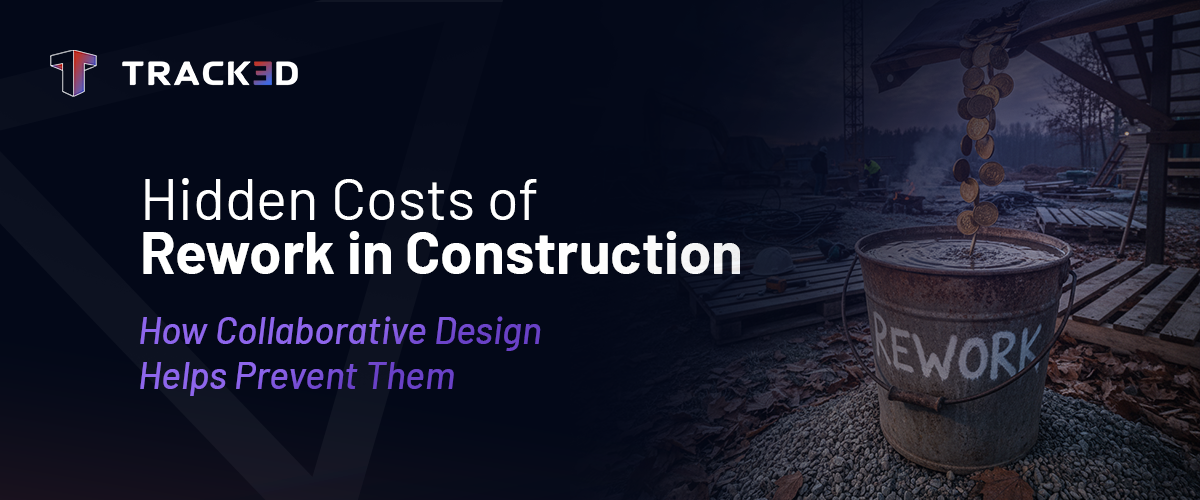
Do you know what drains most of the U.S. construction projects? Rework. Surveys carried out in the construction industry say that more than 14 hours a week are wasted on things like-
rework,
conflict resolution,
searching for information.
This means almost two workdays per person every week are lost.
All that could have been avoided.
These activities are not optimal. At the national level, it’s a costly mistake. Over $177 billion a year just in labor costs, and rework.
These figures indicate something really significant. In construction, rework is not only an issue for the budget due to the wastage of materials. It is also an issue in terms of time, productivity, and team morale.
Moreover, it triggers more safety risks. And the trust with clients is more or less damaged.
No question, construction teams will always use more energy in correcting defects than in working the right way. It is always a setback instead of a fix.
In this read, let’s go over what really causes rework, its real cost, and how collaborative design can help with its prevention.
What is Rework in Construction?
In the construction industry, rework is defined as any activity that has to be repeated because of a prior mistake or some other reason. Usually, it results from errors, lack of proper communication, or misunderstanding among the various involved teams.
Some typical examples of rework are:
– Delays in RFIs leading to redesigns
– Poorly defined scope resulting in removal and replacement of work
– Conflict between trades discovered at the site
– Alterations made based on the old design
Rework is hardly ever noticed as a problem immediately. One might think of it as ‘simply a fix’, what can go wrong? One change, one adjustment, that’s all. But things do not happen like that. Why? Little by little, these minor disturbances accumulate. And then, finally, it creates a significant impact on the project.
Understanding the True Cost of Rework in Construction
Based on the 2024 Autodesk and FMI report, it seems rather alarming that rework makes up to 20% of total project cost. This figure should, at least, make every construction team reconsider their situation.
However, the cost of rework in the construction industry is not just limited to the price of materials and labor hours.
The hidden impacts are as follows:
- Schedule delays- The unplanned work pushes the milestone of the project back even more. A delay in one trade means that the others will either have to wait or they will have to do their work fast later.
- Productivity loss- The laborers lose their pace when they have to stop, redo, or modify their process.
- Strained client relationships- The buyer is usually not very receptive to major and constant changes. Why? It destabilizes the buyer’s confidence and creates conflict among the owners and stakeholders.
- Increased danger of accidents- Where there’s a lot to work along with redo, then the probability of accidents shoots up. Why? Workers and stakeholders are under pressure.
- Lower team morale- Endless rework leads to frustration, blame, and exhaustion. And you know, how it all affects both the field and office staff.
When you collate all these aspects, the actual cost of rework goes up. Even much higher than a single line item.
How Traditional Workflows Make Rework Costs to Swell
Poor execution doesn’t cause rework as often as project organization does.
Just like siloed teams, traditional workflows usually create gaps by allowing mistakes to pass unnoticed.
The following problems are typical in the workflow:
- Siloed teams- The designers, engineers, contractors, and trades are all working one after the other instead of together.
- Information descended to bits- The intercommunication between the teams is mainly through email threads, outdated drawings, and slow updates that soon become useless.
- Late problem detection- Problems are only tackled after they become visible on-site. And this is where the most expensive fixes are done.
With such situations, the rework is often accepted as a natural consequence. However, the truth is that the majority of it can be avoided in the earlier stage.
How Collaborative Design Reduces Rework in Construction
Collaborative design changes when and how problems are solved.
Rather than reacting to issues at the site, the teams will consider them collaboratively. When? During the time of planning and designing. It is quicker and less expensive.
Collaboration helps in the following major ways:
Stakeholders’ Input at the Start of the Project
Before the start of the construction,
– project owner,
– architect,
– contractor,
– main trades
Hold discussions to get a mutual understanding of their expectations.
Clear Design Concept
With this, misunderstandings and misinterpretations that would have occurred later are reduced to a considerable extent.
– Reduced incidence of late changes
– Issues are resolved before the materials are ordered or put in place.
This alone can cut down on a big part of the rework that is usually done.
Best Practices for Project Teams To Minimize Rework in Construction
Rework is not usually the result of one major mistake. It is a build-up of small errors that remain unnoticed. Introducing good practices and improving collaboration can eliminate the majority of such issues. Project teams can adopt some practical measures to avoid rework getting to the site.
Align Early During Preconstruction
Many of the rework issues originate even before construction. The lack of critical voices in the early stage leads to the formation of assumptions.
The project teams must involve the main trades, engineers, and construction leads during preconstruction discussions.
It enables bringing up
design conflicts,
constructability concerns,
scope gaps
That too, while the changes are still inexpensive.
The early alignment will help the teams in the following:
• Set the right expectations before the job starts
• Limit last-minute design changes
• Prevents misinterpretation of the scope by different trades
When the entire team is aware of the plan from day one, the number of repairs needed later on will be reduced.
Standardize Design Reviews
Design reviews, more often than not, take place in an uncoordinated manner. As a result, some details might get neglected.
When you have a uniform and structured review process with well-defined checkpoints, half of the problem is solved. A fixed agenda should be followed for each review session.
Drawings,
models,
assumptions
should be examined and discussed at the same time.
The main points of effective design reviews are:
• Collaboration of trades and clean transfers of responsibility
• Areas with the highest risk like MEP and structural intersections
• Zones with previous rework history
It is not merely the frequency that makes reviews effective. But rather the consistency.
Improve Cross-Team Coordination
The majority of rework problems are not technical. They are due to lack of communication. Frequent short coordination meetings can keep the teams aligned. These meetings do not have to be long. They have to be of high importance only.
Good coordination involves the following points:
- Checking trades weekly
- Making the responsibility of unresolved matters very clear
- Rapid responses to decisions
The small talk of today prevents the major problem of tomorrow.
Learn From Past Rework
Most teams are still facing the same rework problems over and over again. Monitor in which areas rework is taking place and the reason for it. Analyze it after every milestone. Pass on the knowledge learned to the next stage or project.
This brings about:
- Early spotting of patterns
- Changes to design and workflow
- Mistakes reduced in number
Rework should be a teacher, not a replicator.
Keep One Source of Truth
Rework tends to be amplified if different versions of the same information are used. The project teams should work on one common platform where all the
drawings,
models,
updates
are kept and monitored.
This way, everyone knows the place of the latest information.
This can reduce the count of:
- Field decisions made based on outdated drawings
- Different teams issuing conflicting directives
- Misunderstanding taking place while transferring work between parties
Emerging Tools That Help Reduce Rework
New techs are impacting productivity and predictability. This allows the enhancement of the collaborative approach.
The future technologies are:
• AI clash prediction to indicate problems sooner
• Digital twins for comparison of the design and the sites
• AR and VR simulations for the final review of the designs before the actual building
• Predictive analytics to detect the stages of the construction project that are at the highest risk
These tools are just to keep teams always ahead of the game.
Conclusion
Rework is not only a construction issue. It is a problem of the whole system. And takes time, trust, and momentum as well.
So, what exactly plays a big role in preventing rework-
– proper alignment from the start
– timely and clear communication
– design that involves all parties
This leads to-
• less time lost
• safer places to work
• happier workers
• better client relationship
The collaborative design can make rework fade away.
Are you ready to take it further? Check out how progress monitoring helps in early detection of issues, rework reduction, and maintaining schedules.
subscribe to our blog
- Benefits
See the advantage of comprehensive and unified site documentation with Track3D

Blog This release focuses on giving enterprise teams the centralized
Blog If you’ve ever watched a superintendent frantically scribble notes

Blog Construction teams rely on multiple systems to manage designs,