
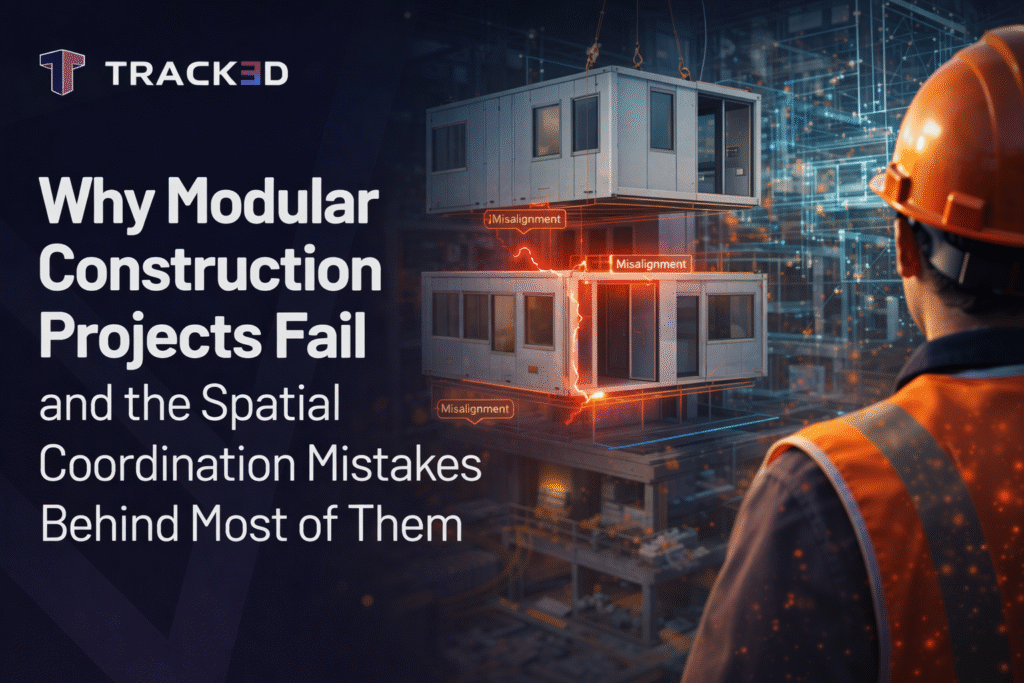
Modular construction is often marketed as the “faster way to build.” And in many cases, it truly is.
It is a delivery method where buildings are manufactured in sections inside a controlled factory environment, then shipped to site and assembled. The big promise is speed. Lots of modular projects are trying to deliver 30-50% faster than traditional building methods.
And the concept makes sense. Instead of waiting for foundations to finish before vertical work begins, modular allows two major workstreams to happen at the same time: Factory production,
Site preparation.
That parallel workflow is where the time savings come from.
In fact, McKinsey has pointed out that offsite construction can actually boost productivity by 50-60 % versus the norm.
So why do modular projects still fail?
Because modular construction is not just about building faster. It is about building with precision. And when that precision breaks down, the project does not just slip. It collapses into expensive delays, site rework, and major coordination headaches.
In this blog, we’ll break down the real reasons modular construction projects fail. And,we’ll be looking into all the spatial mis-coordination problems that cause most of the problems in the first place.
Key Takeaways
Modular construction is pretty good at delivering speed and quality. But only if spatial co-ordination is handled properly.
Most modular failures do not happen because the modules are poorly built. They happen because factory output and site conditions are not aligned.
The three biggest root causes are: design freeze violations, unverified site tolerances, disconnected progress tracking
If you only take one thing from this guide, take this: independent as-built verification before factory production is finalized is one of the most impactful risk prevention steps in modular construction.
And finally, spatial technology like reality capture and BIM-connected monitoring is helping teams close the gap between factory output and site readiness.
What is Modular Construction?
Modular construction also known as prefabricated or offsite construction is when a good chunk of a building is put together in a factory, and then the completed modules are trucked out to the building site for final assembly.
On many projects, you can actually finish 60% to 90% of the building in a factory before anything is installed on the site at all.
This is a world of difference from traditional construction, where everything’s usually built outdoors, in all sorts of weather, with limited space to move around and constant delays because of the different trades getting in the way of each other.
Modular construction works in a completely different way because it splits the job into two separate streams:
Factory production – where all the bits get built into modules\
Site prep – where the land gets readied for the modules to be dropped in
Instead of waiting for one to get underway before starting the other, both get going simultaneously.
This is why modular projects can move at a whirlwind pace when everything clicks.
There are 2 key types of Modular Construction :
- Permanent Modular Construction (PMC)
These are modular buildings built to the exact same codes and standards as traditional buildings and are intended to stay put – no moving and shaking once they’re built. - Relocatable Buildings (RB)
These are essentially modules designed to be moved & repurposed, and could be making an appearance at a different site or project type down the line.
When modular construction is going well, it brings a load of benefits –
notably reduced schedule time,
lower site waste
improved build quality
And this is all because of factory-controlled production. But when things go pear-shaped, the results can be expensive, frustrating & darned hard to keep under wraps.
Why Modular Construction Fails: The Real Picture
Most folks focus heavily on the benefits of modular construction.
Faster schedules.
Cleaner sites.
Better quality.
Less waste.
Indeed, these are real win-win. But you do miss another side of the story. What exactly? More often modular projects still run into
delays,
cost overruns,
rework.
In many cases, those issues wipe out the very savings modular was chosen for.
And here is the key point:
Most modular project failures are not caused by poor craftsmanship. They are caused by spatial coordination breakdowns between the factory and the site.
Think about what modular really requires.
The factory builds modules based on a design model.
Meanwhile, the site team prepares foundations and connection points based on the same model.
Then on installation day, everything must align with near-perfect precision.
Unlike traditional construction, where field adjustments happen daily, modular does not tolerate improvisation well. You cannot easily “make it work” when a module arrives finished and doesn’t fit.
That is why coordination matters so much.
If the factory builds to one reality and the site is prepared for another, the project will stall the moment the first module is lifted into place.
How Does The Modular Construction Workflow Look
To understand where failures happen, it helps to understand how modular delivery actually flows.
Because modular is not a single-phase process. It is a chain of connected stages. And if one stage slips, the rest of the chain feels it immediately.
Here is how the modular workflow typically works:
- Design Freeze & DfMA
The design is locked down. Now you’re structuring it for factory manufacture and on-site assembly.
You’re specifying tolerances and turning the BIM model into the main point of reference – and this is exactly where Design for Manufacture and Assembly (DfMA) comes in.
DfMA is a rule that compels teams to design with real-world manufacturing and installation in mind.
- Factory Production
Modules are made, checked, and dimension-checked in a controlled factory environment before being shipped out.
- Logistics and Transportation
Modules are loaded in the order they’ll go up, and you factor in transport constraints like module size, weight, and road restrictions at this stage.
- Site Preparation
You get the foundations, slabs, and structural connections in place to receive the modules.
- Module Installation
Cranes swing into action, placing modules in sequence. And you start connecting up the inter-module bits. Suddenly, the building starts taking shape at a pace.
- Commissioning and Handover
You hook up the services, finish off the details, do some final inspections, and then it’s done. signed off.
Now here’s the thing that most teams really overlook:
Spatial coordination is a thread that runs through every single phase.
If you miss it early on, the mistake doesn’t stay contained long. It compounds and gets worse.
A small deviation in the slab becomes a major alignment problem.
A last-minute design change becomes a structural mismatch.
A missed tolerance turns into a costly rework job.
6 Spatial Coordination Mistakes Behind Most Modular Construction Failures
Let’s get into the real causes. These six mistakes show up again and again on modular projects.
And what makes them dangerous is that they usually look small at first. But they explode later.
Mistake 1: Violating Design Freeze
Design freeze is supposed to be exactly what it sounds like. The design is frozen.
But in reality, design changes still happen after production begins.
Maybe an architect approves a change late.
Maybe a structural detail gets revised.
Maybe the client wants an adjustment.
Or maybe an RFI response comes back after the factory has already started fabrication.
The problem is not the change itself.
The problem is timing.
If the factory is building to the original design and the site team is preparing for the revised design, you now have two different “truths” on the same project.
Result: Inter-module connections fail to align on site. Modules require rework. Install schedules break down.
And because modules arrive finished, rework becomes far more painful than it would be in a traditional build.
Mistake 2: Building to the Model, Not the Site
Factories build modules to exact BIM dimensions. That is how modular achieves consistency.
But site preparation often follows traditional tolerance expectations. And those tolerances are not always strict enough for modular.
This is one of the most common failure points.
The factory assumes the slab is perfect.
The site team assumes the slab is “within tolerance.”
But modular tolerances are tighter. Nobody checks the slab against the actual module spec.
Then installation day arrives. The first module goes down. It does not sit correctly. Now you are not just dealing with one issue. Every module that follows inherits the error.
Result: The first module placement creates misalignment. Every module after it compounds the deviation.
This is how small site issues become major project failures.
Mistake 3: No Independent As-Built Verification
This is a big one.
Many modular projects rely on site team sign-off that is based on visual inspection. That works in traditional construction because field adjustments can happen.
But modular needs precision. You need hard proof.
If the site team gives the green light on the slab without anyone checking it for themselves, you’re basically taking a wild guess that everything fits the model. And that really is dangerous stuff to do. Why?
Because when the mistake is finally discovered, you’re pretty much stuck with the damage.
The crane is on site.
The installation crew is ready.
Deliveries are already scheduled.
That is a high-cost moment to find out something is wrong.
Result: The installation crew discovers conflicts on installation day. Crane time is wasted. Deliveries pile up. The schedule takes a hit immediately.
This is why independent as-built verification is such a powerful prevention step.
Mistake 4: Disconnected Factory and Site Progress Tracking
Modular construction only works when factory and site workstreams stay in sync.
But many teams track them separately.
The factory has its own schedule. The site team has its own schedule. Updates get shared around in emails & phone calls or crunched into weekly meetings, but there’s no overall, real time view of what’s actually happening.
So what happens?
Sometimes modules arrive early, but the site is not ready.
Other times, the site is ready, but the factory is behind. That means cranes get rescheduled, labor gets idle, and installation windows get missed.
Result: Modules arrive before the site is ready, or the site is ready and factory delays force missed installation windows.
Either way, the project loses the speed advantage modular was chosen for.
Mistake 5: Tolerance Stack-Up Ignored at the Design Stage
This is a technical headache for sure, but the underlying idea is actually really quite simple.
A single module can be within tolerance. That is fine.
But when you stack multiple modules, tolerances compound. A few millimeters here and there can turn into a serious deviation over several floors.
This is a tolerance stack-up.
If the design stage does not account for how tolerances accumulate across multiple modules, problems show up later in the build.
Most commonly, this hits on multi-storey modular projects.
Result: Upper-floor modules require adjustment. Roofing and cladding sequences are disrupted. Installation slows down and becomes unpredictable.
And once installation sequencing breaks, the whole modular advantage starts disappearing.
Mistake 6: Issues Logged Without Spatial Reference
On modular projects, issues must be tied to location. Otherwise, teams waste time chasing the wrong thing.
A defect might be logged in a project management tool, but without a clear spatial reference. That means no one is sure which unit it applies to, which side, which floor, or which connection point.
This becomes especially dangerous during closeout, when multiple punch list items are being tracked across multiple units.
Result: The wrong module is investigated. The real issue persists. Closeout becomes slower and more chaotic.
Tools and Technologies That Prevent These Failures
The teams that consistently succeed in modular construction are not just good builders. They are good coordinators.
And increasingly, they are using spatial technology to prevent coordination gaps between the factory and the site.
Here are the tools leading teams rely on-
• BIM Coordination
BIM becomes the single source of truth.
It defines
module dimensions
connection details
tolerance requirements
Both factory and site teams need to stay aligned to that same model.
• Reality Capture and Spatial Scanning
Reality capture is used to independently scan site conditions. The scan is then compared against the BIM model to confirm readiness.
This matters because it prevents site surprises. It catches discrepancies before production is finalized and before installation day turns into a disaster.
• Automated Progress Tracking
Factory production and site readiness are tracked in a connected view. That allows sequencing decisions to be based on verified data, not assumptions.
• Location-Referenced Issue Management
Every defect, deviation, or quality concern is logged with a spatial reference in the model. That ensures the right team is looking at the right location, every time.
Platforms that connect reality capture, spatial data, and progress tracking help modular teams operate with one verified picture of the project.
When Modular Construction May Not Be the Right Choice
Now that we’re here, here’s the thing-
Modular construction is not perfect for every project. You heard it right.
It works best when the design is-
stable,
repeatable,
well-suited for manufacturing
But you should think twice if:
• The design is still evolving and cannot be frozen early
• Site access makes crane operations or module delivery difficult
• The project includes highly irregular geometry
• The client expects design flexibility throughout construction
In these cases, traditional or hybrid methods may carry lower risk.
Pros and Cons of Modular Construction
Advantages
Modular construction has real benefits when coordination is strong.
It can deliver:
- 30% to 50% programme reduction through parallel workstreams
- Better quality through factory-controlled inspection processes
- Less waste and reduced environmental impact
- Improved worker safety due to reduced on-site activity
- Repeatable delivery for multi-unit and staged projects
Challenges
But modular delivery also introduces challenges that traditional construction does not.
These include:
- Design freeze required early, limiting flexibility
- High demand for disciplined spatial coordination
- Transportation limits module size and configuration
- Tolerance management becomes far more critical
- Upfront coordination effort is higher than conventional delivery
Modular projects succeed when teams respect these constraints early. They fail when teams assume modular is “plug and play.” It is not.
Final Thoughts
Modular construction delivers when spatial coordination does.
The promise of faster, cleaner, more efficient delivery is real. But it depends entirely on how precisely factory production and site conditions are-
managed
verified
kept in sync
The teams that consistently get modular construction right are not just better at building modules.They are better at seeing.
They verify site conditions independently.
They track factory and site progress in one view.
They catch spatial conflicts early.
And they do not wait until installation day to find out something does not fit.
If you want modular construction to work, the biggest mindset shift is simple:
Do not trust assumptions. Verify reality.
Ready to see what automated progress tracking looks like on a modular construction project? Explore how Track3D helps construction teams verify site readiness, track prefabricated module progress, and manage installation with spatial precision so every module arrives at a site that is ready for it.
FAQ’s
1. What is the main cause of failure in modular construction projects?
Failure mostly crops up when there’s a breakdown in communication and planning between getting things made in a factory and what’s actually being prepared on site. All the usual suspects come up – missing deadlines for ‘freezing’ the designs, tolerance checks not being done, and not keeping track of where things are at.
2. What is DfMA and why does it matter in modular construction?
DfMA stands for Design for Manufacture and Assembly. The idea is pretty simple here. It means building something from the ground up with manufacturing and assembly in mind so that it all fits and works together without any issues.
3. How does BIM support modular construction?
BIM helps out by giving everyone a single model that outlines the dimensions, tolerances and the sequence of assembly. So, all of these help keep the people on-site and in the factory working in sync.
4. What is tolerance stack-up in modular construction?
Tolerance stack-up occurs when all the tiny dimensional differences across multiple modules add up to cause installation conflicts, especially in projects that have lots of levels. For instance, multi-story buildings can be a real challenge.
5. What technology helps prevent modular construction coordination failures?
Tools and techs like 3D scanning, tracking the site’s ‘real-time’ state on a BIM map, and issue-tracking tools that tie back to specific locations. These all help verify that the site is ready to go and stop nasty surprises from turning up on installation day.