Construction sites today generate enormous amounts of data, yet much of it remains scattered, underutilized, or delayed. Teams who practice manual documentation and conventional ways of monitoring still rely on images that are on several different devices, fragmented updates, and manual records. This after-the-fact reporting hampers critical decision-making and affects the project workflow adversely. The solution? Construction digitization!
McKinsey ranks construction among the industries that will gain the most from digitization, yet it still sits near the bottom in global digital adoption. Unfortunately, the gap between teams embracing new tools and those still sticking to the old ways is growing, and so are the consequences of falling behind. Thus, it is essential to understand what construction digitization is and how it can transform the workflow. In this blog, we discuss the three main components of construction digitization: visual documentation, artificial intelligence, and reality intelligence. We also explore how they work together to bring about the change in teams. Read on to find out more!
Key Takeaways
- Construction digitization replaces fragmented, manual documentation with connected, real-time data systems.
- Visual documentation creates a reliable, timestamped source of truth that reduces disputes and rework.
- Artificial intelligence makes construction management predictive rather than reactive.
- Reality intelligence bridges the gap between planned designs and actual site conditions.
- Integrating these three elements creates a continuous, closed-loop system for monitoring and insights.
- Digitized workflows lead to faster delivery, better collaboration, and stronger compliance.
- Better data drives better decisions, and this is the biggest advantage of construction digitization.
What is Construction Digitization?
As the name suggests, construction digitization implies bringing a transition into the conventional construction workflows. It means replacing the manual, disconnected processes that no longer serve their purposes on job sites with digital tools that capture, store, and analyze data automatically. Construction digitization helps teams remove the ritual of constantly chasing updates and create a new one where everyone, from the site engineer to the project owner, works from the same live picture.
Construction digitization is meant to transform every phase of a project, from planning and design to handover. However, with the current technology, there are three areas that drive the most meaningful change on active job sites:
- Visual Documentation: Capturing systematic, high-quality site imagery to build a reliable and searchable record of project progress.
- Artificial Intelligence (AI): Analyzing project data to predict problems, automate monitoring, and support faster decision-making.
- Reality Intelligence: Combining site capture technology with AI to create an accurate, real-time understanding of actual site conditions.
Although each of these is powerful on its own, together, they form the backbone of a truly digitized construction operation. Thus, in the following sections, let’s look at each of these parameters of construction digitization in further detail.
Visual Documentation: Why What You Can See Matters More Than You Think
Structured visual documentation includes systematically capturing high-quality images and videos of a construction site throughout the project lifecycle. It gives every stakeholder a shared source of truth, makes inspections faster and more thorough, eliminates costly disputes, and creates a historical record that’s invaluable for future projects. This is extremely crucial because random snapshots, inconsistent walkthrough videos, and unorganized records do not portray the entire picture, and that’s usually detrimental.
Any project manager or contractor would vouch for this – the most common reason for disputes on construction sites is because nobody could prove what actually happened initially. One crew member would claim that the installation was done, but the contractor denies seeing it, and there’s no proof in any of the stored archives.
Visual documentation can change that. Consider this example: a subcontractor completes a concrete pour on a Friday afternoon. By Monday, there’s a dispute about whether the reinforcement was placed correctly before the pour. With structured visual documentation in place, the site manager pulls up timestamped, geotagged photos from Friday in under a minute. This means the dispute is resolved in minutes, there are no delays or he-said-she-said, and this instant clarity saves the project from unnecessary rework.
Visual documentation is one of the first and simplest steps towards complete construction digitization. It also brings about the highest impact, making it the perfect place to start!
Artificial Intelligence in Construction: From Reactive to Predictive
Unfortunately, in the current scenario, ‘artificial intelligence’ has come to be one of those terms that gets thrown around a lot just to garner attention. However, it also has some very practical, tangible applications as well.
Where does AI show its worth? In catching issues early. According to a study conducted by Autodesk, 85% of construction projects experience cost overruns, and a significant portion of those arise because problems weren’t caught early enough. Traditional site management includes responding to problems after they’ve already occurred – a missed safety hazard, a schedule delay that’s already compounded, or a budget overrun that’s been quietly growing for weeks.
But here, AI flips the dynamic entirely. It continuously analyzes data from cameras, sensors, schedules, and historical project records to identify patterns that signal a problem is developing before it fully materializes. For instance, a camera feed that detects a worker entering a restricted zone without the right PPE, a schedule analysis that flags a procurement delay three weeks before it would have shown up in a manual review, or an equipment sensor that predicts a breakdown 48 hours before it happens. This integration of AI is what makes construction teams predictive from reactive.
Beyond prevention, AI also makes construction teams faster and more accurate. Some of its best features, like automated progress tracking software, instant anomaly detection, and AI-generated site reports, dramatically reduce the administrative burden on project managers, so they can focus on what actually requires human judgment.
Reality Intelligence: Deeper Insights Into Existing Data
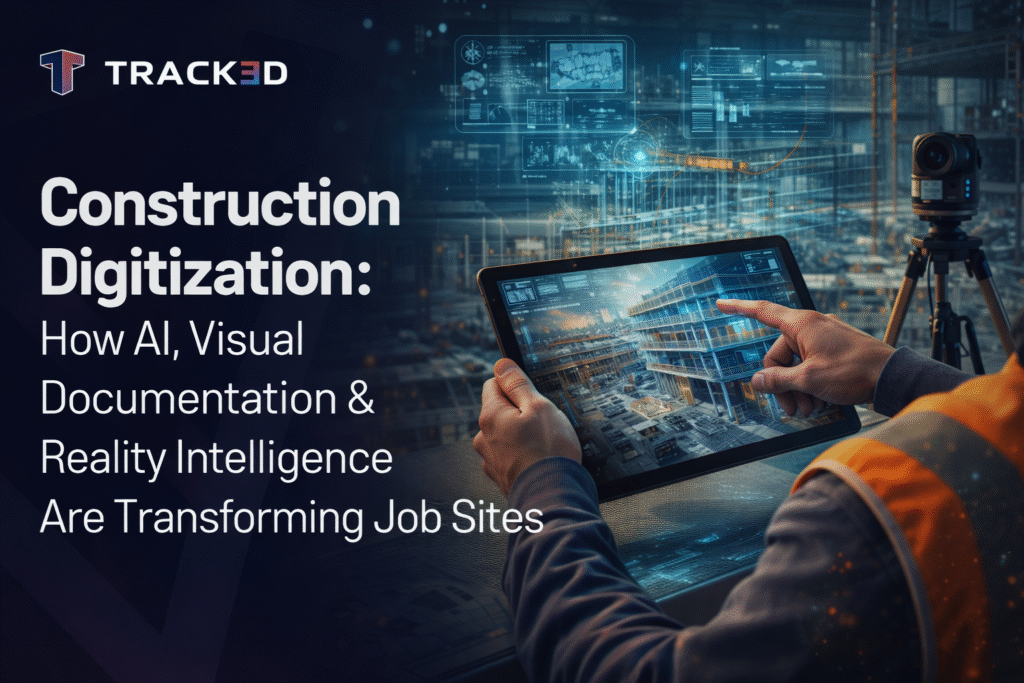
Although reality intelligence is the most transformative tool of construction digitization, it is, unfortunately, the least understood one as well. To put it simply, reality intelligence has the ability to capture the physical state of a construction site in real time and convert that data into actionable insight. It combines technologies like 3D scanning, photogrammetry, and drone capture with AI-powered analysis to create an accurate, up-to-date digital representation of what’s actually happening on the jobsite.
More often than not, superintendents and project managers have a good idea of what’s in the project plan and what’s supposed to happen. But there’s often a gap in what actually happens. Reality intelligence bridges this gap, since that’s where most construction issues arise from.
With reality intelligence, project teams can compare actual site conditions against the original design model, identify deviations early, and course-correct before small discrepancies become expensive rework. Even remote stakeholders, like owners, investors, and consultants, have complete visibility and can get an accurate picture of site progress without having to physically visit. Additionally, quality control becomes a continuous, data-driven process rather than a periodic manual check.
Bringing Together Visual Documentation, Artificial Intelligence, and Reality Intelligence
These three components, although presented separately, work together as interconnected layers. Keeping them in sync is how you can have a powerful tool. Visual documentation, artificial intelligence, and reality intelligence together create a continuous, closed-loop system that constantly monitors everything that happens on the site, understands what it means, and then generates insights to relay to the team. With construction digitization, you no longer have to wait weeks for progress reports and prepare yourself for undue surprises. You can have real-time complete visibility and the intelligence to act on it.
Advantages of Digitization in the Construction Industry
Here’s a simple example workflow to help you visualize how construction digitization can help your teams. The ground team on the jobsite uses structured visual documentation to consistently capture high-quality images and videos across the site throughout the day. These images feed into your reality intelligence platform, which processes it to build an accurate, real-time digital representation of current site conditions. It also automatically compares it against your project plan and flags any deviations. AI then uses that data to analyze patterns, predict where risks are likely to develop, and surface insights that will help the team act before problems escalate.
To look at the larger picture, here are some of the direct advantages of construction digitization for any business:
- Fewer expensive disputes as clear, timestamped site documentation provides proof.
- Faster project delivery as issues, deviations, and delays are identified early.
- Reduced rework since quality issues are caught before they compound.
- Better collaboration between site teams, owners, and remote stakeholders.
- Stronger compliance and audit readiness with always-current digital records.
Potentially the most important benefit of construction digitization is that teams make better decisions. They have better information and more structured data to analyze, and that’s what makes all the difference!
Final Thoughts: The Future of Construction Is Already Here
Construction digitization is not a concept of the future but something that is actively happening now and reshaping the operations of modern jobsites. Teams that adopt construction digitization experience better efficiency, more predictability, and far more control over how the project goes. This is important to understand because for construction teams to move towards digitization, they also need to move away from conventional methods of project management and monitoring that create disconnected workflows.
Start with small steps, like implementing visual documentation via structured capture and smart tools. Your team will see the impact of this small change almost immediately. And in the long run, you’ll experience better decision-making, fewer risks, less rework, and stronger project outcomes.
Curious about what a digitized job site looks like in practice? Track3D brings together near real-time visual documentation, AI-powered insights, and reality intelligence in one platform built for construction teams. Explore Track3D and see what’s possible on your next project.
FAQs
Q1. What does construction digitization actually mean in practice?
Ans: Construction digitization means replacing manual, paper-based processes with digital tools that capture and analyze site data in real time. This includes everything from progress tracking and safety monitoring to documentation and reporting.
Q2. How much does construction digitization cost?
Ans: The costs involved in construction digitization vary widely depending on the tools you adopt and the scale of your projects. Many platforms offer tiered pricing that makes digitization accessible for mid-sized firms and not just large enterprises.
However, the ROI of construction digitization often beats the worry of its cost. The price of not digitizing – in rework, disputes, delays, and missed opportunities – is much higher.
Q3. Is construction digitization only relevant for large projects?
Ans: Not at all! Large projects do have more complexity to manage compared to mid-sized and smaller construction firms. But the latter benefits significantly too, especially in areas like visual documentation and automated reporting, where saving time is crucial.
Q4. How is AI different from other construction software?
Ans: Traditional construction software helps you organize and store information, but that’s where its limitation arises. Artificial intelligence goes even further by analyzing that information, identifying patterns, and generating insights that help you make better decisions and anticipate problems before they occur.
Q5. What is the easiest first step toward digitizing a construction project?
Ans: If you’re confused about where to begin the construction digitization for your project, the simplest step to start with is visual documentation. It requires minimal technical setup; delivers immediate value in terms of dispute resolution and progress tracking; and naturally feeds into more advanced digitization tools as your team grows comfortable with the process.
Q6. How does reality intelligence differ from a simple site photo?
Ans: A simple site photo only captures a moment. Reality intelligence captures the full physical state of a site in 3D, at scale, and with the analytical layer to compare it against your project plan and flag deviations automatically.