Introduction
Communication and documentation become more complex as teams scale up and move towards large projects. How often have we experienced rework and disputes because of incomplete data? Or when there are hundreds of images, but none of them have context, rendering them virtually useless? If these situations sound similar to you, you’re in the right place. In this guide, we discuss how the best digital tools for construction management can be successfully adopted and the way they function. You’ll also learn how to integrate them and what common mistakes to avoid. Continue reading to find out!
A strong digital stack begins with reliable construction project monitoring practices that connect field observations, progress evidence, schedules, and reports.
Key Takeaways
- The best digital tools for construction management have the capacity to replace manual construction workflows with connected, real-time systems.
- The major categories are planning and scheduling, field data capture, visual and reality capture, document management, safety and compliance, and analytics and reporting.
- Digital tools provide better visibility, stronger documentation, and faster decision-making.
- Reality Intelligence converts site imagery into searchable, evidence-based progress records.
- Large projects need digital tools to reduce rework, delays, disputes, and coordination gaps.
- Poor integration, weak adoption, and incomplete documentation reduce tool effectiveness.
What Are Digital Tools for Construction Management?
Everyone in construction has experienced the shortcomings of manual techniques of project management at some point. For instance, the structural engineer has issued a drawing revision. He’s informed the concerned project manager, but the sub or trade’s foreman has no idea. Because of this minor discrepancy, the wrong version gets built. And the worst part is that no one realizes it until a rework notice is issued three weeks later!
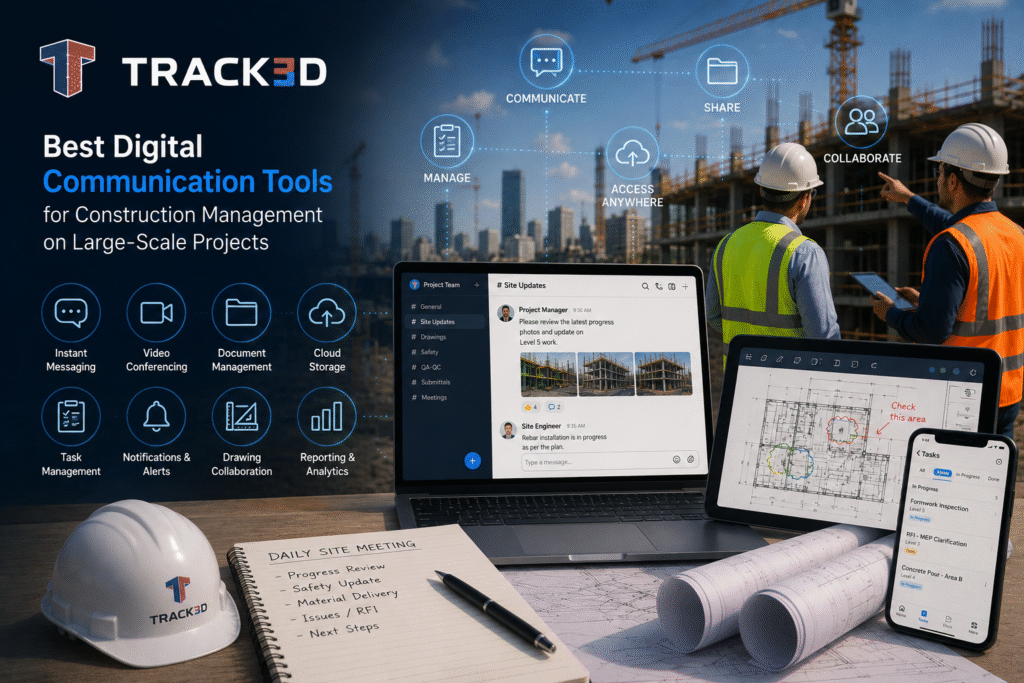
These kinds of communication gaps are common when construction teams still depend on manual documentation and conventional project tracking. However, the best digital tools for construction management can address and tackle these issues! “Digital tools” are not a single software or platform but an ecosystem of different platforms, apps, and software that replace manual workflows with connected, real-time processes for planning, communication, documentation, safety, and progress tracking across a project.
Construction teams looking to digitize and keep up with the competitive market are now adopting a few well-chosen digital tools that they can smoothly integrate into their daily workflows. Keep reading to learn how!
For teams starting this transition, understanding digital construction management helps clarify how field information, workflows, and project controls should work together.
The Six Categories of Digital Construction Management Tools
The best digital tools for construction management can be broadly divided into six major categories. In the following table, we explore these categories, what they entail, and practical examples of each. Check it out!
| Category | What does it include? | Practical example from the jobsite |
| Planning and Scheduling | Program management, resource planning, and milestone tracking. | The project manager assigns trade packages and sets hold points before mobilization. |
| Field Data Capture | Daily logs, mobile forms, time tracking, and safety checklists. | The superintendent completes the daily report from the site in under 5 minutes. |
| Visual and Reality Capture | 360° walkthroughs, drone surveys, Reality Intelligence, and photo documentation. | The site walkthrough is converted into a spatially referenced progress record. |
| Document Management | Drawing version control, RFI tracking, and change order management. | The latest drawing revision gets pushed to all trades simultaneously. |
| Safety and Compliance | Digital inspection forms, toolbox talks, and incident reporting. | The safety officer completes the inspection on mobile, and the report is auto-filed. |
| Analytics and Reporting | Production dashboards, cost forecasting, and progress reporting. | The project manager can review actual vs. planned progress across all cost codes in real time. |
Visual and reality capture, along with Reality Intelligence, is the most efficient and high-ROI tool. It automatically analyzes 360° site imagery to find progress gaps and generate structured documentation. Most progress monitoring tools also come under this category. Unfortunately, this is also the one category in which construction teams invest the least.
A disciplined 360 site capture process gives teams a consistent, location-based record rather than a folder of disconnected images.
How Do Digital Construction Tools Work: A Phase-by-Phase Guide
Moving ahead, let’s look at how the best digital tools for construction management work. This is important because if your team isn’t sure about implementing these, you won’t get the best ROI on your investment. Thus, consider this phase-by-phase breakdown of using digital tools.
- Preconstruction: In this phase, you can use digital tools to plan and schedule program development, document management for drawing control, and capture visuals for baseline surveys.
- Active Construction: During this phase, digital tools are best for capturing field data to create daily logs and safety checklists, documenting progress through visual and reality capture, and tracking management for RFI and change order control. As is evident, this phase shows the highest usage volume.
- Commissioning: During the commissioning phase, you can use safety and compliance tools for punch list management, capture images for evidence of defects with tagged locations, and analyze and track the closure rate.
- Handover: Lastly, during the handover phase, digital tools are great for document management for as-built drawings, O&M manuals, warranties, and lien waivers. You can also use them to capture visuals for records of final condition and generate analytics for performance reporting.
Each stage benefits from a structured construction project documentation checklist so required records are captured before the project moves into the next phase.
Why Do Digital Tools Matter in Large-Scale Construction?
The simplest answer to this question is that manual coordination becomes more difficult as the project scale increases. When you have about 50 subcontractors, 500 workers, and hundreds of thousands of documents to work with, it’s practically impossible to keep track of everything by hand. With the best digital tools for construction management, your team will eventually learn:
- Rework is preventable. If you incorporate smart tools, you can avoid rework by approaching problems at their nascent stage. An Autodesk and FMI research study shows that poor data and miscommunication cause 48% of construction rework, and almost all are preceded by a systemic failure that a digital tool could have prevented.
- Clients demand visibility. Each stakeholder on the team demands complete transparency across all project stages, especially your clients. Owners typically require structured progress reporting and visual site evidence as pre-qualification criteria. What makes this easier? Digital archives created by smart tools.
- Disputes need evidence. When you have a comprehensive digital archive with timestamped GPS-tagged digital records, you can go from absorbing an unfair loss to defending your position confidently. Reliable construction visual documentation preserves the context—date, location, trade, and activity—that turns an image into usable project evidence.
Pros and Cons of Digital Construction Management Tools
In the following table, we look at the pros and cons of using digital tools in construction management.
| Advantages | Disadvantages |
| Near-real-time visibility is available across the jobsite. | Teams might show resistance to adopting new technology. |
| Accurate and transparent communication is accessible for all stakeholders. | Too many tools and platforms, if disconnected, may create data fragmentation. |
| Timestamped, geo-tagged records increase the quality of documentation. | If the network connectivity is weak, it can create real-time sync challenges. |
| The same tools can be scaled up to use across multiple projects without any intermediate loss. | Configuration of tools and training crew members takes time before efficiency starts to build. |
Building a dependable real-time construction data workflow requires clear ownership, consistent data standards, and tools that share information without repeated manual entry.
Common Mistakes To Avoid When Adopting Digital Tools
Based on the disadvantages mentioned above, it’s evident that they arise due to discrepancies in the adoption process. Thus, the simplest way to look past them is to avoid common mistakes that most teams make. Here’s a list of them:
- Starting with too many digital tools at once: This will overwhelm the teams. Instead, you need to start by fixing the highest pain point first and then expand.
- Not having a field champion: Your ecosystem of digital tools requires a site supervisor to keep things moving.
- Ignoring visual documentation: Photos need to have location, date, and other context so they work as comprehensive evidence. Incomplete documentation is always an enemy.
- Not integrating tools in the workflow: Disconnected platforms create fragmented data and documentation. If teams still have to rely on manual re-entry, the core idea behind adopting digital tools has failed.
- Measuring adoption, not outcomes. The best way to track how efficient your digital tools are is to measure the outcome, ROI, and increased efficiency, not the login numbers. These problems are addressed in a broader construction technology adoption strategy that gives field teams a role in implementation and starts with one clearly defined process.
Despite these common mistakes, there are certain situations where adopting digital tools may not be the right investment at all. For instance, when the project duration is too small, teams do not have any capacity for change in their monitoring tools, there’s no leadership support, or there are no data governance foundations at all. These situations will only increase your trouble rather than making the processes more efficient.
Parting Words
Integrating the best digital tools for construction management is a great way to transform the way your team works and increase overall productivity. Using them in a disciplined, phase-mapped way is the most reliable way to keep up in the current competitive market. But what you need is a system of support when implementing the tools. Teams should exercise the capacity to adopt change, the leadership team should provide adequate support, and there must be a solid foundation of governance for access folders, naming conventions, etc. Only then can you expect the construction management tools to show a difference.
Reality Intelligence adds an interpretation layer to captured site data, helping teams turn visuals into searchable progress records and actionable insights.
Track3D supports these workflows through ProgressTrack, which connects site conditions with automated progress tracking. Book a demo to see how Track3D can fit into your digital construction tool stack.
Track3D can provide the required support with this to integrate Reality Intelligence into your everyday workflow. Want to see how Track3D fits your digital construction tool stack? Book a demo today!
FAQs
Q1. What are the best digital tools for construction management?
Ans: Six categories define the best digital tools: planning and scheduling, field data capture, visual and reality capture, document management, safety, and analytics.
Q2: What digital tools do construction managers use on large projects?
Ans: Scheduling software, mobile reporting apps, document management platforms, reality capture, and progress monitoring tools are the most common ones.
Q3: What is Reality Intelligence in construction management?
Ans: Reality Intelligence software automatically analyzes 360° site imagery to surface progress gaps and generate structured records, converting site walkthroughs into searchable, defensible project intelligence.
Q4: How do you implement digital tools on a construction site?
Ans: Start with one high-pain workflow, identify a field champion before go-live, and measure operational outcomes rather than login statistics.
Q5: Do digital tools improve construction project outcomes?
Ans: McKinsey and Autodesk/FMI research prove that the successful adoption of digital tools leads to reduced rework, faster reporting, and fewer disputes. Firms with consistent field adoption report the strongest outcomes.