
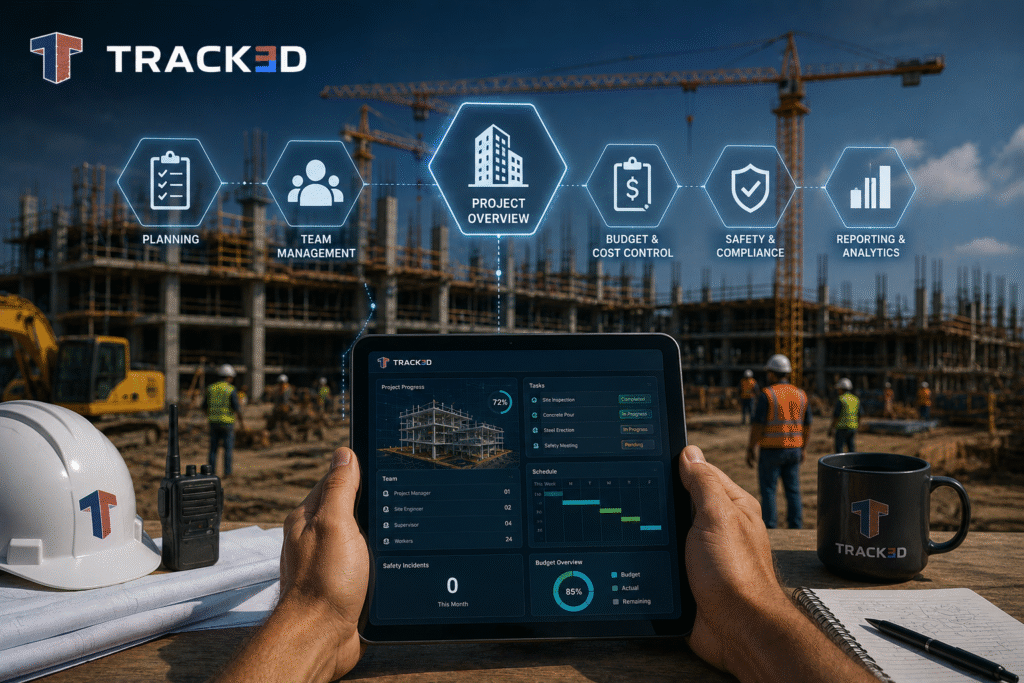
Construction field management is the day-to-day coordination of everything happening on a jobsite, from people and equipment to safety, quality, progress, and reporting. It is what turns an office plan into real work completed on the ground.
And if you have worked on a jobsite before, you already know this truth: the plan in the office means nothing if the site cannot execute it cleanly. That is why field management is such a big deal. And bad field management costs like anything. This is why it matters more than most teams realize. According to McKinsey Global Institute, construction productivity has only improved around 1% per year over the last two decades, which is extremely slow compared to other industries. A big reason is poor coordination and information flow on site.
In this blog, we’ll walk you through all about construction field management. So, read on!
Key Takeaways
- Construction field management is what connects the office plan to site reality, and the gap between those two things is where most projects lose money.
- The information chain between field crew, superintendent, PM, and owner is where most failures happen.
- Visual documentation is the most underused field management tool, and most teams are barely scratching the surface of what it can do.
- Poor field management creates delays and cost overruns just as reliably as poor execution does.
What Is Construction Field Management?
Construction field management is the real-world execution side of project delivery. It is the coordination of labor, materials, equipment, safety, quality, and reporting from mobilization through handover.
In simple terms, field management is what keeps the jobsite moving.
Think about a morning on a commercial build. It’s 6 AM, the concrete sub is on site, but the pump has not turned up. Three RFIs are still sitting unanswered. The owner’s rep is asking for a progress update. And yesterday’s daily report is still blank.
That is not a one-off bad morning. That is what a field management gap looks like in practice, and it compounds fast. Poor field coordination is one of the most consistent root causes. The plans are usually solid. The problem is what happens between the plan and the site. Good field operations management tends to be predictable, while poor field operations management is unpredictable.
Key Functions in Field Operations Management
Field management typically involves the following key functions:
Workforce management: trades scheduling, subcontractor management, dispute prevention
Resources and equipment management: material transport, access, crane use, laydown area management
Safety and quality management: inspection, permit management, compliance, defect prevention
Documentation and reporting: daily reports, requests for information, issue resolution, reporting
Photography-based field management: photography, walk-throughs, reality capture
All of these functions are interconnected to an extent. That’s why difficulties in any may affect the rest.
Why Construction Field Management Matters
Field management is not just “superintendent work.” It directly impacts profit, schedule performance, and client satisfaction. One major reason is rework. Industry research shows rework often costs 4% to 10% of total project value, and in some cases can reach 15% depending on the scope and project complexity.
That is not a small issue. That is the difference between a profitable project and one that barely breaks even. Also, poor data and miscommunication play a huge role. In fact, bad project data contributes to around $88.7 billion in rework globally. And a significant chunk of rework is driven by information errors rather than actual workmanship failures.
3 reasons the stakes are high:
Rework is preventable
Most rework starts small. A missing detail. A misread dimension. A subcontractor not aware of a design change. Good field management catches those issues early.
Owners expect better visibility now
Owners do not want vague updates anymore. They want proof. Photos. Progress records. Clear documentation. Firms that provide structured, visual progress reporting build more trust.
Documentation is legal protection
When disputes happen, the team with clean, timestamped site records usually wins. Daily logs, photos, and inspection reports become your defense.
How Construction Field Management Works: Phase by Phase
Field management looks different depending on the stage of the project. What matters in preconstruction is not the same as what matters during commissioning.
Preconstruction
Preconstruction is the stage that sets up the construction site for success. It is during this stage that logistics plans, reporting requirements, and coordination plans are developed.
Some of the major preconstruction field management processes are identifying delivery routes, designating laydown areas, assessing site access, verifying subcontractor sequence plans, and establishing daily report formats. This is also the point where most projects tend to either win or lose. When you begin with a lack of clear workflow, it becomes a chase for the remainder of your construction process.
Mobilization
Mobilization is where you set jobsite habits. If daily reporting is sloppy during the first two weeks, it will stay sloppy for the rest of the project.
Mobilization typically includes: Establishing site offices and signage, safety induction setup, permit systems, crew sign-in routines and first reporting templates and workflows
The best supers treat mobilization like building the foundation. If it is rushed, the entire project feels unstable.
Active Construction
This is where field management becomes a full-time job. Active construction field management includes daily trade coordination, monitoring progress, managing deliveries, tracking equipment usage, reviewing constraints, handling inspections, and keeping documentation current.
This is also the phase where reality intelligence is starting to play a bigger role. Instead of relying purely on written updates, some teams now use 360° walkthroughs and automated progress monitoring to confirm what has actually been installed. That shift ensures that the project doesn’t just rely on “reported progress” and starts relying on visible proof.
Commissioning and Snagging
Commissioning is where projects often slow down because coordination becomes harder. Multiple trades overlap, systems are tested, and defects are identified. If defect tracking is not structured, the punch list phase can drag on for weeks longer than expected.
Good field management here focuses on clear punch list ownership, photo-backed defect documentation, fast verification, and tight sequencing. The difference between a smooth handover and a messy one is usually how well this phase is managed.
Handover
Handover is not just giving keys. It is delivering confidence. Field management at handover includes:
- as-built record finalization
- O&M manuals collection
- warranty documentation
- final inspections and approvals
If records are scattered, handover becomes painful.
Tools and Technologies Used in Construction Field Management
Field management tools are not meant to replace experience. They are meant to remove friction. Here is a clean breakdown of the most common field management technology stack:
| Tool Category | What It Supports |
| Scheduling tools | Programme planning and sequencing |
| Mobile field reporting apps | Daily logs, safety checklists, time tracking |
| GPS and location tracking | Equipment location and workforce zone tracking |
| Photo and video documentation | Timestamped site records |
| 360° walkthroughs / reality capture | Visual progress evidence and spatial documentation |
| BIM integration tools | Linking site conditions to design models |
| Progress monitoring tools | Automated progress gap detection and reporting |
The biggest value of these tools is speed. When field information reaches the office quickly, decisions happen earlier. And earlier decisions almost always cost less.
The “Two-Day Rule” for Site Problems and Daily Reports
Here is a simple rule you can follow to beat any field management issue-
If a problem stays invisible for two days, it becomes expensive. A missing embed plate. A layout mistake. A sequencing conflict. These are cheap fixes when caught immediately. But when they sit unnoticed, they spread into other scopes. That is why daily field reporting matters.
But the daily report is one of the strongest field management tools when done right. A good daily report should not just say “work ongoing.” It should answer:
- What was completed today?
- What slowed work down?
- What manpower was actually on site?
- What materials were missing?
- What safety or quality issues were observed?
If daily reports are too vague, you lose the chance to spot patterns. For example, if “waiting on delivery” appears five times in two weeks, you do not have a delivery issue. You have a planning issue. Daily reports should also include photo proof. That makes them useful for both management and dispute protection.
Pros and Cons of Digital Construction Field Management
Digital field management has changed how modern projects run. But it is not magic. It works only when people actually use it.
Digital field management tools can improve:
- real-time site visibility
- faster decision-making
- reduced rework through earlier issue capture
- stronger audit trail for disputes
- better owner confidence through visual progress records
- Tradeoffs
The biggest challenges are:
- adoption resistance from crews who dislike new workflows
- setup time before benefits show up
- connectivity problems on remote or underground sites
- data quality risk if forms are poorly designed
Digital tools make reporting faster, but they also make bad reporting faster if the system is not structured.
Common Construction Field Management Mistakes
No shared information baseline
When crews work off different drawings, the site becomes a rework machine.
Fix: establish a single source of truth for drawings, RFIs, and revisions.
Treating daily reports like admin
When daily logs are rushed, they become useless.
Fix: simplify templates and focus them on production, constraints, and manpower.
Visual documentation as an afterthought
Photos taken on personal phones with no location context become worthless later.
Fix: store photos centrally and tag them by zone, date, and work package.
Coordinating subs through email threads
Email coordination is slow and messy. Critical details get lost.
No handover strategy from day one
Many teams have been scrambling during the last month.
Fix: build documentation workflows early so handover records accumulate naturally.
When a Structured Approach May Not Be Necessary
Not every project needs a full digital rollout. A lighter approach may work for very small or short-duration projects, like a two-week retail fit-out. It may also be challenging on remote sites with serious connectivity limitations. But even on small projects, basic improvements like structured daily logs and photo documentation still deliver real value.
Take Control of What Happens on Site
Construction field management is where projects either stay on track or quietly fall behind. This difference between planning and construction is the point from which all problems in any projects begin to arise. However, solving this problem involves having the right information, collected in time and available to the right persons, to act in time.
Track3D helps construction teams extend field management into reality capture, turning 360° walkthroughs into structured progress documentation that PMs, owners, and QS teams can review anytime.
Want to see how Track3D brings structure to your site data? Book a Demo →
FAQ
What is construction field management?
Ans: Construction field management is the coordination of jobsite activities, including workforce, equipment, safety, quality, and documentation from mobilization through handover.
What does a construction field manager do?
Ans: Construction field managers manage daily site execution, coordinate subcontractors, handle site logistics, enforce safety and quality, and report progress to project leadership.
What’s the difference between project management and field management?
Ans: Project management involves planning and contracting, whereas field management involves the actual work at the site in the proper sequence.
What tools are used for construction field management?
Ans: Common tools include scheduling software, mobile reporting apps, photo documentation platforms, GPS tracking, BIM tools, and reality capture systems.
How can I improve field management on a construction site?
Ans: Start by improving drawing control, strengthening daily reporting, using structured visual documentation, and reducing coordination friction through shared communication platforms.