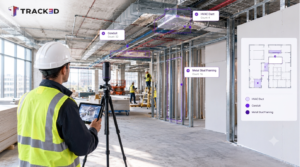

Rework rarely begins as a major failure on the jobsite. It’s usually a small snag here and there that eventually snowballs into a larger issue. Minor hurdles, like a missed detail in a drawing, a late RFI response, a coordination gap between trades, or an unclarified scope assumption, feel like a quick adjustment. But these issues accumulate over time and negatively impact the project workflow. Your team needs to restart, materials have to be reordered, schedules need to be redone, and unnecessary frustration builds across the team.
According to several surveys, the annual cost of construction rework is over $177 billion in the United States. This number alone should be a warning bell to comprehend and actively fix the rework problem. Thus, to help you understand how rework factors into construction projects, we bring you this guide. Explore what exactly rework pertains to, its costs, the shortcomings of traditional systems, the best practices to avoid it, and emerging tools. Continue reading to find out!
Key Takeaways
- Rework is a systemic issue that can cost up to 20% of the total project costs, not an isolated one-off instance.
- Rework can also cause schedule delays, productivity loss, safety risks, strained client relationships, and lower team morale.
- Most rework originates from poor communication, unclear scope, and late stakeholder involvement.
- Traditional, siloed workflows significantly contribute to rework by delaying coordination and problem detection.
- Minimize rework by aligning early, standardizing design reviews, improving coordination and accountability, learning from past mistakes, maintaining a single source of truth, and using technology to detect issues before they reach the field.
- Emerging technologies like AI, digital twins, AR/VR, and predictive analytics can further reduce rework risks.
What is Rework in Construction?
In the construction industry, rework is defined as any activity that has to be repeated because of a prior mistake or some other reason. Usually, it results from errors, lack of proper communication, or misunderstanding among the various involved teams.
Some typical examples of rework are:
- Delays in RFIs leading to redesigns
- Poorly defined scope resulting in the removal and replacement of work
- Conflict between trades was discovered at the site
- Alterations made based on the old design
Rework is hardly ever noticed as a problem immediately. One might think of it as ‘simply a fix’, what can go wrong? One change, one adjustment, that’s all. But things do not happen like that. Little by little, these minor disturbances accumulate. And ultimately, it creates a significant impact on the project.
Understanding the True Cost of Rework in Construction
Based on the 2024 Autodesk and FMI report, it seems rather alarming that rework makes up to 20% of total project cost. This figure is enough to make every construction team reconsider its position.
However, the cost of rework in the construction industry is not just limited to the price of materials and labor hours. There are several hidden impacts as well. Some of them are listed here:
- Schedule delays: Whatever unplanned work comes up pushes the next milestones of the project even further. A delay in one trade implies the others will either have to wait or they’ll have to do their work faster.
- Productivity loss: Ground staff and laborers lose their pace when they have to stop, redo, or modify their process.
- Strained client relationships: The buyer is usually not very receptive to major and constant changes. It destabilizes their confidence and creates conflicts among the owners and stakeholders.
- Increased danger of accidents: When workers and stakeholders are under a lot of pressure, they tend to work faster to meet deadlines. Faster work tends to increase danger.
- Lower team morale: Endless rework leads to frustration, blame, and exhaustion. And it adversely affects both the field and office staff.
When you collate all these aspects, the actual cost of rework goes up. Even much higher than a single line item.
Implement systematic early detection processes during construction to identify and address issues before they escalate into costly rework. A disciplined approach to construction quality control makes this kind of early detection far more consistent.
How Traditional Workflows Make Rework Costs Swell
Poor execution doesn’t cause rework as often as poor project organization does. Just like siloed teams, traditional workflows usually create gaps by allowing mistakes to pass unnoticed.
To help you understand, we’ve listed some of the common problems here:
- Siloed teams: The designers, engineers, contractors, and trade owners are all working one after the other instead of together.
- Information descended to bits: The intercommunication between teams is mainly through email threads, outdated drawings, and slow updates, which inevitably become useless.
- Late problem detection: When detection is delayed, problems are addressed only after they become visible on-site. And this is where the most expensive fixes are done.
With such situations, the rework is often accepted as a natural consequence. However, the truth is that the majority of it can be avoided in the earlier stage.
Root causes like poor communication can be mitigated by implementing coordinated team communication systems that keep all stakeholders aligned.
How Does Collaborative Design Reduce Rework in Construction?
Collaborative design changes when and how problems are solved. Rather than reacting to issues at the site, teams are encouraged to approach them more collaboratively during the planning and design. It is quicker and less expensive.
Firstly, all stakeholders must convene before the project starts to get on the same page. Thus, the project owners, architects, contractors, and main trade owners should hold discussions to get a mutual understanding of their expectations before proceeding.
Next, a clear design concept is extremely crucial. Through a clear idea of what’s expected, potential misunderstandings and misinterpretations are reduced to a considerable extent. There’s a reduced chance of late changes, and issues are resolved before the materials are ordered or put in place. This alone can cut down on a big part of the rework that is usually a general addition to any construction project.
Best Practices for Project Teams To Minimize Rework in Construction
Rework is not usually the result of one major mistake. It is a build-up of several small errors that remain unnoticed. Introducing good practices and improving collaboration can eliminate the majority of such issues. Project teams can adopt some practical measures to avoid rework when getting to the site. Listed here are some of them:
Align Early During Preconstruction
Many of the rework issues originate even before construction. The lack of critical voices in the early stage leads to the formation of assumptions. Thus, the project teams must involve the main trades, engineers, and construction leads during preconstruction discussions. It gives them a space and an opportunity to bring up design conflicts, constructability concerns, and scope gaps. And, while the changes are still inexpensive!
The early alignment will help the teams to:
- Set the right expectations before the job starts
- Limit last-minute design changes
- Prevent misinterpretation of the scope by different trades
When the entire team is aware of the plan from day one, the number of repairs needed later on will be reduced.
Standardize Design Reviews
In most construction projects, design reviews, more often than not, take place in an uncoordinated manner. As a result, some details might get neglected.
On the other hand, when you have a uniform and structured review process with well-defined checkpoints, half the problem is solved. A fixed agenda should be followed for each review session. For instance, drawings, models, and assumptions should be examined and discussed at the same time.
The main objectives of effective design reviews are:
- Collaboration of trades and clean transfers of responsibility
- Analysis of areas with the highest risk, like MEP and structural intersections
- Review of zones with previous rework history
It is not merely the frequency that makes reviews effective, but rather the consistency.
Improve Cross-Team Coordination
According to several studies, it’s been found that the majority of rework problems are not technical but arise due to a lack of communication. Frequent coordination meetings can keep the teams aligned. These meetings do not have to be long. They have to be short and of high importance only.
Good coordination involves the following points:
- Checking trades weekly
- Making the responsibility of unresolved matters very clear
- Rapid responses to decisions
The small talk of today prevents the major problem of tomorrow.
Learn From Past Rework
Most teams are still facing the same rework problems over and over again because they fail to learn from the past. Monitor the areas in which rework is taking place and the reason behind it. Analyze it after every milestone. Pass on the knowledge learned to the next stage of the project.
This brings about:
- Early spotting of patterns
- Changes to design and workflow
- Fewer mistakes
Ultimately, rework should be a teacher, not a reason for a cost surge!
Keep One Source of Truth
The chances of rework tend to be amplified if different versions of the same information are circulating around the project. The project teams should work on one common platform where all the drawings, models, and updates are documented and monitored. This way, everyone knows where to get the latest information from.
This can reduce the count of:
- Field decisions made based on outdated drawings
- Different teams issuing conflicting directives
- Misunderstanding taking place while transferring work between parties
These best practices align closely with lean principles, which focus on eliminating waste and continuous process improvement. Adopting lean construction methods takes this further by building waste reduction into everyday workflows.
Emerging Tools That Help Reduce Rework
New technology and recent digital tools for construction projects are elevating productivity and predictability. This allows the enhancement of the collaborative approach.
Some of the most common and highly useful future technologies are:
- AI clash prediction to indicate problems sooner
- Digital twins for comparison of the design and the sites
- AR and VR simulations for the final review of the designs before the actual building
- Predictive analytics to detect the stages of the construction project that are at the highest risk
These tools are specifically designed to keep you at the top of your game and elevate the efficiency of your project.
Modern progress monitoring tools provide objective verification of work completion, preventing the underreporting that masks rework issues.
Conclusion
Rework is not only a construction issue; it is a problem of the whole system that takes time, trust, and momentum.
At the end of the day, you may wonder about what exactly plays the biggest role in avoiding rework. The answer is proper alignment from the start, timely and clear communication, and a design that involves all parties. This leads to less loss of time, safer places to work, happier workers, and better client relationships. Thus, collaborative design has the potential to make rework fade away.
Are you ready to take it further? Check out how progress monitoring helps in early detection of issues, rework reduction, and maintaining schedules.