
Operational efficiency during construction implies timely, cost-efficient and high-quality completion of a project while maximizing the use of labor, materials, equipment, and information.
But real job sites are rarely smooth. Weather changes, deliveries get delayed, drawings shift, and crews are constantly adjusting. That is why efficiency depends on spotting issues early and fixing them before they grow.
In this blog, we’ll share 7 practical tips to improve operational efficiency, along with key metrics, tools, common mistakes, and more. Sit tight, interesting read ahead!
Key Takeaways
- Operational efficiency has three key parts: planning, process, and site visibility. Most teams manage the first two and ignore the third.
- The shift from reactive operations to proactive operations is one of the biggest efficiency improvements a team can make.
- Tracking verified output against planned production rates is far more useful than tracking hours or tasks marked complete.
- Near real-time site visibility is often the missing piece in most construction efficiency strategies.
- Poor operational efficiency compounds quickly. A problem invisible for two weeks costs far more than one caught in two days.
What Is Operational Efficiency in Construction?
Operational efficiency in construction is made up of three key dimensions.
- Planning efficiency is how well the project is set up before anyone starts building. This includes sequencing, resourcing, procurement planning, and trade coordination.
- Process efficiency is how smoothly work flows once construction starts. This one covers communication, coordination between trades, document control, approvals, and decision-making.
- Visibility efficiency is how quickly the team knows what is really happening on site.
Most teams are good at planning and have decent processes. Visibility is where things usually fall apart. A project manager can have a perfect schedule and a great workflow. But if the information coming in is outdated or incomplete, decisions get made too late. And that is what creates a lot of construction waste.
Many site problems are obvious to the people working in the area. The issue is that those problems do not always reach leadership until the next weekly meeting, or until a cost report shows something is off.
Why Operational Efficiency in Construction Is Hard
Construction is not like manufacturing. A factory has controlled conditions. A job site does not. Construction projects involve multiple trades, sequential dependencies, and conditions that change daily. Even a small issue can block an entire chain of activities.
Construction also consistently ranks among the industries with the highest rate of cost and schedule overruns. In most cases, the root cause is not poor execution. It’s poor visibility into what is actually happening on site. The reactive trap makes it worse. Many problems surface during weekly site walks or show up in the monthly cost report.
Poor operational efficiency usually shows up in four ways:
- Rework consuming hours that produce no net progress
- Idle time caused by trade sequencing conflicts
- Decision lag caused by outdated information
- Programme overruns caused by undetected deviations
How to Measure Construction Operational Efficiency
You can’t make changes to something you don’t have a way of measuring. This is why assessing efficiency is key. Just analyzing its project-level performance won’t provide you with the whole picture, though.
If you want to understand the whole story, begin monitoring these indicators on the work package level:
- Production rate vs. baseline: Compare your real progress to your set objectives.
- Schedule performance index (SPI): SPI less than 1.0 means you’re behind schedule.
- Rework rate: Determined as a percentage of all tasks to be reworked.
- Idle time: Sum up all the hours where there was labor, but no actions could be taken.
- RFI volumes and response times: High volumes can signal coordination failures. Slow responses create decision lag that can stop site progress.
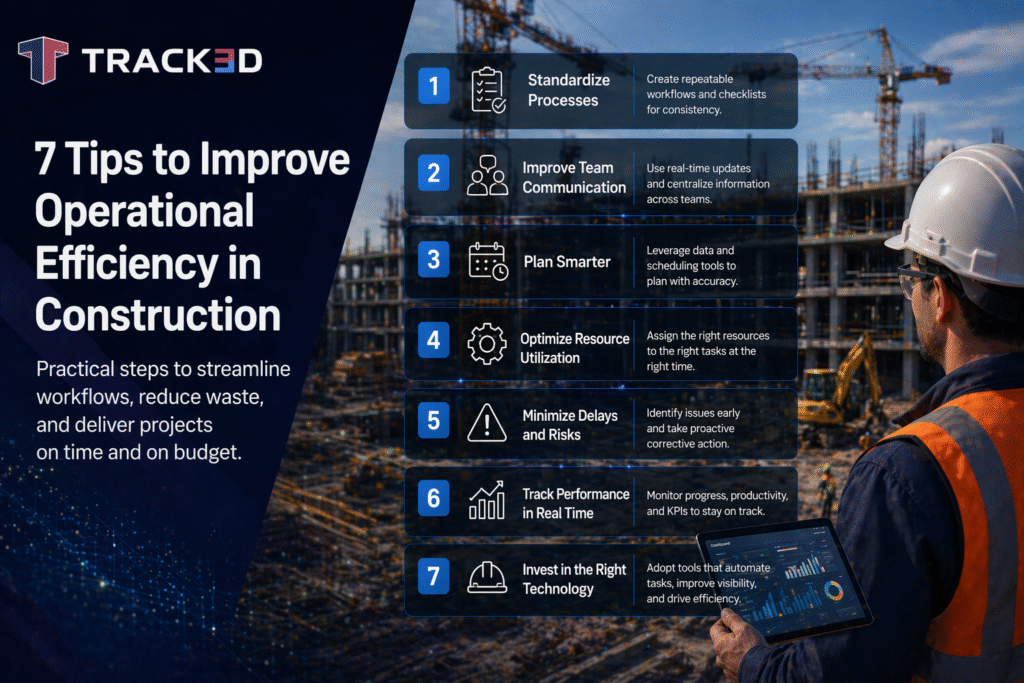
7 Tips to Improve Operational Efficiency in Construction
Now that we’re here, let’s go over key steps that’ll make a real difference on your next project.
1. Invest in Pre-Construction Planning
The best improvement in operations often happens before the first shovel hits the ground.
Pre-construction planning should involve:
- breaking the scope into clear, measurable work packages
- loading resources in the schedule realistically
- coordinating the design with all trades
- identifying long-lead items early
Research from FMI shows that better pre-construction planning can reduce change orders by up to 30%
2. Close the Site Visibility Gap
The visibility gap happens when decisions are made on outdated information. That delay can hide delays, rework, and scope conflicts until they are expensive to fix. Closing the visibility gap means connecting physical site conditions to the project model in near real time. Site intelligence is current, verified, and tied to location.
3. Shift from Reactive to Proactive Operations
Proactive operations are about better data, captured earlier and linked directly to the work that matters. On most projects, field issues show up at weekly meetings or during monthly reporting. That means you are always behind reality. When data is current, teams can spot deviations early, understand what caused them, and fix them while the cost of recovery is low.
4. Focus on Tracking Outputs and Not Inputs
Real productivity is about output. Output-based tracking gives a far clearer view of whether the project is actually keeping pace with its plan. Instead of checking off that a crew “worked 8 hours,” you track actual output such as: square meters of cladding installed, number of footings poured and glazing units installed per day
A KPMG study shows that construction productivity tracking based on output leads to better performance decisions and fewer delays than traditional tracking methods.
5. Manage Information Flow as a Programme Activity
Delays in information flow are one of the biggest hidden causes of operational inefficiency. That’s why managing information flow should be treated as a programme activity.
This means:
- Establishing target response times for RFIs and design clarifications
- Tracking response times as part of project performance
- Escalating overdue responses before they cause delays
- Sharing updated documents instantly with all stakeholders
6. Deploy by Zones, Not by Project Alone
This is where many teams still fall into the “big bucket” trap. Knowing how many workers are on site does not tell you whether they are where they need to be. It does not tell you whether sequences are being followed.
Operational efficiency happens at the zone level. Tracking by zone means you can:
- See where trades are actually working
- Spot sequencing conflicts early
- Deploy manpower where it is needed most
- Measure output zone by zone
7. Standardize Processes and Reduce Variability
Variability in work processes reduces efficiency. When different crews do the same work in different ways, it creates confusion and quality gaps. These gaps lead to rework, which is the enemy of operational efficiency.
Standardization means having clear work instructions, consistent checklists, defined quality criteria and agreed inspection points.
Tools That Support Construction Operational Efficiency
- Construction management tools: Keep RFIs, submittals, drawings, and site documents in one place
- BIM and 3D modeling tools: Aid coordination among the team members and detect conflicts prior to having them resulting in rework
- Mobile field reporting apps: Make it easier for site teams to share updates quickly, without waiting for weekly reports
- Progress monitoring tools: Show what is actually happening on site, not just what is being reported
- EVM and production tracking tools: Link real progress to schedule performance so delays show up earlier
Bottom line is the sooner the right people get the right info, the more effective operations will be.
When Efficiency Improvement May Be Challenging
Efficiency improvements are harder in certain situations, such as-
- Short-duration projects do not always give enough time to build baselines or track trends.
- Highly fluid scopes make tracking difficult because the target is constantly shifting.
- Teams without consistent field reporting will struggle because the data becomes unreliable.
- Fragmented subcontractor bases also create challenges since improvement depends on multiple companies working in sync.
Common Mistakes and Solutions
Mistake 1: Addressing symptoms, not root causes
Rework and delays are symptoms. The root cause is often a visibility gap.
Fix: Trace every deviation back to its origin. Ask whether it started from planning failure, coordination breakdown, information delay, or visibility weakness.
Mistake 2: Measuring inputs not outputs
Hours logged and tasks ticked do not measure efficiency.
Fix: Track verified completed quantities against production rate baselines.
Mistake 3: Weekly reporting on daily problems
If a weekly report surfaces an issue, it is already five days old.
Fix: Match reporting frequency to the pace of site operations.
Conclusion
Improving operational efficiency is about seeing your site clearly in near real time, so problems are identified and resolved before they compound.
The most efficient teams do not rely on assumptions. They track verified output, manage information flow tightly, and deploy resources based on what is happening on site, not what was planned weeks ago.
Want to see it in action? Explore how Track3D brings near real-time site visibility to your construction operations.
FAQ
Q1. What is operational efficiency in construction?
It involves completing a project in time and under budget, with no unnecessary waste in labor or material use. No unnecessary expenses of any type occur. The efficiency is simply smooth implementation.
Q2. What causes operational inefficiency in construction?
The most common causes are poor site visibility, trade sequencing failures, information flow delays, and unverified progress reporting. Most operational inefficiency traces back to a gap between what is happening on site and what management knows about it.
Q3. How does near real-time site visibility improve construction efficiency?
Near real-time site visibility allows construction workers to detect any problem early instead of having to wait until weekly and monthly reviews before addressing an issue. This way, when the site is assessed early, issues are sorted before any possible delay occurs.
Q4. What is the difference between operational efficiency and productivity in construction?
Productivity measures production rate. Efficiency includes planning and coordination too.
This means that construction industry productivity is measured in terms of work volume completed daily or hourly. In contrast, operational efficiency includes various activities such as planning, scheduling, effective communication, and organization.
Q5. What tools help improve operational efficiency in construction?
Construction management software, BIM software, and mobile applications help construction professionals ensure alignment among various departments and teams. In addition, progress tracking and site monitoring applications can be beneficial for the same purpose.