
Introduction
Maintaining accurate construction data is now a standard practice across most teams. It needs to be up-to-date, centralized, and foolproof because the core idea is for it to be an efficient tool. However, how often have you realized that it’s more of a hassle than a help? Do you sometimes feel a lag between the field crew and the office? Or that different stakeholders have different versions of the data? These are common construction documentation management challenges that teams face. But don’t worry! They all have smart solutions that can turn this data into a centralized system of truth, coordination, and efficiency.
In this guide, we look at the top 6 construction documentation management challenges, their causes, and solutions. Keep reading to learn more!
Key Takeaways
- Construction documentation management challenges are common, detrimental, and have drastic effects, yet they have simple solutions.
- Poor documentation and miscommunication are major causes of costly construction rework and project delays.
- Inaccurate documentation also leads to coordination gaps between the team members.
- With improved coordination, real-time data, and better document management, teams can make decisions faster and more efficiently.
- Continuous reality capture and automated documentation help teams detect deviations early and avoid rework.
- Real-time, proactive documentation turns construction data into a reliable operational tool instead of administrative overhead.
Top 6 Construction Documentation Management Challenges
In this section, we look at the most common construction documentation management challenges that teams face and their causes.
#1: Version Control Failure
A common practice followed by most construction teams is circulating drawings and plans via email, shared drives, or printed sets. Because of this, when a revision is created, it often takes time to reach all stakeholders. In fact, sometimes, it doesn’t even reach everyone! Without strict discipline, subcontractors will work on an old, locally saved PDF without knowing that a revision is already out.
Version control problems also affect submittals in construction, where teams work from outdated approvals.
What seems like a minor miscommunication gap can snowball into a huge issue. According to a study conducted by PlanGrid and FMI in 2018, nearly half of all rework in construction projects is caused by poor data and miscommunication. So clearly, small discrepancies in versions and revisions are costing the team money, time, and resources.
#2: The Field-to-Office Documentation Gap
There are, essentially, two main sites of any construction project – one is the actual jobsite, the other is the office. Field teams are occupied with the literal construction; they fill out paper logs, upload photos from personal phones, and rely on verbal updates in meetings. But by the time these updates reach the project manager, the project has already moved on. So the information they have at the office is either incomplete or old. The lack of complete information creates inaccurate as-built records, missed punch list items, and handover disputes.
This undue gap creates a huge issue down the line. Slow information transfer disables active decision-making. And it also undermines the compliance record.
#3: Compliance Documentation That Falls Behind
Compliance documentation is almost always a second thought. Superintendents or project managers rarely make it someone’s primary job. It gets delayed, delegated, or completed from memory. Why is this an issue? Permits, safety inspections, quality assurance records, and handover packages are crucial data in any construction project, and when crafted from memory, they will have gaps, errors, and missing sign-offs. A single missing sign-off can shut a project down for days! And unfortunately, if you miss enough of them, you’re looking at regulatory fines, delayed handovers, and legal disputes.
#4: Inaccurate or Incomplete As-Built Records
Most conventional means of documentation are manual. Thus, most as-built packages are “what we can do best,” not precise records. For instance, site surveyors make periodic visits, field teams mark up drawings routinely, and coordinators compile updates – sounds perfect. But what happens between these actions? Since there’s no constant surveillance, a lot of information is being missed. And eventually, the consequences of incomplete as-built documentation arise, as no one can accurately answer questions in a few weeks.
This is one of the most dangerous construction documentation management challenges, as there’s no clarity on what’s happening and no sturdy records.
#5: Poor Coordination Across Stakeholders
When documents and data are scattered across devices and different media, it becomes difficult to track and find the right information at the right time. Especially in large construction projects, there are dozens of stakeholders involved – owners, GCs, subcontractors, consultants, and regulators – all of whom need different types of information and updates. Without structured access control, documents get shared over email, sensitive contracts end up in broad distribution lists, and critical approvals get stuck waiting on the wrong stakeholder.
As the project grows, the problem worsens. More data, more people, more channels, more devices, and infinitely more confusion! This only adds stress to the person handling all coordination and becomes an operational burden on the team. What you need is a centralized system that has structured documentation and automatic access management.
#6: Late or No Documentation of Issues
As all construction personnel have experienced at some point, the biggest cause of rework and delay is issues being caught too late or not at all! This is directly linked to one of the construction documentation management challenges. Because designs caught during design or preconstruction cost only a fraction of those discovered during construction or closeout. But the reason they’re not identified is poor documentation and coordination discrepancies.
Moreover, when the means of documentation are manual, it takes a stupendous amount of time to spot and repair errors. And by the time the team reaches there, the project has already moved on, and the cost has multiplied.
How to Overcome Construction Documentation Management Challenges
There’s a simple solution to all of the above challenges: moving from reactive documentation to proactive documentation. Once you make the shift, you’ll realize that none of the hurdles are inevitable. In fact, this small solution makes coordination smoother, rework more efficient, and overall productivity much higher. Here’s how:
Maintaining a Single Source of Truth
Solution to challenge #1: Version Control Failure
When there are issues with keeping the team on the same page for different versions, the best possible solution is maintaining a single source of truth for all drawing revisions. Track3D’s VisualTrack can help you out. It replaces scattered file folders with a single source. The moment a revision is approved, the previous version is superseded. The most recent version is then timestamped, attributed, and pushed directly to the field teams on their phones.
What change does it imply? Teams no longer have to chase files or continuously check inboxes. The right drawing reaches the right person automatically.
Automated Field Documentation
Solution to challenge #2: The Field-to-Office Documentation Gap
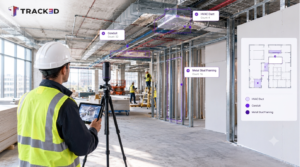
The biggest problem with the field-to-office documentation gap is that not all stakeholders get the necessary information. The solution is automated field documentation. A superintendent does their routine rounds on the field, but this time, with a 360-degree camera. Track3D processes the capture and delivers a dated, visual record, trade-level progress data, and deviation alert within hours.
Now, there are no more forms, follow-up calls, or long waits. All data is available, almost instantly, in a structured manner. The office can see the site as it is today, compliance documentation stops being a scramble at the end of each phase, and the field-to-office documentation gap is automatically closed.
Compliance Built Into the Workflow
Solution to challenge #3: Compliance Documentation That Falls Behind
A construction documentation checklist keeps permits, inspections and sign-offs from falling behind.
As the heading suggests, compliance checkpoints are embedded directly into the documentation workflow, instead of being treated as a separate task. Every task, like a concrete pour, a structural inspection, a safety walkthrough, etc., auto-generates a compliance record with photographic evidence, stakeholder identification, and a date stamp. This way, the audit trail builds itself, and nothing is left to be completed retroactively!
Continuous As-Built Data
Solution to challenge #4: Inaccurate or Incomplete As-Built Records
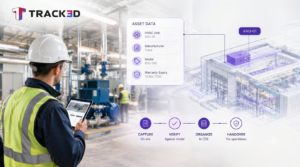
Through reality capture, you can continuously produce an accurate as-built data record throughout the construction lifecycle. Each scan will help you create a verified spatial record of what exists on the jobsite, when it was built, and how it compares to the original design. This way, by the time handover arrives, the as-built package is already complete. Now owners receive a precise, verified record.
Role-Based Access That Manages Itself
Solution to challenge #5: Poor Coordination Across Stakeholders
A centralized platform that ensures role-based permissions for all stakeholders enables everyone to see exactly what they need – nothing more, nothing less. Because of this, updates always flow to the right people automatically, and standardized approval workflows prevent documents from processing without sign-offs. The direct consequence of this system is less admin overhead, fewer escalations, and a clear record of who accessed, reviewed, and approved every document.
Progress Monitoring That Catches Deviations Early
Challenge #6: Late or No Documentation of Issues
That deviation alert is powered by Track3D’s DeviationTrack.
If there’s a manual comparison or scheduled inspection, the construction issues will be flagged late. On the other hand, continuous progress monitoring, when tied directly to the design model, can flag deviations as soon as they occur. So the team gets an accurate picture of what’s been built vs. what was planned, in real time.
It is crucial to understand that early documentation means early detection. Early detection is the only certain way to save money, time, and other resources that would be otherwise spent on extensive rework.
Conclusion: The Common Thread
Every construction documentation management challenge has a common underlying thread: documentation should capture what’s happening in real-time, not after it has already happened. Especially when your project has multiple trades, phased handovers, and compliance obligations, you need a system that will capture every site condition, flag deviations, and automatically build as-built records, so teams can focus on the actual building and not just the paperwork.
The key lies in adapting the right outlook: documentation should not be a back-office task but a real-time operational input that actively supports your project and increases efficiency. When data is captured continuously, synced to the office, and parsed through for deviations, the construction documentation management challenges will automatically reduce.
Track3D can assist you. We close the loop that traditional approaches leave open. To get a clear picture of exactly where your project documentation lies, its gaps, and how we can fix them, book a demo today!
FAQs
Q1. What is construction documentation management?
Ans: Construction documentation management is the process of creating, organizing, distributing, and controlling all documents generated across a construction project. It may also include drawings, contracts, RFIs, inspection reports, submittals, and as-built records.
Q2. What causes the most construction rework?
Ans: According to several research studies, the majority of construction rework occurs due to poor project data and miscommunication, specifically version control failures, inaccurate field reporting, and late issue detection.
Q3. How does reality capture improve construction documentation?
Ans: Through reality capture, every construction site inspection is automatically documented, dated, located, and stored. This technology uses 360-degree scanning to capture site conditions as they actually are, not as someone remembers them. Moreover, this eliminates manual field reporting, closes the field-to-office gap, produces continuous as-built data throughout the project lifecycle rather than just at closeout, and solves all construction documentation management challenges.
Q4. What is an as-built record, and why does it matter?
Ans: An as-built record contains the actual state of a completed construction element, its dimensions, routing, materials, and any deviations from the original design. Accurate as-built records are essential for facility management, future renovation planning, and regulatory compliance. They’re highly important because inaccurate as-built documentation is a leading cause of post-construction cost overruns.
Q5. What should I look for in a construction documentation platform?
Ans: The best documentation platform is the one your team doesn’t have to think about, because it’s already working while they build. Thus, when looking for a construction documentation platform, start by asking how many existing tools it replaces. For instance, Track3D consolidates five into one platform: visual documentation, progress tracking, deviation detection, compliance records, and stakeholder reporting. One site walkthrough automatically produces dated visual records, trade-level progress data, and deviation alerts. Additionally, it connects directly with Procore, Autodesk Construction Cloud, and Fieldwire, so your existing workflows stay intact.