Step into any construction site, and you will see how much things have changed in just the past few years. All the machines, equipment, concrete pouring, delivery of material, and workers at the site are generating data.
The jobsite is now a steady supply line of information. And that, too, is an enormous amount of data we’re talking about. So, what changed? One of the key contributing factors is IoT in construction. It has got everyone’s attention.
Contractors are coming under pressure to get projects wrapped up faster, keep costs under control, and keep their people safe – all at the same time. Having a real-time peek into the site makes those goals a lot easier to hit.
But the thing is, collecting data isn’t the whole story. In fact, the story gets a lot more interesting when we look at what happens after we’ve got all that data. However, despite all the investment in IoT and connected devices, data on its own just isn’t enough to make a real difference. That is, until people actually start making decisions based on it, and use that data as a basis for what gets projects moving forward.
This guide will walk you through IoT in construction, how it’s currently used, highlight the good and the bad, and explore why so many innovative contractors are turning to both IoT data and visual insights to get a better handle on their work sites.
Read on!
Key Takeaways
- IoT in construction connects physical assets, equipment, workers, and jobsite conditions to digital systems.
- Common use cases include equipment tracking, environmental monitoring, worker safety, and structural monitoring.
- IoT helps teams react faster to issues but doesn’t show what has actually been built.
- Combining IoT data with visual project records gives teams more context for decision-making.
- The biggest benefit of IoT isn’t collecting more data. It’s reducing uncertainty across the project.
What IoT in the Construction Industry Actually Does
At its core, IoT in the construction industry connects physical assets to digital systems. Equipment, materials, workers, and structural elements all generate data. That data gets collected, transmitted, and reported in near real time.
Here is where construction teams are actually putting IoT to work today:
| Application | What It Monitors | The Real Benefit | What’s More? |
| Environmental monitoring | Temperature, humidity, air quality, dust, noise | Catches concrete curing problems and confined space hazards before they become incidents or defects | 63% of construction companies implemented IoT-based safety solutions in 2024, and environmental monitoring was the primary use case that they started with. |
| Asset and equipment tracking | GPS and RFID tags on plant, tools, and materials | Reduces idle time, cuts equipment loss, and flags unauthorised movement | Over 68% companies adopted connected machinery in 2024, with more than 42 million IoT-enabled devices operational. |
| Worker safety and location | Wearables detecting falls, fatigue, and geofence breaches | Faster incident response and a compliance record that builds automatically | Construction workers account for roughly 1 in 5 workplace deaths worldwide, making it one of the highest-risk industries for worker safety. |
| Structural monitoring | Sensors in concrete, strain gauges on structural elements | Continuous performance verification rather than periodic manual inspection | Rework can account for 5% to 15% of total project costs, making early detection of structural and installation issues critical. |
Connected Site, Limited Visibility
The construction IoT market was estimated at $17.46 billion in 2024 and is projected to reach $96.39 billion by 2035. That number reflects a real shift happening on job sites everywhere. The data is coming in from everywhere.
The real question is what happens to it. Because data collected is not the same as a decision made. And for most project teams, the gap between those two things is still very wide. That is where most construction problems quietly begin.
5 Benefits of Combining IoT Data With Reality Intelligence
Now that you know how IoT helps the construction teams, let’s clear this:
Many contractors discover that while IoT provides valuable information, it only tells part of the story. A sensor can tell you a machine is operating. It cannot tell you whether the workaround for that machine is progressing properly.
That’s where visual project intelligence becomes valuable. Here’s why:
1. Progress Becomes Something You Can Verify
Before continuous site capture, progress tracking meant weekly meetings, foreman reports, and whatever the PM saw on their last site walk. The information was always late, always partial, and always dependent on what someone remembered to say.
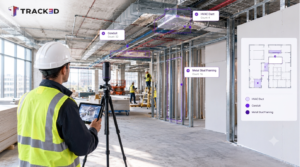
When a superintendent walks the floor with a 360° camera on a round they were already doing, AI engine processes the capture and delivers the project manager a dated visual record, trade-level progress data across all active activities, and alerts within hours. The office sees the site as it stood that morning, not as it was described last Thursday.
2. Discrepancies Are Found Before They Compound
Most expensive construction issues don’t start as expensive issues. They start small. A wall is framed incorrectly. An installation doesn’t match the design. Equipment is operating in the wrong location.
When these issues are identified early, corrections are usually straightforward. When they are discovered weeks later, the cost can increase dramatically. The combination of IoT data and visual project records helps surface these issues sooner. Over 51% of construction projects implemented predictive maintenance platforms in 2024, reducing downtime by 28%.
3. The Field-to-Office Gap Closes Permanently
IoT generates data about what is happening on site. Without a visual layer, that data has no construction context. You know the temperature in a zone. You do not know what was built there. You know where a machine is. You do not know whether the work happening around it is on schedule.
Reality Intelligence changes this. Owners, executives, and consultants can navigate the site virtually, comparing current conditions to previous captures and to the design model. Decisions that used to wait for a site visit happen the same day. Everyone is working from the same verified picture rather than different versions of last week’s report.
4. Compliance Builds Itself Into the Record
IoT safety systems create real-time alerts. But an alert is not a record. What holds up in a dispute or a regulatory inspection is a timestamped, visual record of what conditions existed at a specific location on a specific date.
When site capture is continuous, every safety-relevant event has a documentary record attached to it. Compliance documentation builds automatically throughout the project rather than being assembled under pressure at the end of each phase. By handover, the record is complete without anyone having to compile it.
5. Handover Is a Deliverable, Not a Scramble
The final weeks of most construction projects involve a frantic effort to assemble documentation that should have been built throughout the job. As-built drawings reconstructed from memory. Compliance records chased across email threads from three months ago.
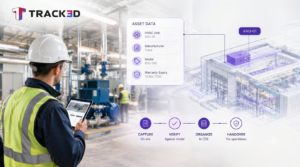
Teams using continuous site capture arrive at handover with something completely different: a verified, navigable record of what was built, when, and how it compares to the original design. Post-completion disputes become substantially harder to sustain against a timestamped visual record covering the entire project.
Why Some Teams Get More Out of IoT Than Others
This is really a data strategy question, not a technology question. 74% of construction firms are actively looking at new technologies to boost productivity and competitiveness. But buying sensors is not the same as having a strategy for what the data does once it arrives.
Here’s how top achievers use IoT and reality intelligence-
| Technology | What It Provides | Typical Insights |
| IoT | Real-time conditions and operational data from connected devices and sensors | • Environmental readings (temperature, humidity, air quality, noise levels)• Asset and equipment locations• Worker locations and movement patterns• Structural load and performance data |
| Reality Intelligence | Visual and spatial context about actual construction progress | • What has been built on site• Where work differs from the design or BIM model• How progress compares to the project schedule• Visual evidence of site conditions and completed work |
This is how project managers get the visibility that used to require significantly more people on the ground.
The Hidden Cost of Fragmented IoT Systems
This is the part most IoT guides do not cover. And it’s where a lot of investment gets quietly wasted. 41% of construction firms cite integration challenges as their primary barrier to getting full value from IoT deployment.
Basically, project teams have plenty of information but very little context. Some of the most common challenges include:
| Fragmentation Issue | Business Impact |
| Equipment tracking disconnected from project progress data | Difficult to understand whether assets are supporting schedule performance |
| Safety alerts stored separately from project records | Compliance documentation requires additional manual effort |
| Environmental data isolated from site documentation | Site conditions cannot easily be linked to completed work |
| Multiple dashboards and reporting systems | Teams spend more time compiling reports than acting on insights |
What IoT Still Cannot Tell You
IoT sensors are excellent at measuring conditions. They are not designed to tell you whether the right work has been done, in the right place, to the right standard.
In layman’s terms-
→ A temperature sensor tells you the curing environment is correct. It does not tell you whether the pour itself was executed to specification.
→ A GPS tag tells you an excavator is in the north-east zone. It does not tell you whether the excavation in that zone matches the design drawings.
→ A worker wearable tells you someone was present in a location. It does not tell you what they built while they were there.
That construction context, the spatial record of what has actually been built and how it compares to what was designed, requires a separate layer entirely. And it is the layer that most IoT implementations in construction are still missing.
59% of contractors reported 30% productivity gains due to IoT integration. So what exactly are the firms that are seeing the largest gains doing? They’re consistently prioritizing visual and spatial intelligence on top of their IoT layer. And that’s what gives them a complete picture rather than a detailed view of one part of the problem.
3 Common IoT Mistakes Construction Teams Make
Even the best IoT systems can fall short if they’re not used strategically.
Mistake #1: Trying to Track Everything at Once
Teams collect too much data without a clear priority, making it harder to find actionable insights.
Fix: Start with one high-impact use case and expand gradually.
Mistake #2: Making IoT Feel Like Extra Work
Complex systems often get ignored on busy job sites.
Fix: Integrate data collection into the workflows teams already follow.
Mistake #3: Tracking Conditions, Not Progress
IoT shows what’s happening on site, but not what has been built.
Fix: Combine IoT data with Reality Intelligence for a complete project view.
Final Thoughts
Collecting site data is the easy part now. The real benefit comes when you turn that data into quicker decisions, catch potential problems way earlier, and get better results from the project.
Winning in construction right now is having the real-time site data and matching it up with visual, verifiable records. It helps you see problems sooner, track what is being built accurately, and hand over a project with a clean, complete record.
Track3D brings all the bits together: Reality Intelligence, 360° site capture, progress tracking, and all the visual records you’ll ever need in one neat package. Want to know how Track3D can help your team cut through the uncertainty and make better choices from day one? Book a Demo→
FAQs
Q1. What is IoT in construction?
“Internet of Things in construction” is the application of interconnected(through the internet) devices that monitor information about the environment, construction equipment, on-site workers, and even construction materials. Such information is useful in improving project management and decision-making.
Q2. How does IoT improve safety on construction sites?
IoT enhances safety through wearables, location detection, environmental monitoring, and alert notifications.
Q3. What are the limitations of IoT in construction?
IoT sensors collect conditions data: temperature, location, movement, structural load. They cannot tell you whether the right work has been completed, in the right place, to the right standard. That spatial and visual context requires a separate layer. Teams that add reality capture and AI-powered progress tracking on top of IoT data get a complete picture of both site conditions and construction progress.
Track3D’s VisualTrack brings that 360 site capture and every visual record into one platform.
Layering ProgressTrack on top of IoT data turns raw sensor feeds into verified, schedule-aligned progress.
Combined with a structured construction daily report, IoT data becomes part of a defensible project record.
Track3D’s DeviationTrack surfaces those discrepancies automatically by comparing site conditions to the plan.
Q4. How does IoT support construction project management?
By giving project managers live data on equipment utilisation, site conditions, worker locations, and structural performance.
Q5. What is the difference between IoT and reality capture in construction?
IoT devices collect information about the site environment and assets. Reality Capture records whatever has actually been constructed, providing a visual and spatial record for comparison with the model. The two are complementary.