

The Last Planner System is a collaborative planning process used in Lean Construction. It shifts scheduling authority from top-down pushing (Executives → Foremen) to bottom-up commitment (Foremen → Executives).
Key Takeaways:
- The Last Planner System puts planning power in the hands of subcontractors and frontline foremen.
- It depends on pull planning, where the team maps work backward from a project milestone.
- The Last Planner System increases reliability through constraint tracking and weekly commitments.
- It reduces rework and miscommunication on complex job sites.
- Progress tracking tools like Track3D’s Reality Intelligence help teams verify plans against actual progress.
What is the Last Planner System?
Picture a schedule built entirely in an office, far from the crew who will carry it out. No one asked the electrician when the panel could actually go in. No one asked the concrete foreman how long the pour would really take. On paper, the schedule holds together. In the field, it starts breaking down within the first month, usually over something that could have been caught in advance.
That gap between the plan and the work is what the Last Planner System was designed to close. Glenn Ballard and Greg Howell developed the method in the 1990s, as part of the broader lean construction movement. Its premise is straightforward: the people planning the work should be the people close enough to know whether it is actually ready to happen. That is the source of the name. They are the “last planners,” the ones responsible for the final commitment on what gets built this week.
LPS construction methods replace top-down scheduling with shared responsibility. Project Managers, Supervisors, and trade partners work from the same table rather than passing instructions down a chain. The schedule becomes something the team builds together, not something handed to them.
Why the Last Planner System Matters?
Traditional scheduling assumes conditions will hold steady. On an active job site, they rarely do. Materials arrive late. Permits stall without a clear explanation. Weather can undo a week’s worth of planning overnight.
LPS is built around that unpredictability rather than around an assumption that it will not happen. It introduces a regular checkpoint where teams measure what was actually completed against what was promised. That measure is called Percent Plan Complete, or PPC. Tracked consistently, PPC data reveals patterns. Teams start to see where the same kind of breakdown recurs and can address it before it repeats on the next phase.
This distinction matters because reworks and delays remain two of the most expensive problems on a construction site. Even a modest reduction in either has a measurable effect on a project’s bottom line. The Lean Construction Institute, which helped develop the method, has published research over the years examining how consistent LPS use affects schedule reliability.
How the Last Planner System Works
LPS operates through a series of connected planning layers, with each one narrowing the focus closer to the actual work.
- Master Schedule: The overarching timeline. It establishes major milestones but stops short of daily detail.
- Phase Pull Planning: Teams work backward from a milestone, identifying the immediate preceding step and the step before that, and continuing until they reach the present. This is pull planning, and this is the heart of the entire LPS.
- Look-Ahead Planning: Covers the coming four to six weeks. Teams surface constraints early, such as missing materials or a permit that has not yet cleared.
- Weekly Work Plan: The most granular layer. Crews commit only to tasks they can realistically complete within the week.
- Percent Planned Complete Review: The team examines which tasks were finished and which were not. They ask why, without assigning blame, and carry that answer forward into the next cycle.
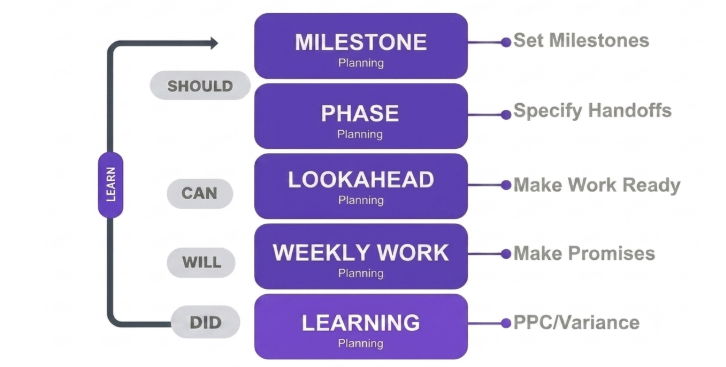
Pull planning is worth examining more closely, since it is where teams most often struggle. It reverses the habit of scheduling forward from day one. Instead, the team starts at the finish line and works backward. That reversal necessitates an honest discussion regarding sequence and preparedness while it is still inexpensive to rectify, rather than several weeks into construction when it isn’t.
Making Collaborative Planning Stick
Collaborative planning is easy to describe in a presentation. Sustaining it week after week takes more discipline.
A few practices tend to separate teams that maintain it from teams that let it lapse:
- Involve the right people: Trade foremen and site supervisors, not only project managers reviewing the plan from a distance.
- Use visual planning tools: Whiteboards, sticky notes, or a digital equivalent. What matters is that the team can see the sequence, not just hear it explained.
- Surface constraints openly: If a task cannot start yet, that should be stated early, with someone assigned to resolve it.
- Review PPC weekly: The goal is to identify and understand why something slipped, not to penalize whoever missed it.
- Keep the look-ahead window realistic. Four to six weeks is generally enough to catch problems without adding an unnecessary layer of process.
Common Mistakes and When LPS Is Not a Perfect Fit
Some teams treat LPS as a single kickoff session rather than an ongoing discipline. That undermines much of its value. Weekly commitment meetings held without a genuine PPC review tend to drift back toward old, top-down habits within a few cycles.
Skipping pull planning to save time is another frequent shortcut, and it typically costs more than it saves. Sequencing conflicts that would have surfaced in a two-hour planning session instead appear mid-construction, where they are far more expensive to resolve.
There is also a cultural adjustment involved that is easy to underestimate. Teams used to rigid, top-down schedules require time to adapt to collective ownership of the plan. It represents a genuine shift in the decision-making process, not simply a new form to complete. On very small projects with limited trade dependencies, a lighter planning approach may be sufficient, and a full LPS implementation may introduce more structure than the job requires.
For most mid-size and large projects, though, the system builds a habit of scheduling grounded in current conditions, rather than in what was originally hoped for.
Where Track3D’s Reality Intelligence Fits In
Planning only accounts for half the equation. Teams also need a reliable picture of what is happening on site, on a timeline that keeps up with the work. This is where Reality Intelligence platforms such as Track3D contribute.
Track3D captures site conditions and turns them into verifiable progress data. It provides insights on percent complete by trade and activity, measures production over time, and flags work that is stalling or slowing before it turns into a scheduling problem. Progress gets mapped zone by zone relative to the schedule; therefore, the project team can check whether the current pace matches the plan, not just a snapshot of what’s been completed.
Teams running the Last Planner System can check weekly commitments against actual field conditions instead of relying on memory or time-consuming walk-throughs. It puts real data behind the same question LPS has always asked: did what we promised actually get built. Talk to Track3D about bringing real-time site data into your weekly PPC reviews.
Frequently Asked Questions
Q1: What is the Last Planner System in construction?
A: It is a lean construction planning method in which frontline supervisors and trade partners plan and commit to weekly work together, rather than receiving a schedule set entirely from above.
Q2: What is pull planning in LPS?
A: The team begins at a milestone date and works backward, determining what must happen immediately before it, step by step. The result is a sequence the whole team has agreed to, rather than one imposed on them.
Q3: How is Percent Plan Complete calculated?
A: Divide the number of planned tasks actually completed by the total number of tasks planned for that period. Teams review this figure weekly to catch recurring constraints before they repeat.
Q4: Is the Last Planner System only for large projects?
A: Not necessarily. Large, multi-trade projects tend to gain the most from it, but smaller projects with fewer dependencies can often manage with a lighter version of collaborative planning.
Q5: How does technology support LPS construction methods?
A: Reality Intelligence platforms like Track3D let teams verify planned progress against actual site conditions, giving weekly PPC reviews concrete data to work from rather than an estimate.