
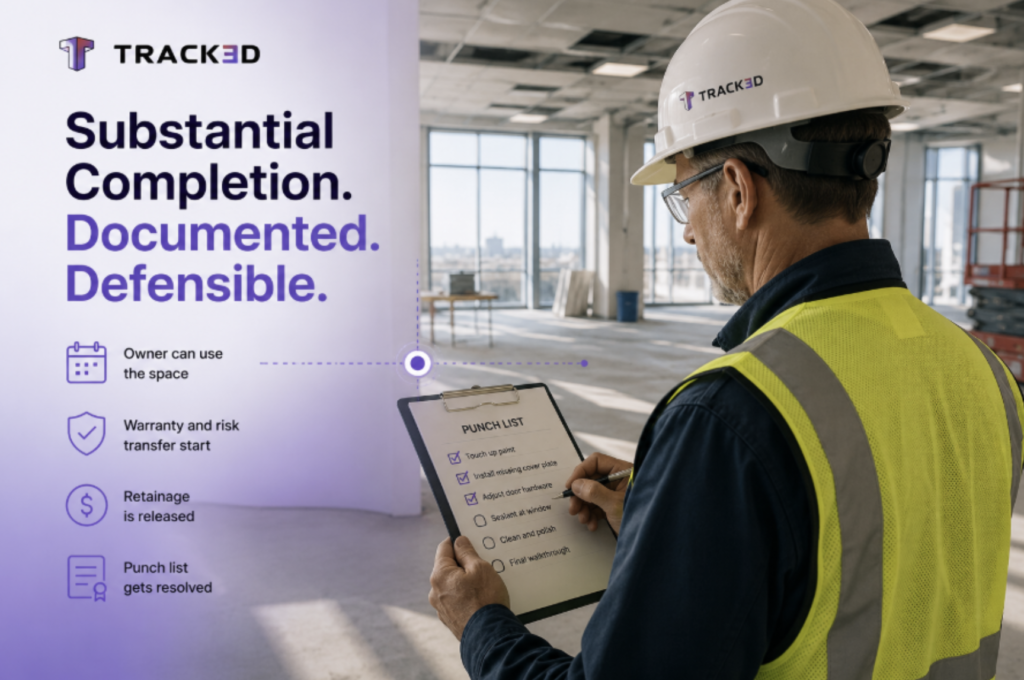
A construction project can look almost finished without actually being ready for handover. There may still be a few doors to adjust, walls to touch up or labels to install. That is where construction substantial completion comes in.
Substantial completion is that stage at which the owner is able to use the structure or premises for their intended purpose despite the fact that there are still some small details left to do. It is a crucial stage in any contract as the date is crucial in many aspects of the contract.
Key Takeaways
- Substantial completion means the project is usable for its intended purpose, not that every task is finished.
- Minor outstanding work is usually recorded on a punch list.
- Final completion comes after the remaining work and closeout requirements are finished.
- The contract determines how substantial completion is defined and certified.
- Good site records can help support the agreed completion date if questions arise later.
Substantial Completion in Construction: What And Why?
So, what exactly does the substantial completion in construction mean? Simply put, it means that the owner may begin using the finished work for its intended purposes.
For instance, a newly constructed office may have to go through some additional painting or fitting of hardware. When employees can safely use the office premises and conduct their activities, then the construction may be declared substantially complete despite some unfinished items.
The actual definition depends on the agreement made between the parties. According to the guidelines of AIA, substantial completion refers to a point at which the owner may start occupying or using the work. Form G704 of the AIA is frequently used for recording the date and unfinished work.
]Who Decides When Substantial Completion Has Been Reached?
The contract usually identifies who is responsible for determining or certifying substantial completion. Depending on the project, this could involve the:
- Architect
- Engineer
- Owner’s representative
- Construction manager
- Other designated contract administrator
The contractor will usually inform the concerned person about completion of the project so that it can be inspected to see if the required level of completion has been attained. That makes the contract important. A project should not be declared substantially complete simply because it “looks nearly finished.”
Why Is the Date of Substantial Completion Important?
This date may be associated with certain actions. After the determination of the substantial completion date, the contract may cover:
- Warranty periods: They usually start from substantial completion unless otherwise indicated in the contract.
- Obligations of the owner: They may change in terms of maintenance, utility, security, or insurance.
- Retainage: There may be some cases when partial retainage may be released after substantial completion.
- Incomplete work: The contractor will get a definite time limit to complete the work.
- Closeout: It is another phase in which the project will be documented and completed.
According to AIA, the provisions in A201 make sure that the substantial completion certificate is tied to completion of incomplete work, allocation of responsibility, and warranty start. However, the specific consequences will be determined by the contract and applicable requirements, and it would be a mistake to assume that all projects have the same schedule.
Substantial Completion Does Not Mean “Almost Done”
This is an important distinction.
A project can be 98% complete but still not be considered substantially completed because of the remaining 2% that could keep the owner from being able to use the facility properly. Conversely, there could be very little work outstanding on a project and still it would be considered substantially completed.
| Project condition | What it may indicate |
| Minor paint, finish or hardware work remains | Potentially suitable for substantial completion |
| Major building system is still incomplete | May prevent substantial completion |
| Space cannot be safely occupied | Substantial completion is unlikely |
| Owner can use the space and only minor corrections remain | Potentially ready for certification |
This is why percentage completion alone is not a reliable test.
What Should Teams Look For Before Determining Substantial Completion?
Prior to the inspection, the team should go beyond mere appearance and see if the project is truly complying with the terms of the contract. Among other things, an inspection may include the following:
- Purpose of use: Is the property suitable for the purpose intended?
- Systems: Are all of the necessary electrical, mechanical, plumbing, and other systems working properly?
- Approval: Have all that should have been approved been approved or inspected?
- Remaining work: Is the remaining work minor in nature?
- Documentation: Is there enough documentation on the project in order to justify the expected date of completion?
The last point is frequently ignored. But when the date of substantial completion is challenged, it will take more than just someone’s memory of how the site appeared. Photos, project documentation, and other records of the progress of the work can give a better idea of what the site really looked like.
This is especially important in larger or phased projects, where each part of the site may reach completion at a different time. The AIA guidance even includes the ability to document substantial completion of a designated portion of the project.
The objective is clear – to set a date of completion based on the actual state of the work and documentable through the project documentation.
What Is the Difference Between Substantial Completion and Final Completion?
Substantial completion and final completion are two different stages of any construction project. The easiest way to differentiate between these two stages is that substantial completion is that stage when the construction becomes suitable for its intended purpose, while final completion involves completion of all outstanding works.
A few minor tasks can remain after substantial completion. Those items are usually recorded on a punch list and given a deadline for completion.
| Substantial Completion | Final Completion | |
| Owner can use the space | Generally yes | Yes |
| Minor work remains | Possible | No |
| Punch list | Usually created | Items should be closed |
| Warranty | Often begins around this stage | Usually already running |
| Closeout | Still in progress | Completed |
The exact effect of each milestone depends on the construction contract. For example, the standard G704 by AIA mentions the date of completion, the incomplete work, and the time in which the same is to be accomplished.
What Is a Punch List and Who Prepares It?
A punch list is simply a record of work that still needs to be completed or corrected. It may include relatively small issues such as:
- Touching up paint
- Adjusting doors or hardware
- Replacing damaged finishes
- Completing labels or signage
- Correcting minor installation issues
Punch lists must not become places where unfinished work is being hidden. If there is a system that is not operating, or an area that cannot be used for its designated purpose, then this problem might need to be solved first before any substantial completion.
In AIA projects, the contractor creates the initial list, whereas the architect checks and confirms the rest of the items on the list. Then, the completed list can be affixed to the certificate of substantial completion. It’s quite beneficial to have a detailed list of items because no one will say that “there are just a few things pending.”
Why Do Substantial Completion Disputes Happen?
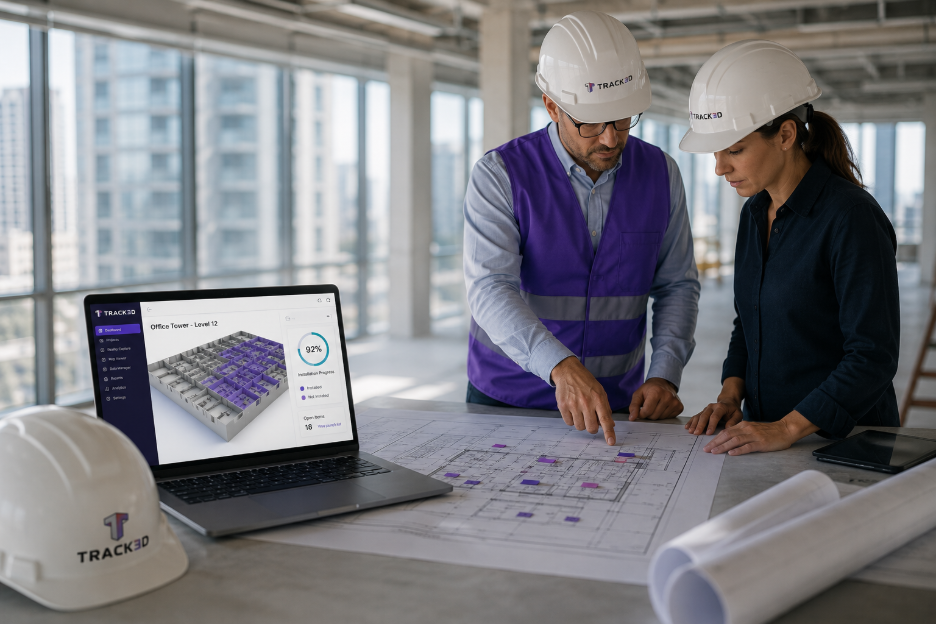
Disagreements often happen because the contractor, owner and design team have different views about whether the project is actually ready for use. Some common reasons include:
Unclear contract language
If the contract does not clearly explain what constitutes substantial completion, deciding whether the milestone has been reached becomes harder.
Different completion dates
Large projects may have several buildings, floors or phases. One area could be ready while work continues elsewhere. AIA’s guidance allows substantial completion to apply to a designated portion of the work, which can be useful for phased handovers.
Critical work is unfinished
A building can look nearly complete while an important mechanical, electrical or life-safety system is still being tested or corrected. Visual appearance alone cannot determine substantial completion.
Poor documentation
This is perhaps the easiest problem to avoid. If one side declares the location as ready on June 10 and the other side states that the work went on until June 20, then the group needs documentation to prove what really occurred.
The 2025 Arcadis construction disputes report showed that the average cost of a dispute in North America from the 2024 dataset is $60.1 million and took 12.5 months on average. These are values that apply to all construction disputes and not only to substantial completion disputes.
Substantial Completion Vs. Certificate of Occupancy
A certificate of occupancy may take place at the same time as the substantial completion but are not necessarily one and the same thing.
The certificate of occupancy is usually obtained from the relevant authorities indicating that the premises can now be utilized for its intended purpose. However, substantial completion is a contractually defined event.
| Certificate of Occupancy | Substantial Completion |
| Issued by the relevant authority | Determined according to the contract |
| Focuses on occupancy requirements | Focuses on contractual completion |
| May be required before use | Marks a project milestone |
| Does not automatically establish substantial completion | Does not replace required occupancy approvals |
So, receiving a certificate of occupancy does not automatically settle the substantial completion date. The team still needs to look at the contract and the actual condition of the work.
A Simple Pre-Inspection Check
Substantial completion walkthrough shouldn’t be the first time the team looks for incomplete works. Walking through prior to this point helps identify any problem and fix it beforehand.
- Check usage of space: Is it possible for the owner to use the space?
- Check critical systems: Do important electrical, mechanical, plumbing, and other systems work properly?
- Look at incomplete tasks: Are they truly minor?
- Check all inspections and tests: Are they complete and approved?
- Collect all documentation: Does the team have enough project documentation to confirm the suggested date?
That last step can make a real difference during closeout. Time-stamped photographs, 360-degree captures and other reality-capture records can show how an area changed over the course of construction.
For teams using a platform such as Track3D’s Reality Intelligence platform, these site records can be connected to project progress and used when teams need to verify what was completed and when.
The purpose is not to create another layer of paperwork. It is to make the completion record easier to understand and defend when questions come up later.
What Should You Document Before Substantial Completion?
As a project nears substantial completion, “it looks done” isn’t enough. You need to show what was finished. You need to show when. And you need to show what was still left. This gets harder on large projects. Several teams might be working across floors, buildings or phases. Remembering exactly when one area was ready? Tough.
A useful record makes these points clear:
– Which areas were ready for use
– What work was still outstanding
– When an area reached the required condition
– Who inspected or verified the work
– What was agreed about the remaining items
– When substantial completion was formally established
That doesn’t mean heaps of paperwork. Keep the important evidence together. That way, nobody has to rebuild the story from old emails and photographs.
Common Mistakes That Can Hold Up Substantial Completion
Big construction problems don’t always cause delays. Sometimes small details are left until the end.
Looking only at percent complete
Being 98% done doesn’t mean substantially complete. The last 2% might be a critical system. Or an area the owner needs before the building can open. So ask: can the owner use the completed work for its intended purpose?
Starting the punch list too late
Waiting for the final inspection to find defects adds pressure. Walk the project a little earlier. The contractor gets time to fix the simple stuff. The owner and design team can also clarify which items must be finished before substantial completion.
Assuming the certificate of occupancy is the finish line
It’s important. But it doesn’t automatically set the contractual substantial completion date. The two are closely related, yet they serve different purposes. Check your contract.
Keeping evidence in too many places
It happens a lot. Photos are on a phone. Inspection records are in an email thread. The most recent punch list is found on an Excel spreadsheet that hasn’t been accessed for two weeks. Disorganized documents make searching difficult. Consistent collection and organization of site data make closeout simpler.
How Reality Capture Can Help at Closeout
By substantial completion, you have a huge amount of information. Collecting more isn’t the problem. Finding the right piece when a question comes up is.
Reality capture can help. Regular 360-degree captures, drone imagery, laser scans and other site records create a visual history. Date them. Organize them. Then you can look back and see an area at different stages.
Say there’s a disagreement about when a floor was ready. Skip the guesswork. Look at the site record from that period. It helps with smaller questions as well:
– Was the punch-list item actually fixed?
– When was the area cleared?
– What did the space look like before handover?
– Was work still happening on a particular date?
– Which areas were ready while other phases were still being built?
Track3D’s Reality Intelligence platform is one example. It brings site captures together with project information. Teams get a clearer record of progress and site conditions.
But technology doesn’t decide substantial completion. The contract does. So does the actual condition of the work, along with the people responsible for certifying it. Better documentation simply gives them a clearer basis for the decision.
A Simpler Way to Approach Closeout
Don’t overcomplicate it. A straightforward process keeps everyone aligned.
1. Start with the contract: Before the final walkthrough, use the actual definition of substantial completion. Not an informal understanding.
2. Walk the project as the owner will use it: Check access, functionality, major systems and anything that could prevent normal use.
3. Separate minor corrections from major unfinished work: A paint touch-up is not a system that hasn’t been commissioned.
4. Keep the punch list specific: “Finish remaining work” is useless. Name the exact location and correction.
5. Consolidate the records: Inspection reports, test results, approvals, pictures, and site captures. Ensure that these are easy to access.
6. Document the decision made: After substantial completion has been determined, the date, the remaining tasks, and the persons involved should be documented.
This pays off later. A question might come up months after the project moves on. You’ll have something concrete to refer to. No reconstructing from memory.
Ready to Make Your Closeout Date Defensible?
Substantial completion looks like a simple milestone. It isn’t always. The date can have real consequences. It can affect warranties, owner responsibilities, remaining work, retainage and the move from construction to occupancy. Treat it carefully. Don’t just mark the project “nearly finished.”
Start with clear contract language. Make sure the site is truly ready for its intended use. Keep the punch list specific. Maintain enough dated evidence to show how the project got there.
A reliable site record makes this easier. Reality capture plus organized project data gives you a clear trail from ongoing construction to substantial completion. Track3D helps teams turn site captures into an organized record of progress and conditions. Verifying what happened on site gets easier when you need it. Want to know more? →
FAQs
Q. What is substantial completion in construction?
A. It’s a milestone in the project when the building, or a section of it, can be used for its purpose, even with some minor work left over. The contract usually decides what exactly it means for a particular project.
Q. What is the difference between substantial completion and final completion?
A. The distinction lies in the volume of work outstanding. Substantial completion involves some small unfinished work, but at final completion, the contractor has finished all outstanding work and has satisfied all the closeout terms of the contract.
Q. Who determines substantial completion?
A. The construction contract usually identifies who determines or certifies substantial completion. Depending on the project, this may be the architect, engineer, owner’s representative or another designated professional.
Q. Does substantial completion release retainage?
A. It can. It depends on the contract. Some agreements release part of it at substantial completion. The rest waits until final completion.
Q. Does the warranty period start at substantial completion?
A. That is correct, as many contracts will state. Warranties usually start from substantial completion or thereabouts. Because of the difference in timing, it’s important to see what is stated in your contract. Keeping dated records is also a good idea because of this date.