
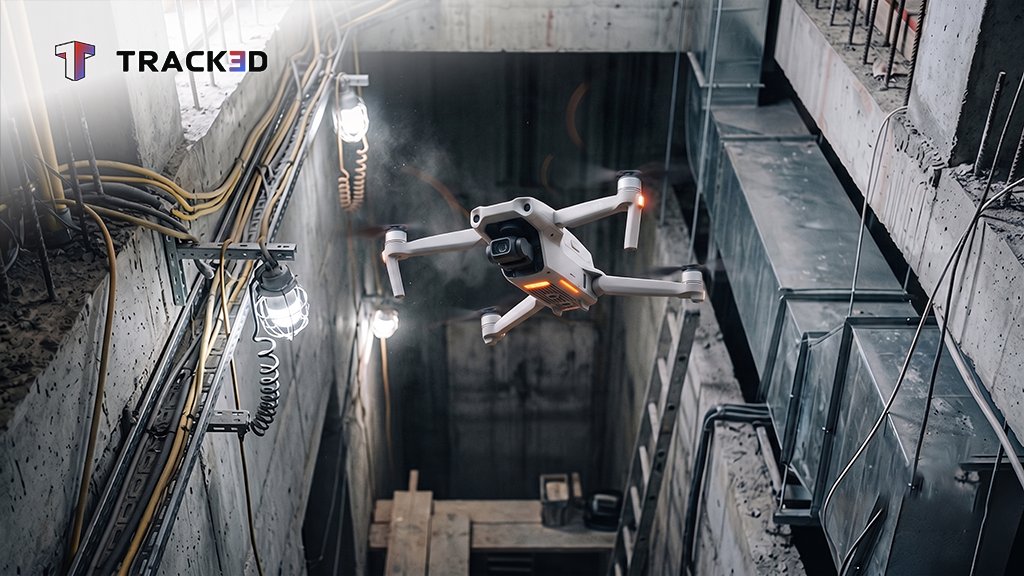
Track3D’s aerial 360 capture library now includes footage from two drones, the DJI Avata 360 and the Antigravity A1. Both fly a full 360 camera through overhead space and feed the same Reality Intelligence workflow.
Key Takeaways
- Both drones capture full-sphere 360 footage and feed it into the same Reality Intelligence layer as ground-level walks.
- The DJI Avata 360 is built to fly close to walls and equipment, with sensors that hold up in mixed light.
- The Antigravity A1 is a sub-250g drone with a built-in light, built for dark, tight, or hard-to-register spaces.
- Neither drone replaces the other. Each one answers a different question about the space you are flying.
- The choice comes down to the room, not the rating.
Track3D Now Flies Two Drones
A construction site is not one kind of space. Some rooms are tight and busy, with ductwork, cable trays, and steel close enough to touch. Others are dark, narrow, or nearly impossible to enter safely, like a shaft or an unlit mechanical closet. One drone, built for one set of conditions, was always going to run into a room it wasn’t shaped for.
That is the real reason two drones now sit inside the same aerial 360 capture ecosystem. Not to offer a choice for its own sake, but because the range of spaces on a job site is wider than any single airframe can cover well. Adding the Antigravity A1 alongside the DJI Avata 360 means a team walks onto site already knowing they have an answer, whatever the room turns out to be.
What The DJI Avata 360 Is Built For
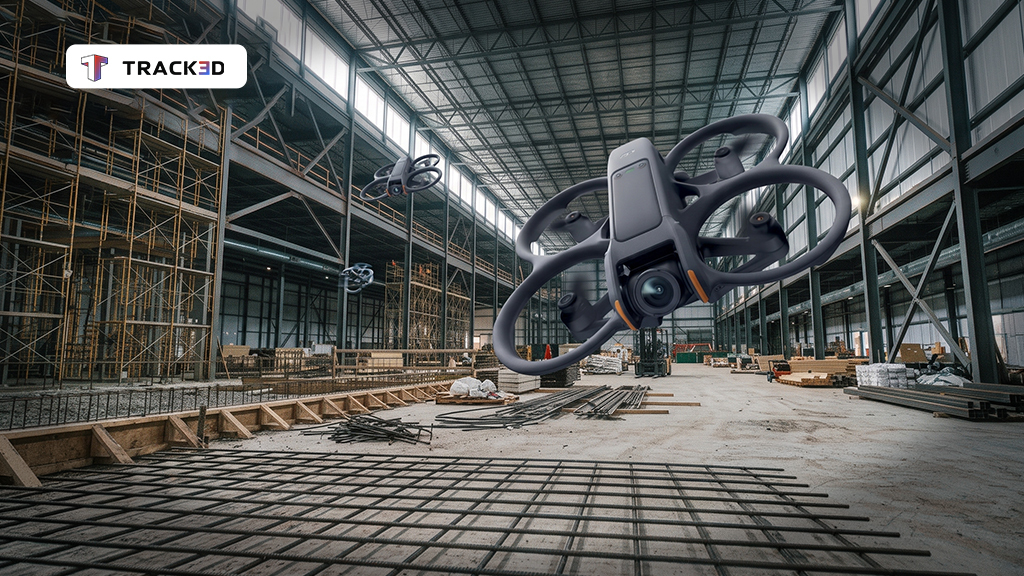
The Avata 360 is built to get close. Its integrated propeller guards let it fly near walls, overhead systems, and equipment without much hesitation, which matters in a tight mechanical room where the margin for error is small. It carries dual 1-inch-class sensors that record 8K HDR 360, so it holds detail across the kind of mixed lighting most interiors actually have. A bright bay next to a shaded corridor does not confuse it.
When a straight, forward-facing shot is all a job needs, the Avata 360 switches into Single-Lens mode and records flat 4K video, so it can double as a standard drone without a second airframe on site.
When Does Flying The Avata 360 Make Sense?
The Avata 360 tends to make sense in spaces that are tight but not dark. Think of a data center aisle, a mechanical room with equipment close on both sides, or a distribution center where ductwork and trays sit just above head height in daylight or bright work lighting. Its prop guards make close, careful flying feel routine instead of risky.
What The Antigravity A1 Is Built For
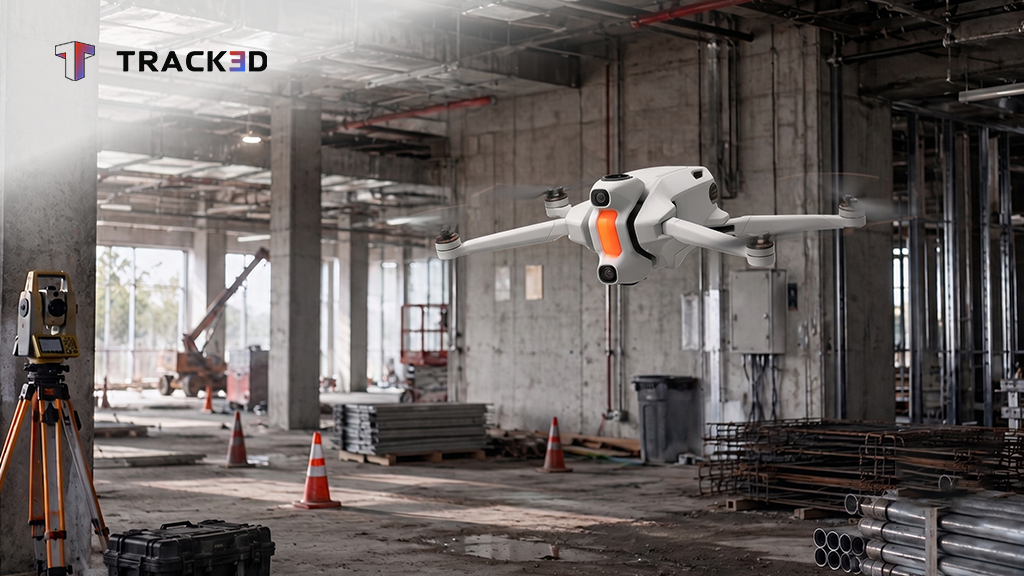
It also carries a built-in light on its underside. That single detail changes what it can fly into. Shafts, unlit mechanical rooms, and dark overhead zones stop being off-limits. And because no one is holding it overhead, there is no arm, body, or equipment blocking part of the frame. Every pixel it records is usable.
It isn’t just limited to interiors. The same flight that documents an overhead system inside can pull back and track the facade on the way out, sheathing, the air and vapor barrier, curtain wall conditions, all without switching to a second platform.
When Does Flying The A1 Make Sense?
The A1 tends to make sense where light runs out. An elevator shaft, an unlit riser, a mechanical space with no fixtures turned on yet. Its size and weight also help on sites where getting a drone approved and in the air quickly matters as much as the footage itself.
Neither list is the whole picture. Most sites have both kinds of rooms in the same building, sometimes on the same floor.
What Never Changes: One Workflow, Two Sources
Whichever drone flies, the footage lands in the same place. Both feed the same Reality Intelligence workflow that ground-level 360 walks already use. Same interface, same review process, same navigable record. A field team reviews the footage after landing and pulls exactly what is needed: a close-up on a connection, a wide shot of an overhead run, a tracking shot down a shaft. The drone changes. The record it builds does not.
Where Ground-Level Capture Already Has It Covered
Aerial 360 capture earns its place in high-ceiling, overhead-heavy spaces, generally above roughly 15 feet, where conditions get concealed before anyone can document them well from the floor. In a low-ceiling room with little overhead complexity, a ground-level 360 walk already covers what is needed. Aerial capture is there for the rooms that call for it, not a replacement for the walkthrough your team already trusts.
This is really the point of building an ecosystem instead of settling on one drone. A tight, well-lit mechanical room, a dark shaft, a straightforward corridor: each one calls for a different tool, and each one now has one. Track3D added two drones specifically so that whatever a site looks like, there is already a match for it. That is what a complete Reality Intelligence record depends on, having the right way to capture every space.
See Both Drones Inside One Workflow
Whether a site needs close-in flying through a bright, busy mechanical room or a light-equipped pass through a dark shaft, Track3D’s aerial 360 capture now has a drone built for it, feeding the same Reality Intelligence record your team already relies on.
Book a demo to see both drones in action →
Frequently Asked Questions
Q1: What is the difference between the DJI Avata 360 and the Antigravity A1?
A: The Avata 360 is built for close-in flying in mixed light, with prop guards and dual 1-inch sensors. The A1 is a sub-250g drone with a built-in light, built for dark spaces and easier registration in many regions.
Q2: Which drone should a team fly in a dark mechanical room or shaft?
A: The Antigravity A1 carries a built-in light, which makes it the practical choice for unlit or dim overhead spaces where the Avata 360’s sensors would have less light to work with.
Q3: Can both drones be used on the same project?
A: Yes. Many sites have both tight, well-lit rooms and dark, hard-to-reach ones, so teams often fly both drones depending on the space.
Q4: Does the drone used change how footage is processed in Track3D?
A: No. Footage from either drone feeds the same Reality Intelligence workflow as ground-level 360 walks, so the review process and the record stay consistent.
Q5: Is one of these drones simply better than the other?
A: Not in general. Each is built around a different constraint, tight spaces with mixed light versus dark or hard-to-register spaces, so the better choice depends on the room.