Artificial Intelligence, as the name suggests, mimics human intelligence based on the data and information that we supply to train it. It can analyse huge amounts of data to discover hidden patterns, predict risks and outcomes, and provide insights, all in real time. These abilities are now facilitating the rapid rise of AI in construction and engineering.
People tend to think that AI in construction directly implies robots replacing people. However, that’s not the case at all! In an ideal setting, AI elevates the work, increases efficiency, and works alongside people to get better results. To find out more about how AI in construction can help you work smarter, continue reading!
Key Takeaway
- AI in construction is not about replacing your team. It works alongside your General Contractor, superintendent, and Project Manager to make faster and smarter decisions across the whole project.
- It fits inside your existing workflows and helps at every stage, from preconstruction planning and scheduling all the way through to safety walks, quality checks, and progress tracking on site.
- The biggest challenge is not the technology. It is scattered data, high upfront costs, and teams that are not yet ready to trust AI driven decisions.
- AI is only as good as the data you feed it. Clean, consistent, and well organized project data is what makes it actually useful on site.
- You do not need an AI team to get started. Pick one use case, get your data in order, and build from there.
Components of AI: Quick Refresher
Before we jump into AI in construction and its implications, let’s take a quick moment to look at the different components of AI and how they can be integrated in this line of work.
- Machine Learning: ML typically involves training algorithms to learn from datasets to make informed decisions and accurate predictions. In construction, ML can come in handy for predicting systemic failures and potential safety hazards, estimating costs, and optimising resources based on past data.
- Internet of Things: IoT refers to the network of physical devices that are involved in data exchange. The simplest examples of IoT are smart watches, smart TVs, or smart refrigerators. IoT can be used on construction sites to monitor real-time air quality, trigger alerts for malfunctions, and blare alarms in case of accidents.
- AI Robotics: AI-powered robots can be used for manual, repetitive tasks. It reduces the chance of error and accidents.
- Computer Vision: These are tools that can analyse images or videos to identify repetitive patterns and make notes for progress.
- Natural Language Processing: NLP is a useful technology to read and understand documents, contracts, and daily logs.
What Does AI in Construction Really Mean?
AI in construction is simply smart software that learns from your past project data and helps your team spot problems, delays, and risks before they actually happen on site.
In other words, instead of just storing your project information like normal construction project tracking software, it reads through your schedules, site photos, and documents and starts connecting the dots for you.
Why Do We Need AI in Construction?
First and foremost, AI adaptation is crucial for companies to stay relevant and competitive in the current market, especially when practically every company, construction or not, is keen to integrate AI into their workflow. It helps superintendents and workers improve the quality of work, safety, and productivity. It is a definite way to streamline work and have a virtual assistant. At its core, AI can resolve minor snags, repetitive blunders, and time-wasters in the process.
Most importantly, new technologies propel us forward toward progress and development. Digital collaboration of any type almost always assists in accelerating growth.
Ways in Which AI is Already Changing Construction
AI isn’t a tale of the distant future. It’s already here, addressing everyday pain points and making lives easier. Here’s how:
- Progress Tracking: Computer vision tools analyse daily photos to detect task completion, updating logs and visual timelines without manual data entry.
- Risk Forecasting: Predictive models surface tasks or trades that are likely to be delayed based on current trends and historical patterns.
- Schedule Optimisation: AI reviews sequencing and dependencies, flagging conflicts or opportunities to re-sequence tasks for better flow.
- Safety Monitoring: Vision-based AI can flag unsafe behaviours (e.g., missing PPE) captured in site footage to support proactive safety measures.
Scope and Benefits of AI in Construction
We can divide the construction process into three phases: preconstruction, construction, and postconstruction or maintenance. In preconstruction, AI can help with design development, risk analysis, scheduling, and planning. Similarly, during construction, AI can assist with inspection, safety parameters, budgeting, and daily logs. Lastly, AI can help with monitoring, detecting problems, scheduling regular maintenance, and suggesting better solutions for previous issues.
Let’s look at some of the direct benefits of AI in construction:
1. Safety
As mentioned above, AI improves construction safety by continuously monitoring worksites through cameras, sensors, and drones to detect hazards in real-time. It can also predict risks like equipment failure, worker fatigue, or inadequate weather, so stakeholders can act before accidents occur. By automating inspections in hard-to-reach or hazardous zones, superintendents can ensure AI keeps workers out of harm’s way. Overall, it strengthens early detection, prevention, and rapid response, making sites significantly safer.
2. Cost-Efficient
When compared to the conventional methods of estimation and monitoring, AI tools are not only faster but also more cost-efficient. Traditional tools usually can’t adapt to real-time changes as fast as an AI model can. Moreover, AI can assist project managers in maintaining the budget and controlling unnecessary spending through accurate estimates.
3. Increased Productivity
When the most time-consuming tasks of project management are handed over to an efficient tool, time opens up for more serious tasks. Thus, AI in construction can be used to effectively increase overall productivity by letting it plan tasks, manage schedules, keep track of budgets, and oversee materials and equipment management.
4. Quality Control
When you have Artificial Intelligence surveying your project, both behind the scenes and in the field, non-stop, you can certainly look forward to better quality control long-term. Because of AI’s powerful predictive maintenance, it can trigger alarms and suggestions for regular upkeep and servicing. AI sensors, cameras, and drones are very useful for this.
5. Designing
AI can strengthen construction design and planning by predicting how spaces will be used, generating optimised layouts, and reducing design errors before building begins. Machine learning can evaluate design options under different constraints, like cost, materials, energy efficiency, and regulations, to find the best solutions. 3D models, built with AI, can offer innovative solutions for presentation, conceptualisation, and an accurate project plan.
6. Sustainability
Through AI’s capabilities for data and predictive analysis, we can make informed decisions about energy consumption, material use, water usage, and waste processing. This predictive analysis, if done properly, can reduce the waste of energy and resources. Thus, AI can be used for long-term sustainability.
How AI Works in Construction Workflows
AI does not take over your project. It sits inside the workflows of your team which makes them even smarter and quicker. Let us see how Artificial Intelligence works at each stage of a construction project.
- During Planning and Preconstruction
AI looks at your project history, similar scopes, crew sizes and cost data and gives you a realistic starting point for your timeline and budget. It also runs what if scenarios so you can see the trade-offs before you commit to anything. - During Design and Scheduling
Picture your team going through drawings and schedules manually trying to find clashes and conflicts. That used to take days. Now AI scans through the BIM model and automatically flags the clashes. Suggests where the critical path is most at risk. This way your team gets a picture of where delays are most likely before work even starts on site. - During Procurement and Approvals
Now imagine your submittal register is backed up and nobody noticed until it started blocking work on site. AI watches your RFI and submittal timelines spots which packages are running late and sends an alert before it becomes a schedule problem. It can even read documents, sort them by trade and flag what needs attention next. - During Site Execution and Progress Tracking
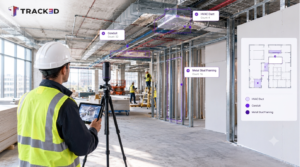
This is where it gets really useful for the superintendent and PM. Your crew does their regular weekly progress walk and captures site photos or 360° footage. AI processes site photos or 360° footage compares them against the schedule and plans. Tells you exactly where work is ahead, behind or out of sequence. This way your Project Manager gets an automated progress update with the numbers. - During Safety Walks and Quality Checks
Picture a safety manager trying to review hours of site footage every week looking for PPE violations or unsafe access points. AI does that automatically. AI scans site footage, flags safety issues in time and sends an alert so the safety team can act immediately. It also tracks punch list trends and defect patterns and highlights which areas or trades need a look. - In the Back Office
Here is the part nobody talks about enough. Your team spends hours reading through change orders, contracts, daily logs, and meeting notes. AI reads all of that, pulls out the key impacts on cost and schedule, and gives your leadership a short clear summary instead of a 20-page document nobody has time to read.
At the end of the day Artificial Intelligence does not reinvent the way construction works. It just finds the spots in your construction workflow where time is being lost, decisions are being delayed or data is being missed and fixes those gaps with automation, prediction and better visibility across the construction project. Artificial Intelligence works with your construction team to make them more efficient.
Challenges of AI Adoption in Construction
AI sounds great. Working with it on a construction project is not easy. Here are the real challenges.
- Data is everywhere: Your plans, schedules, site photos, and RFIs all live in different tools and formats. AI needs connected data to work well. When data is scattered AI can’t see everything and results suffer.
- The upfront cost is hard to justify: Software, integration, and training all cost money. Every construction project is different so return on investment is not always easy to prove.
- Nobody knows how it makes decisions: AI gives you a prediction but does not always explain why. That makes it hard for a PM or superintendent to act on it with confidence, especially when something goes wrong and accountability becomes a question.
- Data security is a real concern: Project data includes schedules, drawings, financials and site details. If the platform is not secured it is a risk, especially, on government or institutional projects.
- Everyone is on a different tool: The General Contractor, designer, subcontractors, and owner are all using different systems. Getting AI to work across all of them is a coordination problem before it even becomes a technology problem.
6. The site is not always ready: AI tools need stable internet and decent hardware to work properly. On remote or early phase sites, that is not always available, which makes real time AI features hard to use on the ground.
What Do You Need To Make AI Work?
The entire crux of Artificial Intelligence lies in the data. Any AI system is only as smart as the data it trains on. This implies that if your data is scattered across spreadsheets, the naming conventions are inconsistent, or photos aren’t geotagged, AI will not be able to work efficiently. The best way to ensure your AI model works well is to:
- Create and maintain a solid data foundation with structured documentation
- Follow consistent naming and formatting
- Maintain accurate timestamps and locations
- Standardise field inputs like checklists and drop-downs
- Clarify workflows for capturing and storing data
At the same time, you don’t need:
- A full AI team – you only need to explore tools that already have AI integrated.
- To tackle everything, all at once. Pick a use case and focus on perfecting that.
- Shiny tools that promise “total AI transformation” without evaluating the tool and assessing if your workflows are even ready for that.
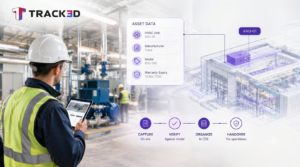
To maintain a solid database, you can use reality capture tools, like 360° cameras or mobile walkthroughs, because they generate visual data that’s automatically tagged and organised. When that data is clean, AI can do its job – turning site conditions into insights you can act on.
Is AI Replacing People?
In conclusion, AI in construction is not aimed at replacing people or removing jobs. The main objective is to improve efficiency, cut costs, and elevate the safety measures. You can use AI to generate insights about your work and use those to transform your work.
subscribe to our blog
- Benefits