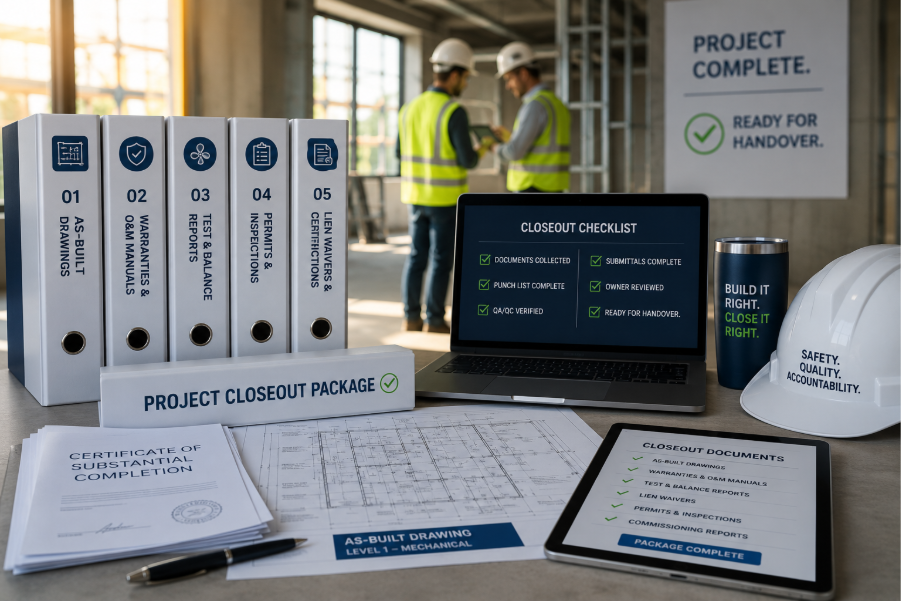
Project closeout documents refer to all the records, diagrams, approvals, warranties, and other information required for a smooth transition of a finished project from contractors to owners. It might look relatively easy on paper. After all, the building is done, the project has been inspected and approved, and now the owner gets access to it. However, in reality, project closeout may be among the most challenging phases of the construction process.
Construction crews wrap up their fieldwork. The subcontractor moves to its next project. The owner wants to occupy the building. However, the construction project crew needs to collect numerous pieces of documentation scattered around emails, folders, and spreadsheets.
When documentation is poorly organized and/or incomplete, it might take much more time to conduct the handover procedure, delay final payments, tie up retainage funds, and frustrate the owner. Well-planned closeout documentation proves the successful completion of construction projects.
This is why we’ve covered all about closeout documentation in this read. Let’s dive in!
Key Takeaways
- Closeout documentation serves to officially verify the completeness, compliance, and readiness for turnover of the project.
- Omissions of documents can lead to delays in occupancy permits, payments, and completion.
- As-built plans are among the most critical closeout documents as they capture what has been built.
- Closeout documentation consists of warranties, manuals, test and inspection reports, lien releases, and many other documents.
- Effective closeout processes begin early on and are not confined to the later stages of the project.
- Reality Intelligence assists in developing accurate construction records by constantly documenting on-site conditions.
What Are Construction Project Closeout Documents?
Construction closeout is the final stage of the project lifecycle. It begins when physical construction is largely complete and continues until ownership is formally transferred. At this stage, the focus shifts from building work to documentation. Owners need confirmation that systems perform as intended. Inspectors need proof that regulations have been satisfied. Contractors need approval to receive final payment. Facility managers need information that will help them operate and maintain the building for years to come.
Closeout documents bring all of this together. Think of them as the building’s permanent record. Long after the project team leaves the site, these records continue to serve a purpose. They help future maintenance teams locate systems behind walls. They support renovations and upgrades. They provide evidence if disputes arise years later.
The problem is that many teams still approach closeout documentation as something to deal with once construction is finished. That approach often leads to missing information, incomplete records, and stressful handover periods.
Industry studies show that construction professionals dedicate much of their time to looking for information about projects than to using the information. The more the documentation is delayed, the more difficult the closing out process gets.
The most effective contractors take a different approach. They begin collecting, verifying, and organizing closeout records throughout the project so that by the time handover arrives, much of the work is already done.
Getting project closeout documents right helps teams:
| Benefit | Why It Matters |
| Faster final payment | Owners can process final payment without documentation delays |
| Reduced disputes | Complete records provide evidence if questions arise later |
| Easier inspections | Authorities can quickly verify compliance requirements |
| Better owner experience | Owners receive organized information for operations and maintenance |
| Lower legal risk | Documentation protects all parties if issues emerge after handover |
Simply put, closeout documentation protects everyone involved in the project.
Essential Documents for Construction Project Closeout
While closeout requirements vary by project type and contract structure, most commercial projects require the same core set of deliverables.
The table below provides a quick overview.
| Document | Purpose |
| As-Built Drawings | Show what was actually constructed |
| Certificate of Substantial Completion | Confirms project is substantially complete |
| Certificate of Occupancy | Authorizes building occupancy |
| Punch List Documentation | Confirms outstanding items are resolved |
| O&M Manuals | Guides operation and maintenance of systems |
| Warranties | Transfers warranty coverage to owner |
| Lien Waivers | Confirms contractors and suppliers have been paid |
| TAB Reports | Verifies HVAC system performance |
| Commissioning Reports | Confirms systems function as designed |
| Inspection Reports & Permits | Demonstrates regulatory compliance |
| Subcontractor Closeout Records | Collects required documentation from trades |
| Final Payment Application | Supports release of final payment |
Let’s look at each of these closely.
1. As-Built Drawings
As-built drawings show the completed construction as precisely as it appears on-site. Everything changed during construction must be included. That may include altered utilities, relocated equipment, dimensional changes, field adjustments, and approved design modifications. Owners need these drawings for ongoing maintenance, renovations, and future expansion projects.
2. Certificate of Substantial Completion
It’s one of the key documents in the construction process. It means that the project has reached the level of completion at which the owner can begin using it for its intended purpose. This document triggers significant contractual activities like warranty periods, retention release, and other contractual provisions.
3. Certificate of Occupancy
It’s an official document issued by the jurisdictional government body. The certificate verifies that the structure meets all applicable codes and safety standards. No legal occupation of the property is possible without the CO.
4. Punch List Documentation
They’re drawn up near the end of construction. It indicates unfinished or corrective work to be done. After all such items have been sorted out, this document will verify the same. This is useful both for the contractor and the owner, as proof of project completion.
5. Operation and Maintenance Manuals
Operation and Maintenance manuals offer instructions for operation and maintenance of installed systems. These manuals usually include the following:
- HVAC systems
- Electrical systems
- Plumbing systems
- Fire protection systems
- Elevators
- Specialty equipment
For facility managers, these manuals are some of the most often used close-out documents.
6. Warranty Documentation
It includes coverage details for installed systems and materials used in the structure. Property owners require this information to know what they are covered under, how long the warranty is valid, and what contacts are needed if there is a problem. A lack of warranty documentation creates many post-occupancy problems.
7. Lien Waivers
It ensures that contractors, subcontractors, and vendors have been paid. Plus, there will be no future disputes involving payments against the owner’s property. It is unlikely that an owner will release final payment without receiving lien waivers.
8. TAB Reports
It ensures that the HVAC systems are performing as they should when it comes to airflow and temperature control. They are more common in commercial construction projects due to issues related to energy efficiency.
9. Commissioning Reports
Large, complex buildings may involve commissioning processes. Commissioning is common for hospitals, labs, data centers, and institutions. Commissioning reports show that systems are performing properly at operating conditions.
10. Final Inspection Reports and Permits
Projects generate numerous permits and inspection records during construction. Closeout packages should include copies of:
- Building permits
- Inspection approvals
- Fire department approvals
- Specialty system certifications
- Regulatory sign-offs
Together, they demonstrate compliance with applicable regulations.
11. Documentation for Trade Partner Close-Outs
Close-out is not possible without the involvement of trade partners. Subcontractors have to provide warranties, manuals, certificates, and test results among others. This can be quite a task when dealing with many trades.
12. Final Payment Application
The final payment application formally requests project closeout payment. Owners typically require supporting documentation before processing final invoices.
A complete closeout package helps eliminate payment delays.
Why Are As-Built Drawings a Critical Closeout Document?

There is always one document that delays the closing-out process: the as-built drawings. It is because construction seldom goes as per design. Why?
- Field conditions change.
- Routing changes.
- Equipment placement gets modified.
- Design modifications come about.
- Changes occur weekly.
These are reflected in as-built drawings.
For owners, this is critical information. Why? Because maintenance teams depend on as-built drawings when fixing equipment or making repairs.
For contractors, as-builts provide protection. Years after project completion, disputes often come down to one question: “What was actually built?” Accurate as-built documentation answers that question clearly.
However, traditional as-built processes rely heavily on manual markups and memory. Important updates are often missed, lost, or recorded inconsistently.
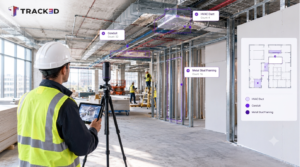
This is where Reality Intelligence changes the process. Instead of relying solely on redlines, teams can use ongoing site captures and spatial records collected throughout construction. By the time closeout arrives, much of the information already exists in a verified format. The record is built continuously rather than reconstructed later.
The Cost of Waiting Until the End
Many contractors still approach closeout documentation as something they’ll deal with later. Unfortunately, it arrives faster than expected. Waiting until substantial completion creates several common problems:
| Waiting Until The End | Collecting Throughout The Project |
| Missing records | Documentation already organized |
| Lost field changes | Continuous project record |
| Delayed payments | Faster approval process |
| Last-minute stress | Predictable closeout workflow |
| Increased disputes | Strong documentation trail |
The difference often comes down to planning. The projects with the smoothest handovers rarely work harder at closeout. They simply start earlier.
Software Solutions for Construction Closeout Document Management
Managing closeout documents across multiple teams, subcontractors, consultants, and owners requires more than spreadsheets and email folders. Today’s construction teams increasingly rely on digital platforms to organize documentation and track closeout progress.
| Feature | Why It Matters |
| Centralized storage | Creates a single source of truth |
| Version control | Prevents outdated documents from circulating |
| Status tracking | Shows what is complete and what remains outstanding |
| Mobile access | Allows field uploads from the jobsite |
| Drawing integration | Connects documentation directly to project records |
Where Reality Intelligence Comes In
A lot of construction teams already use software like Procore or Autodesk Construction Cloud to manage closeout paperwork. The problem is, construction software can help you organize documents. But organizing paperwork and verifying actual site work are two very different things.
That is where Reality Intelligence adds another layer of value. When site conditions are captured continuously throughout construction, project records become easier to verify, easier to validate, and easier to trust.
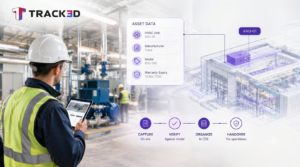
With Track3D, teams can document site progress as the project moves forward, instead of trying to piece everything together later. That makes closeout much easier because the project record has already been built from day one.
A few closeout practice tips that help:
- Assign a closeout owner early instead of waiting until project completion
- Collect warranties and manuals from subcontractors throughout the project
- Keep a live document tracker that gets reviewed in regular project meetings
- Use photo documentation and site scans to support as-builts and compliance records
- Standardize document submission requirements across all subcontractors early on
Closeout Timeline: What Should Be Collected and When?
One of the biggest misconceptions in construction is that closeout begins when construction ends. In reality, closeout should start on day one.
| Project Stage | Documents to Collect |
| Early Construction | RFIs, submittals, approved changes |
| Throughout Construction | Photos, site scans, field updates |
| Mid-Project | Equipment data, warranty information |
| Pre-Completion | O&M manuals, testing reports |
| Substantial Completion | Punch list records, inspections |
| Final Handover | As-builts, CO, lien waivers, final payment package |
Teams that build documentation consistently usually do not face as many closeout problems as those who wait till end.
Common Closeout Mistakes That Delay Handover
Many closeout delays stem from avoidable mistakes. Some of the most common include:
| Common Mistake | Result |
| Waiting until project end to gather documents | Missing records and rushed closeout |
| No designated closeout coordinator | Confusion over responsibilities |
| Poor subcontractor follow-up | Incomplete documentation packages |
| Outdated as-built drawings | Owner dissatisfaction and future risk |
| Manual tracking systems | Increased administrative effort |
Projects that avoid these issues generally experience smoother handovers and faster payment processing.
Ready to Close Out Faster and More Accurately?
Anyone who has worked on construction projects knows the real pressure often comes at the very end. Not because the work is unfinished, but because the paperwork usually is.
Teams that document consistently throughout the build avoid that last-minute rush and deliver smoother handovers with fewer surprises.
Track3D helps capture and organize project data as work happens through Reality Intelligence, 360° site capture, and verified project documentation. This makes closeout simpler and more accurate. Want to see it in action? Book a demo now →
FAQs
Q1: What are the most important construction project closeout documents?
A: Important documentation includes as-built plans, certificate of substantial completion, certificate of occupancy, punch-list approval, O&M manuals, equipment warranties, lien waivers, and final inspection documentation. Exact documentation needs differ by the type of contract and governing body.
Q2: When should I start collecting closeout documents for a construction project?
A: Closeout paperwork should never be an end-of-project task. The smoother projects are usually the ones where documentation is collected throughout construction.
Q3: What happens if as-built drawings are incomplete at project closeout?
A: When as-built drawings are not updated properly, the project closeout process gets messy fast. Payments can get held up, disputes become harder to resolve, and building owners are left without reliable documentation for future operations or maintenance work.
Q4: Who is responsible for preparing construction closeout documents?
A: Usually, the GC is responsible for putting together the final closeout package, while subcontractors provide warranties, manuals, certifications, and supporting documents.
Q5: How does 3D scanning improve construction closeout documentation?
A: 3D scanning creates an accurate visual record of what was actually built, making as-built documentation more reliable and reducing manual errors during closeout.