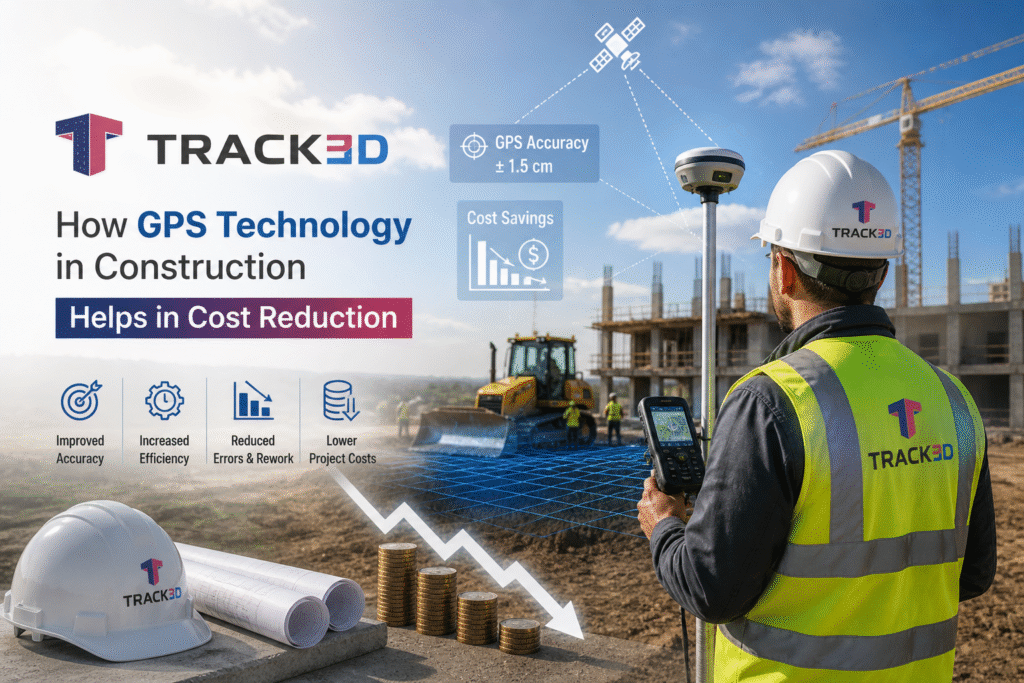
GPS tracking cost reduction in construction is basically the use of real-time satellite location data and telematics to give construction teams live visibility into equipment, workers, and assets. And when you can actually see what is happening on your site in near real time, it becomes much easier to stop cost leaks before they get out of control.
Let’s be honest. Most cost overruns do not come from one giant mistake. They come from small issues that repeat every day. A machine sits idle too long. A truck makes extra runs. A crew clocks in early. A breakdown happens that could have been avoided.
None of these things look “serious” on their own. But add them up over 10 weeks, and suddenly your margin is gone. That is where GPS tracking earns its place. It gives you real numbers instead of guesswork.
Key Takeaways
- GPS tracking gives foremen and project managers live visibility into equipment and assets across the jobsite.
- Idle time, fuel waste, time theft, and reactive maintenance are the biggest cost leaks GPS helps close.
- Construction firms using GPS fleet management report 15% to 25% reductions in total operational costs.
- Equipment theft costs the US construction industry up to $1 billion every year.
- GPS becomes even more powerful when combined with construction progress monitoring.
Why Construction Sites Keep Bleeding Money (Even on “Good” Projects)
You’ve probably seen this exact situation. It’s early morning. The excavator is sitting where it was yesterday. The operator is waiting because nobody has confirmed where the next trench starts. The dump truck is stuck at the gate. And the timecard already shows a full shift for someone who left early. This isn’t always “bad management.” Most of the time, it’s a visibility gap.
According to McKinsey, the construction industry loses more than $1.6 trillion annually as a result of inefficient operations. This loss comes in many forms: unnecessary delays, lack of organization, down-time, etc. That’s precisely the problem. And the most infuriating part is that project failures don’t happen because of laziness or incompetence. Rather, the problem is that nobody knows what’s going on right now.
This is where GPS tracking comes in handy. Of course, it’s not a productivity enhancer as such. But it does make any waste more obvious.
What Is GPS Tracking in Construction?
In construction, GPS tracking involves the use of telematics devices fitted on the construction machinery and vehicles. These tracking systems provide real-time locations and, based on the tracking systems used, can also track fuel consumption, engine hours, idle times, and fault codes.
All of that information flows into a dashboard that both the site team and the office team can access. And that is the key advantage. Instead of relying on calls, paper logs, or “I think it’s over there,” you get an actual live picture of where assets are and how they are being used.
Unlike basic tracking used in logistics fleets, construction GPS systems are designed for heavy equipment. They are built to handle rough environments and include features like geofencing, utilization reporting, and maintenance triggers. So you are not just tracking location. You are tracking behavior.
Why GPS Tracking Has Become a Real Cost-Saving Tool for Contractors
Construction is not a high-margin industry. Most contractors already know that. On many projects, a 3% to 5% overrun can wipe out profit completely. The frustrating part is that these overruns rarely come from one big disaster. They come from “death by a thousand cuts. So, basically, the cost leaks do not show up as obvious line items. They show up slowly, over weeks, as extra fuel, extra labor, and extra downtime.
GPS tracking helps reduce costs because it makes the following things more transparent to you:
- It shows how much time the equipment is actually working versus sitting idle.
- It highlights unnecessary travel and fuel burn.
- It supports accurate labor tracking.
- It also helps with compliance.
It also protects assets from theft or misuse. The National Insurance Crime Bureau reports construction theft losses between $300 million and $1 billion annually in the US. That is not a rare problem. It is a normal risk on many jobsites. Once you can measure these issues, you can control them.
How GPS Tracking Works on Site
GPS tracking systems are simple at their core. They rely on three basic pieces working together. First, a device is installed on the equipment or asset. It records location and operational data. That information is transmitted through cellular or satellite networks into a cloud platform. Then the project team views everything through a dashboard.
The real value comes from automation. For example, if a machine leaves the jobsite boundary after hours, the system can send an alert immediately. If equipment is idling for too long, the foreman can see it before the fuel is wasted. If a unit is due for service, the system can flag it automatically. Instead of discovering problems days later, you see them while they are happening. That alone changes how jobsites run.
How to Set Up GPS Tracking on Your Jobsite (Step by Step)
Step 1: Identify your biggest cost leaks
Before installing GPS across everything, you need to know what is costing you the most. Basically, you need clarity on what you are trying to fix. Is fuel your biggest issue? Is it labor accuracy? Is it equipment downtime? If you skip this step, you will end up buying tools you don’t actually use.
Step 2: Install the right device for each asset
Hardwired telematics units are usually used for heavy equipment since they can be connected directly to the engine system. For trailers, generators, or other unpowered assets, solar-powered trackers work well because they do not require wiring.
Step 3: Set geofences before you go live
This is where GPS becomes a real management tool. Geofencing lets you set virtual boundaries around the site, restricted areas, and storage zones. If something moves when it should not, you get an alert.
Step 4: Connect GPS data to payroll and project systems
This is where savings start showing up quickly. When time and location data connect to payroll, you reduce manual timesheet errors and stop “soft inflation” of labor costs.
Step 5: Brief the crew before switching it on
A lot of GPS systems fail because teams feel like they are being watched. But if the message is clear, that the system is meant to reduce waste and prevent blame games, adoption becomes much smoother. A short briefing before go-live makes a bigger difference than most managers expect.
4 Practical Ways GPS Tracking Cuts Construction Costs Fast
1. Eliminating Time Theft
Time theft is not always dramatic. It is usually small, daily slippage. The American Payroll Association estimates that up to 75% of companies experience losses tied to buddy punching and inaccurate timekeeping. Even a 15-minute discrepancy per worker per day adds up fast. On a 50-person crew, that can turn into thousands of dollars per month. GPS-linked time tracking helps because clock-ins can be tied to verified site location. That reduces payroll disputes and makes labor reporting more defensible.
2. Cutting Idle Time
Idle equipment is one of the most expensive “silent leaks” in construction. Studies show heavy equipment often idles around 30% to 40% of its operating time. And every idle hour burns fuel and adds wear without producing any work. GPS idle alerts help supervisors spot the problem in real time. On well-managed sites, idle rates can be reduced to below 15%. That is real money saved without changing the scope of work at all.
GPS data feeds directly into construction productivity tracking to expose where time is really lost.
3. Reducing Fuel Costs and Theft Risk
Fuel waste is not only theft. A lot of it comes from inefficient movement. When equipment is dispatched without clear coordination, machines end up traveling across the site unnecessarily. That burns fuel and burns time. With GPS data, supervisors can assign the nearest machine first, which often reduces fuel costs by 10% to 15% on larger fleets.
On the theft side, GPS tracking makes recovery much more likely. Many contractors report significantly higher recovery rates once trackers are installed. Some insurers also offer premium discounts when equipment is actively tracked.
These savings are a core part of improving operational efficiency in construction.
4. Supporting Preventative Maintenance
Breakdowns not only result in costly repairs, but also cause delays in work and disrupt scheduling processes. Reactive maintenance is an expensive process, costing many hundred dollars per hour for downtime, including emergency repairs and idle labor.
Telematics GPS technology provides an assist through monitoring engine hours and faults. Instead of waiting for failure, teams can service equipment before breakdown happens. Many contractors see reductions in unplanned downtime of up to 25% when preventive maintenance becomes data-driven.
Tools and Tech Used on Modern Jobsites
| Tool/Tech | What it does | Why it saves money |
| Hardwired telematics units | Connect to heavy equipment engines | Tracks hours, idle, fuel use, diagnostics |
| Solar-powered asset trackers | Tracks unpowered assets | Prevents loss and improves utilization |
| Fleet management software | Central dashboard and reports | Helps managers act faster |
| Geofencing | Virtual site boundaries | Prevents unauthorized movement |
| Idle time reporting | Tracks engine running without work | Reduces fuel waste |
| Maintenance scheduling tools | Tracks service intervals | Prevents breakdown downtime |
| BIM + progress monitoring integration | Links equipment data to project milestones | Aligns operational spend with actual progress |
What’s interesting is where the industry is heading next. GPS alone helps with operations, but when it is combined with progress monitoring and reality capture, you get a much fuller picture.
GPS becomes even more powerful alongside construction progress tracking that verifies what has actually been built.
Track3D’s VisualTrack adds the visual layer that shows what was actually built, not just where equipment sat.
So, instead of managing equipment data and build progress in separate systems, site teams get one connected view showing not just where assets are, but what has physically been built and whether it aligns with the programme.
Pros and Cons of GPS Tracking
| Pros | Cons |
| Real-time asset visibility | Upfront hardware and setup cost |
| Reduced fuel, labor, and downtime waste | Requires training and buy-in |
| Higher recovery rates for stolen assets | Older machines may lack diagnostics |
| Stronger compliance and audit trail | Value depends on acting on the data |
GPS is not magic. But it is extremely useful when the data is reviewed consistently.
When GPS Tracking Might Not Be The Best Approach
GPS tracking may not be the best solution for every contractor out there. There are small projects where the usage of only one or two machines would hardly pay off. Also, there are remote projects where connectivity is not optimal and near real-time tracking suffers because of it. Finally, if no one ever looks into alerts and reports, then the whole idea becomes quite costly “data collection.” The problem that usually kills GPS solutions is poor execution.
If you have no experience with GPS, then the right way to begin would be starting from high-cost equipment like excavators, loaders, and trucks. If you manage to save on those, you can expand.
Bottom Line
Every idle machine, every unnecessary fuel burn, every missing asset, and every padded timesheet eats profit faster than most project teams realize.
GPS tracking cost reduction in construction is not about controlling people. It is about controlling waste. It gives managers the kind of visibility that construction sites have always needed but rarely had. And when GPS data is combined with progress monitoring, teams get the full picture: not just where assets are, but whether the project is actually moving forward the way the programme says it is.
Want to know more on this? Track3D helps construction teams take this further by connecting equipment location, worker activity, and real-time build progress into one view.
GPS for Equipment & Fleet Tracking
Beyond labor, GPS equipment and asset tracking is where a lot of the hard-dollar savings show up. Tagging excavators, generators, trailers, and small tools with GPS trackers tells you where every asset is, whether it is running or idle, and whether it has left the site without authorization. That visibility cuts theft, reduces the “ghost” rentals of equipment nobody can locate, and helps you move assets to where they are actually needed instead of buying or renting duplicates.
GPS Tracking ROI: A Quick Estimate
You can sanity-check the payback in a couple of minutes. Multiply your crew size by the minutes of paid-but-unworked time you eliminate each day, then by your loaded labor rate and working days. For example: 20 workers × 20 minutes/day recovered × $45/hr loaded rate × 250 days ≈ $75,000/year — before you even count fuel, idle-time, and theft savings. Compare that against the per-device subscription cost, and most jobsites see payback in the first few months.
Because labor is usually the single largest line item, these recovered minutes add up fast — see what actually drives labor costs in construction for the bigger picture.
GPS Tracking & Timesheet Fraud
Timesheet fraud — buddy punching, rounded-up hours, and clock-ins from the parking lot — quietly inflates payroll on many sites. GPS-based, geofenced time capture ties each clock-in to an actual location, so workers are only paid for time genuinely on site. That single control often pays for a GPS program on its own, while also giving you defensible records if hours are ever disputed.
FAQ’s
Q1. How does GPS tracking help with cost reduction in construction?
Ans. GPS allows site management teams to have near real-time tracking of equipment location, downtime, fuel consumption, and labor hours. This allows inefficiencies to be dealt with right away, before seeing them in the cost report at the end of the month.
Q2. What cost reduction strategies in the construction industry does GPS support?
Ans. It supports better labor tracking, reduced idle time, fuel savings, theft prevention, preventive maintenance scheduling, and improved compliance documentation.
Q3. How quickly can contractors expect ROI from GPS tracking?
Ans. Most mid-size contractors see a measurable return within 3 to 6 months. Payroll and fuel savings typically show up first, while maintenance savings grow over time.
Q4. Does GPS work for equipment without a diagnostic port?
Ans. Yes. Solar-powered trackers can be installed on unpowered assets like trailers or generators. They still provide location and movement tracking without engine connection.
Q5. How does GPS data connect to construction progress monitoring?
Ans. When GPS is combined with reality capture and AI-driven progress monitoring, teams can link operational activity to actual site progress. That means managers see not just where equipment is, but whether work is truly moving in line with the programme.
Q. What are the challenges or limits of GPS tracking?
Ans. GPS tracking has real limits: signal can drop indoors, in deep excavations, or in dense urban canyons; hardware and subscriptions add ongoing cost; and rollout can raise privacy or trust concerns with crews if it is not communicated well. It also tells you where an asset is, not the quality of the work being done. Treat GPS as one layer of jobsite visibility — pair it with clear crew communication and other progress data for the full picture.