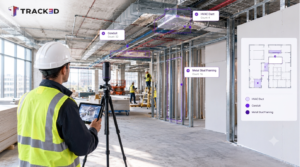

A crucial part of managing a worksite is capturing visuals, like images, videos, and walkthroughs. What most people tend to overlook is that capturing them is the easy part; what matters most is how you manage and utilise them later. Scrolling through numerous folders called “misc” or trying to remember the date and progress for a task is only going to add to your workload. Your best shot at moving past this chaos is quality construction visual documentation. Continue reading to find out how you can integrate this into your work and how it will transform your project management skills.
Key Points
- Time-stamped photos are your strongest defense when disagreements or claims come up on site
- Photos without context, like date, location, and trade, are just noise, not proof
- Construction visual documentation keeps the contractor and project manager and subcontractors and owner on the same page without everyone having to visit the construction site
- Structured visuals tied to drawings, RFIs, and punch lists speed up decisions and protect your project
- Without proper structure and consistency, your site photos are just extra noise, not real documentation
How Construction Visual Documentation Works?
Think about the weekly progress walk your superintendent takes across the site. They take photos of the poured concrete and the mechanical electrical and plumbing work done on each floor and the scaffolding set up for the next phase. These photos are only useful if they are taken the right way and stored in the right place and connected to the rest of the construction project data.
That is how construction visual documentation works.
- Before capturing any videos or photos, the construction team needs to plan what needs to be documented before any crew steps on site with a camera.
- Then on a regular schedule, start capturing in consistent angles, focusing on the elements that matter to progress, safety, and quality.
- Then upload everything into one cloud-based location and tag by date and area and trade. From there the visuals are linked directly to drawings and requests for information and punch-list items so nothing exists in isolation.
- That way the general contractor and project manager and subcontractors and owner can pull the visual record up from anywhere and see exactly what is happening on the construction site at any given moment.
What Is Construction Visual Documentation?
Construction visual documentation is the planned, consistent capture of photos, videos, 360° walkthroughs, and time-lapse footage that shows what is actually happening on your construction site over time.
Here is the difference. Drawings tell you what is supposed to be built. Visual documentation tells you what was actually built, when it happened, and who was on the construction site that day.
The right things get captured at the right time. Everything gets stored in one place. And it all connects back to your drawings, schedules, and project records so your whole team can pull it up when it matters most. That is what separates real visual documentation from just snapping photos on your phone during a safety walk.
Best Practices for Construction Visual Documentation
Most construction sites take photos. Not all of them take the right photos in the right way at the right time. That is the difference between visual documentation that actually protects your project and a camera roll full of images nobody can use.
Here are a few practices that make the real difference.
- Plan before you capture: Before anyone walks the Construction Site with a camera decide what needs to be documented. This includes Pre-construction conditions, milestone shots, MEP rough-ins before they get covered up and safety setups before an inspection. Build this into your schedule so nothing gets missed..
- Keep it consistent: Same angles, same areas, same day every week. When your superintendent captures photos the same way every time, your PM can actually compare this week against last week and spot what changed. Random photos from random angles tell you nothing.
- Store everything in one central place: Not on someone’s phone. Not in a shared drive that three people have access to. A cloud-based platform where your GC, PM, subs, and owner can all pull up what they need, whenever they need it. Tag everything by date, area, floor, and trade so it is searchable when it matters.
- Connect your visuals to your project data: Photos linked to drawings, RFIs, and punch lists are far more powerful than photos sitting alone in a folder. When something comes up, you want to see the plan and the actual site condition side by side, not hunt through two different systems.
- Make it part of your routine: Tie visual documentation to your weekly progress walk, your safety walk, your coordination meetings. When it becomes part of what you already do, it stops feeling like extra work and starts feeling like a normal part of running the construction site.
- Train your field teams: Good tools only go far for Construction Visual Documentation. Your superintendents and field crews need to know what a useful photo looks like for the Construction Project. This includes framing, no shadows blocking the view labels visible in the shot.
The Hidden Costs of Messy Visual Documentation
Before we jump into the ‘how’, let’s look at the ‘why’. If your visual documentation is all over the place, you’re basically looking at:
- Wasted time hunting for the right image.
- Numerous disputes over who installed what and when.
- Incomplete records during closeout.
This kind of fallacy arises because we often look at images and videos as an afterthought. One member of the crew will take a couple of pictures on their phone, upload them to a folder or to the group, and it’s almost always left at that. But without proper structure and consistency, these images are acting as extra noise or fluff that comes in the way of actual documentation, rather than providing any proof.
Why Is Context So Important?
Whenever we look at a picture in any situation, the most important piece of information we need is context. Not just ‘why am I looking at this?’ but also ‘what does this imply?’ and more. The same goes for construction visual documentation. Just images are no longer enough. What you need is CONTEXT! Here’s what info it should ideally cover:
- What am I exactly looking at?
- Where is this on the jobsite?
- Is this before or after an install?
- Who took the picture?
- What is the purpose behind this documentation?
Without the answers to these questions, your images are just random pictures of the jobsite. On the other hand, optimal construction visual documentation can become a powerful tool of project management by:
- Protecting against disputes: visual proof and time-stamped pictures are the best defence you can create to back up your argument.
- Keeping everyone on the same page: every single stakeholder can’t possibly be present at the worksite every day. By creating good construction photo documentation, you’re ensuring that everyone is aligned on the progress and goals.
- Speeding up reporting: what’s better than fully-annotated, plan-linked visual data that speaks for itself? At this point, you barely need to spend any time on writing a report.
Elevating overall quality control: well-maintained documentation (both visual and written) means you can spot errors quickly, fix risky operations, and track progress much better.
What Ideal Construction Visual Documentation Looks Like
To summarise, great visual documentation isn’t just capturing pictures, but making them useful. Your pictures should be more than raw images – they should be trusted records. Here are some of the essential points to keep in mind while organizing your visuals:
- Photos should be clearly mapped with both time and location. This allows the team to focus on specific rooms, systems, or phases with confidence.
- Pay attention to useful metadata, or context, like floor, room, trade, and activity.
- Images should be structured. You should be able to see the progression of a wall, room, or system over time.
- Visuals should be organized by trade or phase. You should not have to sift through HVAC to find the right images.
Visual documentation should seamlessly fit in with other data and notes. Your ideal aim should be ensuring that anyone who reads the notes does not have to pause to figure out what the pictures indicate.
You know what ideal photo documentation looks like. But do you know how to get started and set the foundation? If not, you can always start with existing site conditions. Capture the initial state of the worksite. Some of the things you must record include pavement integrity and surface conditions, pre-existing structural deficiencies, drainage systems, landscape features, significant environmental factors, adjacent area up to 15 feet, utility locations, and access points to the site.
Real Use Cases Where Visual Documentation Is Useful
Visual documentation is most useful when it is directly tied to real decisions. Here are a few ways teams use visual documentation beyond record-keeping:
- Change order justification: Reference past conditions to support added scope.
- Dispute resolution: Use time-stamped photos as proof in case of any altercation.
- Punch list closeout: Mark off issues visually, with before-and-after evidence.
- Schedule tracking: Visuals can help you compare planned vs actual timelines.
- Owner updates: Share milestone images with all stakeholders to improve transparency and confidence.
How Construction Visual Documentation Helps Every Project Team?
Construction sites are a team effort. Hence, when visuals are captured and organized efficiently, it benefits all members of the team. When construction visual documentation is treated as a must-have, the superintendents can use it to verify work and track progress. Similarly, project managers or other in-charges can link images to pay or change orders.
VDC coordinators can validate install vs design conditions. Moreover, the owners and investors can observe real proof of progress and quality. Lastly, trade partners can resolve scope questions faster with image references. And these aren’t even all! There are many other hidden ways in which construction photo documentation can bring a positive change to your project management.
Conclusion
As construction becomes increasingly data-driven, the value of optimal construction visual documentation also increases. As the project manager or superintendent, you must ensure that your records have clean, structured, and accessible photos. Add them with your drawings, annotations, specs, schedules, and daily logs. Treat photo documentation with the same importance as daily record-keeping. By investing a little more effort, you’re building an information layer that supports faster decisions, better documentation, and stronger accountability. In the long run, it will pay off!gery, you’re building an information layer that supports faster decisions, better documentation, and stronger accountability.