Did you know that about 20% of workplace fatalities occur in the construction industry? That makes 1 in 5 deaths as per the U.S. Bureau of Labor Statistics. You can say that construction is quite a notorious industry in terms of worker safety. And falls remain the main reason for deadly accidents. At the same time, the sector is actively adopting technologies to decrease this risk.
This approach affects the role of safety officers significantly. With cameras, sensors, drones, and AI-powered software, contractors get additional tools to see the current situation on the worksite.
AI construction safety does not mean automating the safety management process and eliminating employees. The primary purpose is to assist safety teams in identifying risks, documenting, and making effective decisions at an early stage of the process.
Curious how? Read on to find out!
Key Takeaways
- AI safety tools use cameras, sensors, and software to spot risks in real time.
- They help teams catch PPE issues, blocked areas, and unsafe equipment activity earlier.
- Early hazard detection matters because falls remain construction’s biggest safety risk.
- Construction safety software cuts down time spent on inspections and reporting.
- AI supports safety teams by improving visibility across the site.
- Results depend on adoption, site conditions, and strong safety processes.
- Platforms like Track3D create a reliable visual record of changing jobsite conditions.
The Growing Role of AI in Construction Safety
Construction sites change by the hour. One crew may be pouring concrete while another installs steel overhead. Forklifts move materials across active work zones. Temporary barriers appear and disappear. In that environment, a missed safety issue can quickly become a serious problem.
Traditionally, safety was based on inspections, paper, and supervision of the worksite by experienced managers. All that is still important. However, there is an issue of scale. Projects get bigger, timeframes become more limited, and workers usually move around from project to project. There is no way for one safety manager to keep an eye on everything on the worksite.
That is why construction companies are becoming interested in AI construction safety solutions. Rather than inspecting once in a while, such solutions allow constant monitoring through cameras, wearables, drones, and software. They look for patterns that may signal danger and alert teams before a minor issue becomes a serious incident.
Research from the Construction Industry Institute has identified safety monitoring and training as two of the areas where AI is already delivering practical value on active projects. The appeal is simple. AI does not get distracted, tired, or pulled into meetings. It keeps watching while crews focus on getting the job done.
That does not mean technology replaces human judgment. An experienced superintendent still understands context better than any software ever will. AI simply gives that person more information and broader visibility across the site.
How AI Construction Safety Works on a Modern Jobsite
Most AI safety systems combine three technologies:
| Technology | What It Does | Common Use Cases |
| Computer vision | Analyzes live video feeds | PPE checks, hazard detection |
| Wearable sensors | Tracks worker conditions | Fall detection, fatigue monitoring |
| AI software | Processes and organizes data | Reporting, analytics, risk prediction |
All these work together to form a steady stream of safety information. The flowchart below shows an example process.
- Cameras and sensors collect site data
- AI analyzes that data in real time
- The system identifies unsafe conditions
- Supervisors receive alerts
- Teams respond before incidents escalate
Unlike traditional reporting, the process happens continuously throughout the workday.
AI-Powered Computer Vision Is Changing Jobsite Safety Monitoring
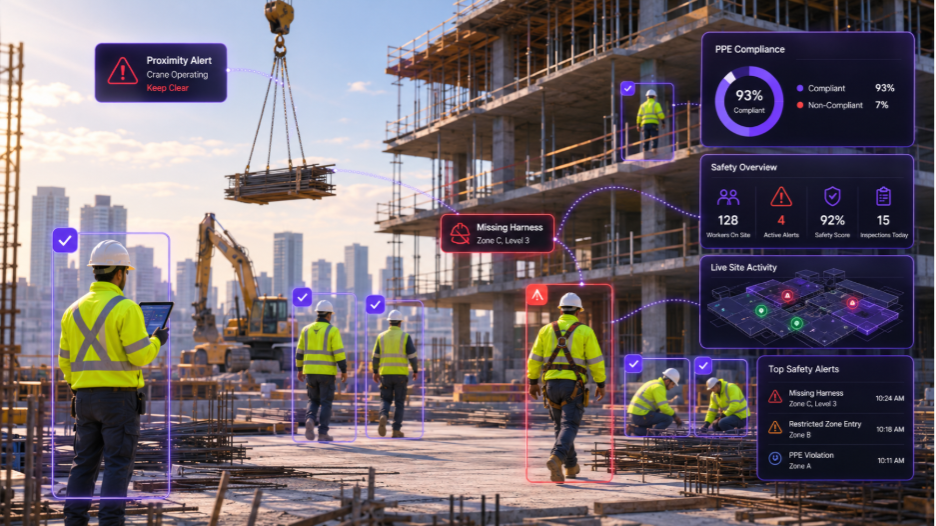
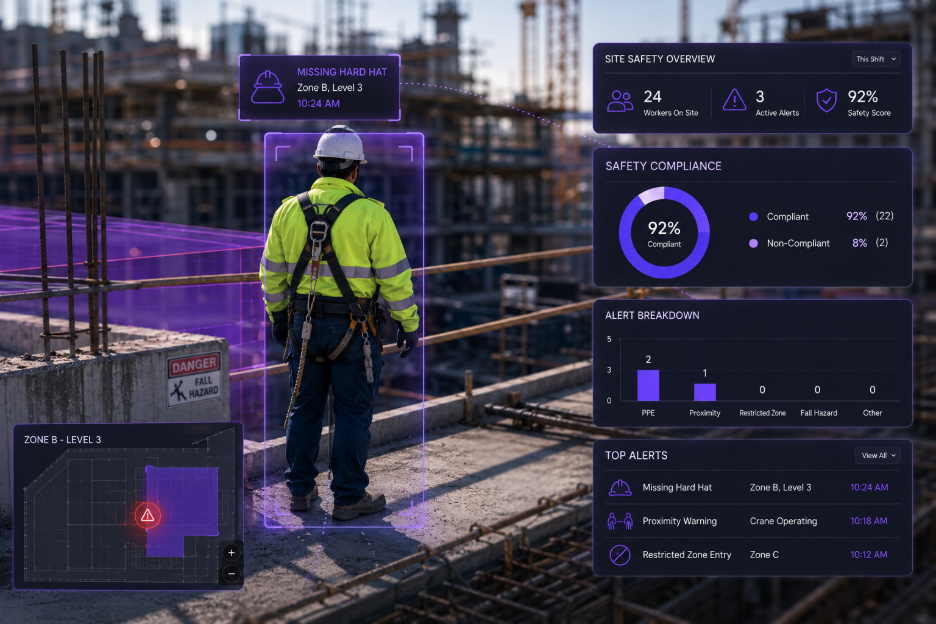
Computer vision safety construction systems are often the first AI tools contractors adopt. These systems use cameras combined with machine-learning software to analyze video footage automatically.
The software is trained to recognize:
- Hard hats and safety vests
- Fall-protection equipment
- Workers entering restricted areas
- Unsafe distances from equipment
- Blocked exits
- Open edges and trench hazards
- Vehicle and pedestrian conflicts
How computer vision safety monitoring works
| Step | What Happens |
| Video capture | Cameras monitor active work areas |
| Image analysis | AI scans footage frame by frame |
| Risk detection | The system identifies potential hazards |
| Alert generation | Supervisors receive notifications |
| Follow-up | Teams investigate and correct issues |
For instance, when an employee enters the hazardous area without wearing PPE, the application can give an alarm right away. Some contractors are already seeing measurable results.
According to safety technology company CompScience, one contractor reduced workplace injuries significantly after implementing AI-based monitoring across multiple sites.
Results vary from project to project, of course. Large commercial projects often benefit the most because they have stable camera coverage and consistent workflows. Smaller residential projects may not see the same return, especially where crews move quickly between locations.
Computer vision systems tend to work best when:
- Camera coverage is strong
- Lighting is consistent
- Internet connectivity is reliable
- The site layout is relatively open
Primary Ways AI Improves Construction Safety
Computer vision gets most of the attention, but AI affects safety in several different ways.
1. PPE compliance monitoring
Safety managers no longer need to manually check every worker for hard hats, harnesses, goggles, or reflective gear. AI systems automatically flag missing equipment.
2. Restricted-zone detection
Construction sites contain hazardous areas:
- Crane swing zones
- Excavations
- Electrical rooms
- Demolition areas
- Heavy equipment routes
AI jobsite safety monitoring tools notify supervisors when workers enter those zones.
3. Fall prevention
Falls remain OSHA’s leading cause of construction fatalities. Catching problems early can prevent serious injuries. AI systems monitor guardrail installation, harness usage, roof access points, scaffolding conditions and open edges.
4. Heavy equipment monitoring
Collisions between workers and machinery remain a major risk. AI aids in tracking vehicle motion, footfall, blind spots, equipment proximity, and environment monitoring.
There are certain AI software that work alongside sensors to record temperature, dust, air quality, gas exposure, and sound. They are extremely useful in tunnels and confined spaces as well as industrial applications.
How The Technology Adds Another Layer of Protection
Safety Predictive Analytics
Companies have years’ worth of accident reports and inspection records collected. The problem lies in analyzing all the data. AI technology can help understand the past data and find patterns humans would overlook. For instance, computer software will be able to figure out that:
- Certain activities result in more near-misses.
- Certain weather results in higher risks.
- Certain shifts see more accidents.
- Certain project phases lead to accidents.
Preventive actions can be taken ahead of time rather than after an accident occurs.
Drones and Robot Inspections
Inspections sometimes put people into risky situations.Inspections on roofs, structurally unsound areas, or deep excavations require people to enter those areas traditionally. Drones and robots alleviate that risk.
They can:
- Inspect elevated areas
- Capture imagery from hazardous zones
- Document site conditions
- Monitor remote infrastructure projects
- Support emergency assessments
For large infrastructure projects, this saves both time and risk.
Reality Capture and Digital Site Records
One of the quieter changes happening in construction safety is continuous site documentation.
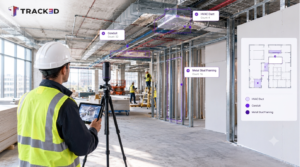
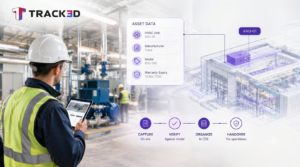
The reality capture software uses 360 degree cameras, laser scanning devices, aerial photography with drones and mobile mapping. All these technologies help to form a visual timeline of the project. It may not identify hazards automatically, but it gives teams a record of what the site looked like at any given time.
Track3D’s Reality Intelligence platform focuses heavily on this type of documentation. For safety teams, that means fewer arguments about what happened, where it happened, and when conditions changed.
AI Is Changing Safety Inspections and Reporting
Documentation is one of the least liked parts of construction safety. The superintendents would spend hours of their week filling out reports, taking photographs, keeping track of inspection logs and taking notes on corrective measures and audits.
Construction safety software dramatically reduces that workload. The workflow often looks like this:
- A supervisor records observations on a tablet
- Photos and videos are uploaded automatically
- AI organizes the information
- The software generates reports
- Recurring issues are flagged
| Traditional Process | AI-Assisted Process |
| Manual photo sorting | Automatic image tagging |
| Handwritten notes | Digital records |
| Hours of reporting | Minutes of review |
| Separate systems | Centralized documentation |
| Reactive follow-up | Faster issue tracking |
According to industry research from Datagrid, automation tools are helping contractors save several hours each week on reporting tasks. The biggest advantage is not simply speed. It is consistency. When reports are consistent every time, the patterns will be more easily detectable. This makes it possible for safety personnel to recognize any repeated incidents.
Role of AI in Worker Training and Safety Protocol Adherence
AI-Powered Simulations
Safety training using the traditional approach involves the use of slides, manuals, and classroom training sessions. However, the issue with this is that learning takes place through practice. With AI-driven simulations and virtual reality, learners can be immersed in practical environments. They can learn to recognize:
- Unsafe scaffolding
- Fall hazards
- Damaged equipment
- Improper rigging
- Confined-space risks
The advantage is obvious. Mistakes made during training do not put anyone in danger.
Personalized Learning
Not every worker faces the same risks. AI training platforms can adjust lessons based on job role, experience level, previous incidents, certification records and past safety violations. A worker with repeated fall-protection issues may receive additional training in that area, while another employee focuses on equipment safety.
Real-Time Safety Reminders
Wearables are beginning to play a role in behavior as well. Some systems provide:
- Vibration alerts
- Audio warnings
- Zone notifications
- Fatigue reminders
Workers receive immediate feedback instead of waiting for the next toolbox talk. That small intervention can change behavior much faster than another email or poster. However, training alone is not enough to complete the equation. The contractors should also be aware of the effectiveness of the technologies on their safety performance.
Let’s understand how. Keep reading!
How Contractors Measure Whether AI Safety Tools Are Working
Buying software is easy. Proving that it improves safety is much harder. The most successful companies establish clear benchmarks before rolling out new systems. Common metrics include:
| Metric | What It Measures |
| Near-miss reports | Potential incidents caught early |
| PPE compliance | Safety gear usage |
| Inspection completion | Documentation consistency |
| Incident frequency | Number of accidents |
| Response time | Speed of corrective action |
| Lost-time injuries | Serious safety outcomes |
Without those baseline numbers, it becomes difficult to know whether technology is creating real value. That is why many safety leaders start with one use case rather than deploying multiple systems at once. With these metrics, a contractor might ask:
- Are fewer hazards being missed?
- Are reports being completed faster?
- Has PPE compliance improved?
- Are crews responding to issues more quickly?
Benefits and Challenges of AI in Construction Safety
Construction sites generate a huge amount of information every day, but until recently, most of it just disappeared once the shift ended. That’s starting to change. AI now lets safety teams track patterns, catch problems sooner, and build a much clearer picture of what’s actually happening on site. The benefits show up in practical ways:
| Benefit | Impact on the Jobsite |
| Faster hazard detection | Issues get flagged in real time instead of turning up hours later during a routine check. |
| Wider coverage | One safety manager can effectively watch several areas without physically being in all of them. |
| Less admin work | Inspections, photos, and incident logs get organized automatically. |
| Easier record access | Site history is easy to pull up later, which matters when questions come up after the fact. |
| Early problem-catching | Small issues get handled before they turn into injuries, delays, or rework. |
| More realistic training | Workers learn from actual site footage instead of generic examples. |
One underrated advantage is consistency. Manual inspections depend on who’s available and where they happen to be standing at a given moment. AI adds another steady layer of attention that doesn’t waver throughout the day.
There are certain limitations, however:
- Requires proper camera positioning and an internet connection.
- Dust, reflections, and weather conditions may hinder accuracy.
- Continuous surveillance may make some workers uncomfortable.
- Need for proper policy concerning privacy.
- Still needs human interpretation and intervention.
What Contractors Should Know Before Investing in AI Safety Tools
Projects do not always have to incorporate the same level of technology. Contractors need to ask some questions before implementing AI safety monitoring on their projects.
| Question | Why It Matters |
| What safety problem are we trying to solve? | Technology works best when tied to a specific challenge. |
| Does the site have reliable connectivity? | Most systems depend on cameras and real-time data transfer. |
| Who will review alerts and reports? | AI identifies risks, but people still make decisions. |
| How will workers be trained? | Adoption determines whether the system succeeds. |
| What are the privacy policies? | Clear rules help build trust among crews. |
Many contractors make the mistake of buying technology first and figuring out the process later. The teams that see the strongest return usually start with a clear goal, whether that means reducing fall incidents, improving inspections, or strengthening documentation.
How AI Supports OSHA Compliance and Safety Audits
One overlooked benefit of AI construction safety systems is how they simplify compliance. Preparing for audits often requires teams to collect inspection logs, safety observations, incident records, training documentation, photos and corrective actions.
When those records are spread across emails, notebooks, and spreadsheets, audits become stressful. AI-powered construction safety software centralizes that information. Instead of rebuilding the timeline after an incident, teams can access:
| Compliance Task | How AI Helps |
| OSHA inspections | Faster access to records |
| Safety audits | Organized documentation |
| Incident reviews | Time-stamped evidence |
| Insurance claims | Clear site history |
For large contractors managing multiple projects, this visibility can significantly reduce administrative work.
Future Prospects and Ethical Considerations of AI Adoption in Construction Safety
AI Will Become More Common on Jobsites
The application of AI for construction site safety is still developing, but its implementation is surely gaining pace. As stated in Deloitte’s 2025 Engineering and Construction Industry Outlook, the contractors are planning to invest further in digital solutions that will help enhance the level of safety, productivity, and visibility on their projects.
In the upcoming years, it can be expected that there will be better interconnectivity between the cameras, wearables, drones, and project management platforms. Rather than dealing with different software solutions, safety officers will have a better understanding of what is going on at the construction site.
Trust and Privacy Still Matter
Technology by itself is not enough to make the jobsite any safer. Employees must be aware of which data is being gathered, how it is going to be used, and who can get access to it.
This becomes particularly relevant with AI jobsite safety monitoring technologies. Businesses that clearly explain their policies regarding data use are much more likely to be accepted by the crew than those that suddenly bring new technology into play.
But even advanced AI tools face certain limitations. Dust particles, insufficient lighting conditions, unfavorable weather and crowded workplaces could influence the results of inspection negatively. Cameras may fail to detect the hazard, while sometimes software generates alerts related to non-dangerous situations.
That is why the use of AI should be considered as a complementary approach but not as a substitute of human experience and knowledge.
See How Reality Intelligence Fits Into a Safer Jobsite
Construction sites will always involve risk. Cranes will continue moving overhead. Crews will keep working in difficult conditions. Schedules will remain tight. What is changing is the amount of information available to safety teams.
With the help of AI-assisted surveillance, automated reporting, and reality capture software, contractors have been getting a more accurate picture of what’s going on at their sites each day. Track3D’s Reality Intelligence combines drone data, 360 imagery, and site documents all in one place. This means that less will be hidden from safety managers, project teams, and owners.
Want to know more about Reality Intelligence and how it will work for you? Connect with us at Track3D and learn more about how AI-assisted documentation can benefit your projects.
FAQs
Q1: Does AI replace safety managers on construction sites?
A: No. The purpose of AI is to complement the efforts of the safety team. Technology allows for multiple camera and sensor coverage and identification of risk factors but not without human intervention. Managers conduct investigations based on alerts and make further decisions about the safety protocol compliance of workers.
Q2: Is AI construction safety software expensive to set up?
A: It depends on the complexity of the project as well as the number of devices used. A solution using several cameras will be much cheaper than a system integrating wearables, drones, and real-time analytics. Usually, a lot of companies opt to begin with a limited number of devices before starting to receive benefits from their use.
Q3: What data does AI jobsite safety monitoring need to get started?
A: The majority of solutions utilize some kinds of inputs – camera footage, sensor data, jobsite layout, safety protocol (e.g., PPE policy or no-go zones). With time, the software learns from the data gathered at jobsites.