Construction site activities are almost always in motion and slow down rarely. Crews rotate in and out, different trades overlap, and tasks change quickly.
But usually, amid this hustle and bustle, some details get overlooked.
Two persons attempting to verify if the installation was done yesterday or not. One is browsing through his images on the phone, the other one is taking a stroll to the site.
In the traditional work methods, this is also more or less normal. Details slip through the cracks. Installations get buried. And when the team needs reliable proof, it is not always available.
This is just the ultimate drawback of having information scattered and mixed up.
But why does it happen? Well, due to the incessant activity on the jobsite.
This is where reality capture technology made its way to the construction site. It provides the field crews with an accurate daily record of progress. That too, without anyone getting slowed down.
Photogrammetry is one of the key instruments used in reality capturing. It has now come to the forefront of progress monitoring.
Want to know more about it? Read on!
What is Photogrammetry in Construction?
The concept of photogrammetry is quite simple. It measures distance by capturing multiple images of a location and processing them.
Here’s how-
→ You capture photographs (with a 360° camera, drone, or just your smartphone)
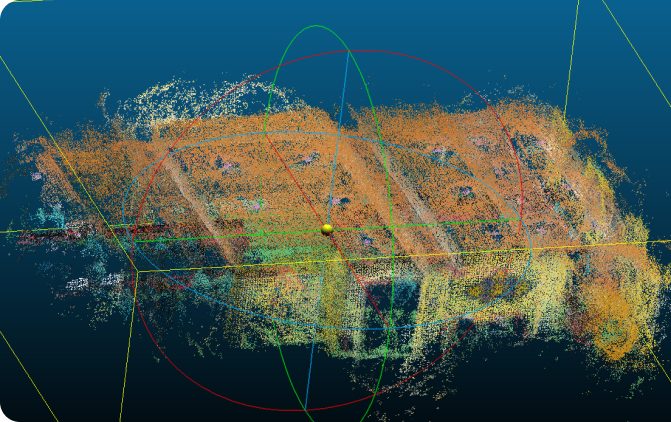
→ Put them into a software application and a 3D model appears
→ From this model, you are able to take measurements.
To put it differently, photogrammetry allows you to record the site in the same way you normally do. But, in addition, you will have reliable measurements.
How does it actually work?
Photogrammetry relies on a method known as triangulation. In this, you take at least two different angles to pinpoint the position of objects.
This is the case when two human eyes are used, one for each viewpoint. Eye closing will obstruct the distance perception between the objects. But with both eyes, the perception of depth is very clear.
Similarly, the photogrammetry technique is based on the same principle. But in this case, photos are used instead of the human eye’s sight. The process is outlined in several steps as follows:
- The operator will capture a variety of photographs as they go around the project area.
- The program analyses each picture one by one and crosses the dots that appear in more than one image.
- It compares the changes in the position of these points in the various images.
Then, it finally measures the distance, scales and verticals.
Consequently, a virtual 3D map of the space is formed which is reflective of the actual area around the site. The task does not require any special abilities. All you need is to have enough photos that are clear and overlap.
5 KeyBenefits of Photogrammetry for Progress Monitoring
Photogrammetry is becoming popular as it addresses several issues in the construction site.
Measurement with Visual Proof
Traditional field measurements can sometimes be either hasty or not so reliable. The pictures, however, leave behind a recorded evidence which is visual and carries a time stamp on it.
This reduces the misunderstanding between trades as verifying work done becomes easier. It even helps the work teams in detecting problems before they cause rework.
Accelerated and More Convenient Progress Monitoring
The pace of the jobs is fast. The teams always need a method to confirm progress without causing any slowdown. Photogrammetry offers a quick and easy way to take progress documentation. This method is suitable for small, medium, and large projects. All that may be needed is a walk with the camera.
“Many contractors now use AI-powered construction progress tracking software alongside photogrammetry workflows to improve reporting accuracy and site visibility.”
Proper Documentation of Progress
The 3D model provides the team a quick and easy method to evaluate the work done vs. work supposed to be done. The owner knows it, the supervisor knows it, and the subcontractor knows it too. There are no technical barriers.
“Centralized construction visual documentation platforms also help teams organize photogrammetry captures, walkthroughs, and field imagery for long-term project records.”
A Digital Replication of the Site From Natural Pictures
Site teams can travel back in time to any particular stage of the construction once a 3D model is generated. They can find out the location of pipes, see the structure prior to drywall or if a region is ready for inspection.
All this can be done from a distance. Thus, no time is wasted in searching for the answers that are supposed to be easily accessible.
Assistance in Case of Damages, Safety, or Disputes
In case of
– bad weather
– equipment damage
– unforeseen problems
Photogrammetry lets the team capture conditions fast and accurately.
This often helps to avoid disputes because the exact situation is clear from the record.
“Construction project monitoring platforms help stakeholders validate site conditions using continuously updated visual evidence and field data.”
What Do Industry Numbers Tell Us About Progress Monitoring And Photogrammetry
Reworking in construction is still a primary source of cost. Rework usually makes up 5 to 10% of the total cost of projects as per PlanRadar and GEW-LLC. A few mistakes can lead to extensive delays and thus, very expensive corrections.
The transaction costs can be put down through better documentation. Reality capture is widely in demand in the construction industry.
The global construction reality capture market will reach $19.1 billion by 2033 with a compound annual growth rate of 13.7%. In addition, the market for photogrammetry software is speeding up. Why? Because the industry is moving to better documentation and site data.
Challenges to Keep in Mind
Indeed, photogrammetry is a strong technology. But accuracy can still be impacted by some factors:
- Poor lighting reduces the measurement accuracy.
- Images could get distorted on a windy day or a dusty one
- Low resolution cameras could lead to distorted images
- If the images are not overlapped adequately, it will be difficult to combine them
The majority of these problems can be solved. How? By consistent capture routines and casual awareness of the site environment.
Photogrammetry Vs. Laser Scanning in Construction
While photogrammetry is one way to create 3-dimensional models, LiDAR is an equally competent technology that aids in recreating accurate 3-D interpretations of sites, structures, and ongoing works. While both generate 3-D spatial data, their working principles differ significantly in terms of accuracy, cost, and utility. In present-day construction, one technology is not considered better than the other; it is more about what suits the builder’s requirements and which is economically viable.
In this section, we compare photogrammetry and LiDAR based on several aspects that affect modern construction.
Concept and Working Principle
Photogrammetry involves capturing overlapping images using drones or high-precision cameras to recreate construction models. Photogrammetry uses algorithms such as Structure-From-Motion (SFM) and Multi-View Stereo (MVS) to identify common points across images and measure their spatial separation.
LiDAR makes use of laser beams to recreate images with accurate measurements. It is an active sensing technology that emits laser pulses and measures the time taken for each pulse to return after striking a surface.
Accuracy & Reliability
Photogrammetry and LiDAR are both highly reliable technologies that produce accurate results. However, their use depends on what is required at a given time. While photogrammetry produces accurate, high-quality images, LiDAR produces visually less appealing, highly accurate images that highlight exact measurements.
LiDAR works well under variable lighting conditions, especially proving to be useful for dimly lit environments and terrains under vegetation, producing precise layouts that can be used later to visualise projects on a larger scale.
Photogrammetry relies on high-quality image capturing mechanisms to capture layouts accurately; hence, its performance is less reliable for sites with heavy foliage and poor lighting. Drone photogrammetry often delivers accuracy sufficient for progress monitoring, topographic updates, and volumetric calculations. However, it’s performance reduces when surfaces are reflective, of uneven texture, shadowed or obstructed.
Visual Quality
Photogrammetry produces highly visual layouts that can be used for client presentations, providing stakeholders with realistic depictions of projects. It captures the look of the construction site really well.
LiDAR makes use of a laser pulse to estimate measurements and make accurate predictions. Although the results are visually less stimulating, LiDAR images are more useful to executives who prepare 3-dimensional models.
Speed of Data Capture and Processing
In photogrammetry, capturing images is quicker with the help of drones and cameras. However, post-computational processing can be tedious and time-consuming.
LiDAR, on the other hand, undergoes less processing compared to photogrammetry.
Cost and Affordability
LiDAR is more expensive than photogrammetry. Photogrammetry does not require specialised equipment to capture images. The work can be done with the use of a DSLR or mirrorless camera or relatively accessible software platforms.
LiDAR systems require specialized sensors, calibration requirements, and processing workflows.
Application-Wise Suitability in Construction
As mentioned above, both photogrammetry and LiDAR deliver excellent results. However, their use is dependent on factors such as the nature of the terrain to be captured, affordability, purpose of the exercise, etc.
Photogrammetry is more suitable for:
- Progress photography and documentation.
- Drone-based site surveys.
- Stockpile volume calculations.
- Cut and fill visualisations.
- Facade and roof inspections.
- Marketing and stakeholder inspections.
LiDAR is more suitable for:
- Scan-to-BIM workflows
- As-built verification
- Structural deformation
- MEP coordination
Role in BIM and Digital Construction
With BIM and digital twins and smart construction taking precedence in this era, both technologies are relevant in helping capture accurate depictions of construction sites.
LiDAR is particularly powerful in Scan-to-BIM workflows, where accurate point clouds are used to compare site conditions with the design model. This is extremely useful in refurbishment, retrofitting, infrastructure upgrades, and high-precision coordination.
Photogrammetry also supports BIM integration, especially when combined with drone imagery for external envelope mapping and progress validation. However, converting photogrammetric outputs into structured BIM geometry may involve more interpretation where geometric clarity is weaker.
Integrating Photogrammetry With BIM (Building information Modelling) in Modern Construction
Integration of photogrammetry with BIM has become a game-changer in the construction industry. Fusing real-world site conditions with a project’s digital design environment is what today’s fast-paced construction industry needs. Photogrammetry provides updated visual and spatial data using orthomosaics, point clouds, and 3D models, which can be aligned with BIM platforms to provide a visual representation of the planned idea, vs. how it actually may end up looking.
Integrating both technologies enables builders to fulfill multiple goals, such as construction progress monitoring, estimation of quantity, quality assurance, deviation detection, and well-optimized project documentation.
It also enhances the coordination among the various stakeholders by providing a more realistic realisation of the project and site conditions. It also gives a clear picture of the project’s status, addressing various areas of concern.
“Many firms are also adopting AI in construction workflows to combine BIM data, photogrammetry, and automated site analysis for better decision-making.”
Where is Photogrammetry Is Headed
The future of construction documentation is moving toward real-time understanding of jobsite conditions.
As AI progresses, software will compare the photogrammetry models to design drawings to find missing or wrong works.
The teams will be able to spend less time searching for information. And more time on acting based on the clear insights.
Progress updates will be almost fully automated.
A simple visit to the site could help in the generation of-
→ a complete visual
→ measurable record of the day’s activity.
Bottom Line
Photogrammetry has evolved into an industry standard. It’s now an everyday practical tool used in continuous monitoring and jobsite documentation.
Construction is a complex process. Hundreds of people collaborate on thousands of moving parts. Photogrammetry eliminates confusion in the process. It allows the teams to work beyond speculations to accurate, measurable data.
What’s More?
-It works slong with the already existing tools
-It monitors the progress relability while minimizing the possiblity of rework.