
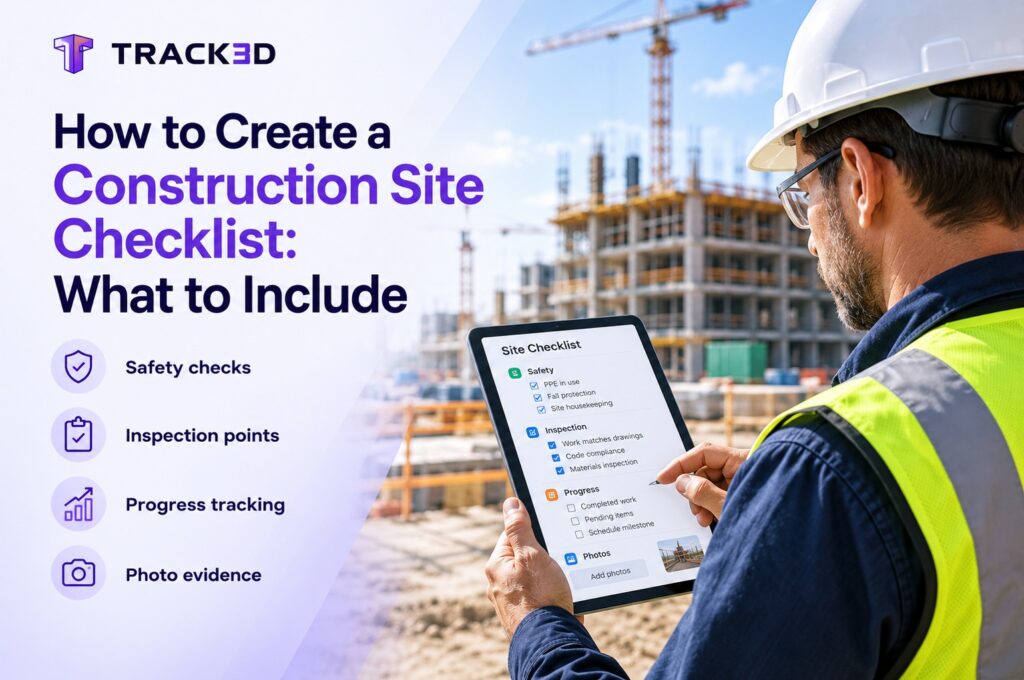
A construction site checklist is a written list of the safety items, inspection points, and progress checks that a team reviews during every site walk. It gives everyone who walks the site the same standard to work from. That way, important details don’t slip through between one visit and the next.
Key Takeaways
- Build your checklist around your site’s specific risks, since a generic template often misses hazards like deep excavations or live utilities.
- Organize the list into separate safety, inspection, and progress sections. This helps each person on the team quickly find the checks they’re responsible for.
- Assign every item a named owner and a set frequency, such as daily, weekly, or per milestone, so nothing falls between roles.
- Write each item as a specific yes/no condition, which makes results easy to verify and hard to misread.
- Support your findings with dated photos or 360 captures. They give you visual proof of site conditions when questions come up weeks or months later.
If you’re figuring out how to create a construction site checklist, start with the hazards and quality checks your site actually faces, not a list written for a different project. Give each item an owner and a schedule, and revisit the list at every new phase. Done this way, it becomes one of the most reliable tools in construction field management.
What Is a Construction Site Checklist?
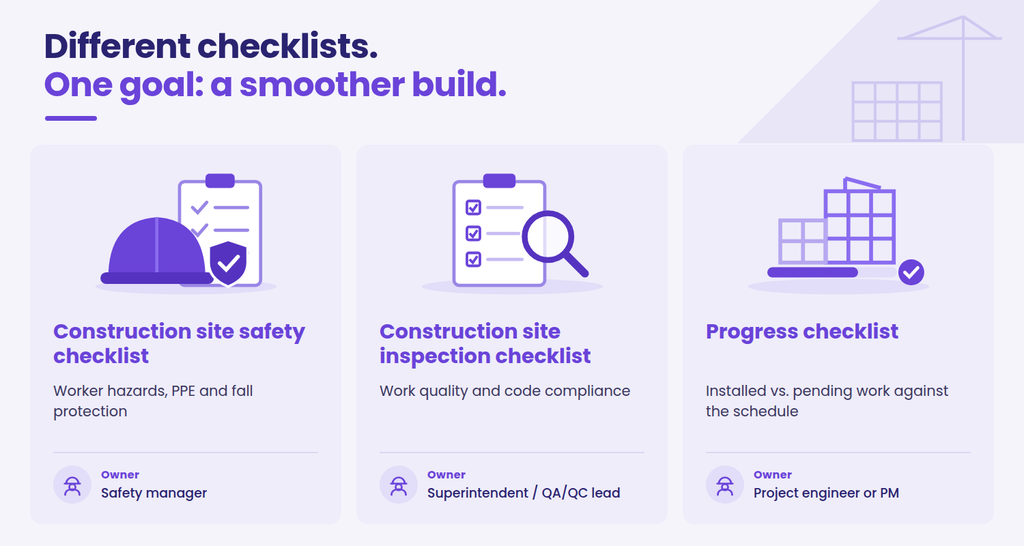
Superintendents, safety managers, and QA/QC leads rely on a checklist to run site walks the same way every time, instead of depending on what each person remembers to look at. Most teams work with three types, each with a different focus and owner:
| Checklist Type | What It Covers | Who Usually Owns It |
| Construction site safety checklist | Hazards to workers, including PPE, fall protection, housekeeping, equipment, and emergency access | Safety manager |
| Construction site inspection checklist | The quality of the work, including code compliance, materials, and whether installed work matches the drawings | Superintendent or QA/QC lead |
| Progress checklist | What has been installed, what is still pending, and how the work compares to schedule milestones | Project engineer or PM |
When it’s done well, a construction site checklist replaces a vague “looks fine to me” with a dated record that anyone on the project can review later.
Why Does a Construction Site Checklist Matter?
Memory doesn’t work well on a jobsite, because crews rotate often and conditions can change several times a day. A checklist gives every walk the same starting point, whoever is doing it.
A checklist also builds your project’s paper trail. If an owner asks about an issue three months later, a dated, signed checklist answers faster and more reliably than anyone’s recollection.
Safety is the third reason. OSHA identifies four hazards, known as the Focus Four, behind most construction deaths: falls, struck-by incidents, electrocution, and caught-in or caught-between incidents. A checklist built around them directs attention to where serious injuries are most likely.
How to Create a Construction Site Checklist in 6 Steps
- Review the scope and site conditions: Read the drawings, specifications, and site safety plan, and note anything that makes this site different, such as deep excavations or limited delivery access.
- List the risks for each phase of the project: Sitework, foundations, structure, MEP rough-in, and finishes each bring their own hazards and quality concerns. A checklist written for sitework won’t be much help once the crews are hanging drywall. Plan for each phase separately.
- Write each item as a yes/no check: “Guardrails installed on all open edges above 6 feet” gives the inspector a clear condition to confirm, while “Check fall protection” leaves too open to interpretation.
- Assign an owner and a frequency to every item: Some checks happen daily or before each shift, while others are weekly or tied to a milestone like a concrete pour. A name next to each line makes responsibility clear.
- Add space for evidence and follow-up: Leave room for site photos, notes, and corrective actions next to each item. When an item is marked “no,” the checklist should show what the problem was, who will fix it, and by when.
- Test the draft on site, then refine it: Walk the site with the first version, remove anything nobody can realistically check, and add what you noticed was missing.
What Should a Construction Site Safety Checklist Include?
Every construction site safety checklist should be tailored to the site, but most start with the same core areas you can adapt:
| Area | Example Check Items |
| PPE | Hard hats, hi-vis vests, safety glasses, and gloves are worn by everyone in active work zones |
| Fall Protection | Guardrails are in place, floor openings are covered, and harnesses have been inspected |
| Housekeeping | Walkways are clear, debris has been removed, and materials are stacked securely |
| Electrical | GFCI protection is in use, cords are undamaged, and electrical panels are labeled |
| Equipment | Daily equipment inspections are logged, operators are certified, and swing radius areas are barricaded |
| Excavations | Shoring or sloping is in place, and a competent person has inspected the excavation |
| Emergency Readiness | Fire extinguishers are charged, first aid kits are stocked, and exit routes are clearly posted |
Safety requirements vary by region and by contract. Check your local regulations before you finalize the list. It also helps to record your findings in your construction daily report, where safety observations can sit alongside the rest of the day’s site activity.
What Goes on a Construction Site Inspection Checklist?
A construction site inspection checklist focuses on quality and compliance rather than worker safety. The main question it answers is whether the work on site matches the plans and specifications. Common items include:
- Installed work matches the current drawings and the approved submittals.
- Delivered materials match the specifications and are stored in a way that protects them from damage.
- Pre-pour sign-offs are complete before any concrete is placed.
- Punch items are logged with a photo, a location, and a responsible owner.
- Each work area is clean and ready before the next trade moves in.
Keep one limitation in mind: a checked box confirms someone inspected a wall, but it doesn’t show what that wall looked like that day.
What Should the Progress Section Track?
Progress is the section teams most often skip, even though it’s frequently the first thing owners and project managers ask about.
Keep it simple. For each area or floor, note what has been installed, what is currently in progress, and what hasn’t started yet. Flag anything running behind schedule so the team can respond early. Consistent construction progress tracking makes this much easier, and recording the date of every check lets you compare one week’s progress against the next.
A note like “framing mostly done” leaves the reader guessing, while “Level 3 framing complete except east stair core” tells the project manager exactly where things stand.
Paper, Spreadsheet, or App: Which Format Works Best?
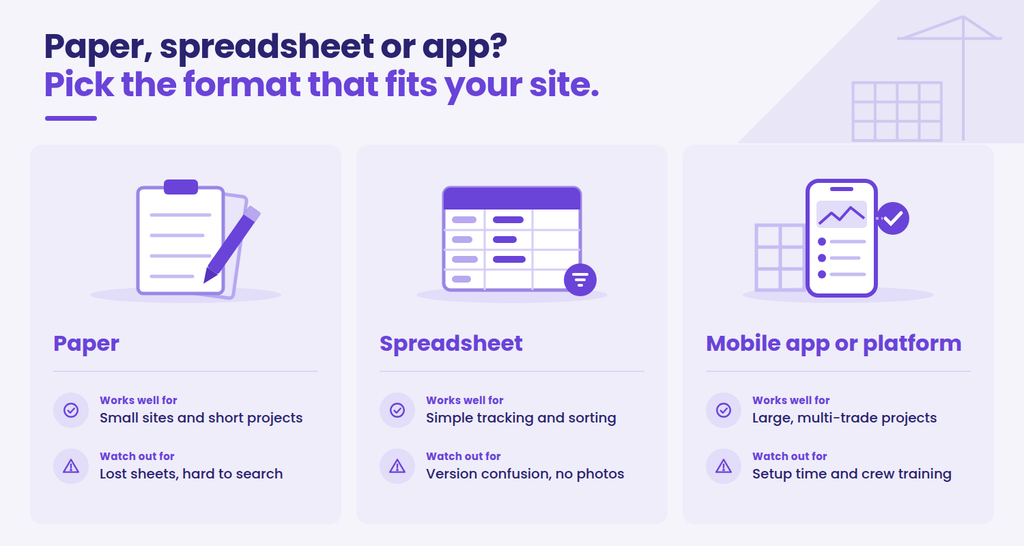
The best format is the one your crew will consistently fill out on a busy day.
| Format | Works Well For | Watch Out For |
| Paper | Small sites, short projects, and crews new to checklists | Lost or damaged sheets that are hard to search later |
| Spreadsheet | Teams that want simple tracking and sorting | Multiple versions in circulation and no easy photo uploads |
| Mobile app or platform | Larger projects with several trades and frequent reporting | Setup time and crew training |
If your site has five people and a six-week schedule, a clipboard may be all you need. Digital tools start to pay off when several teams, locations, or stakeholders need access to the same jobsite documentation at the same time.
How to Create a Construction Site Checklist That Stays Useful
Most checklists don’t fail on day one. They lose value over the project because of a few common habits.
The first is using the same template for every project. A template is a reasonable start, but rebuild it around each new site’s risks.
The second is writing items that are too vague to verify. Nobody can confirm an item like “site is safe” one way or the other. Replace it with the exact condition you expect the inspector to see.
The third is never updating the list. A checklist written during the foundation phase will be out of date by the time the roof goes on. Make a habit of reviewing and revising it at every phase change.
The fourth is checking boxes without any evidence. A tick mark on its own won’t settle a dispute six months later. Attach a photo or a capture reference to any finding that needs follow-up.
Where Does Visual Documentation Fit?
A checklist tells you what someone looked at. A visual record shows what they actually saw, which matters when questions come up later.
This is where Reality Intelligence from Track3D fits into the process. With VisualTrack, teams capture the site using a 360 camera during their regular walks, without adding a separate documentation step. Each capture becomes a timestamped record the team can revisit, share, and compare over time. ProgressTrack then measures installed quantities across 200+ progress categories, so the progress section of your checklist is backed by measured data rather than estimates.
You don’t need software to start, and a clear list on paper beats a complicated one nobody opens. As projects grow, though, linking checklist items to visual records saves a lot of back-and-forth between field and office.
Frequently Asked Questions
Q: How do you create a construction site checklist from scratch? A: Review the drawings, schedule, and safety plan, then list the risks for each phase. Write each item as a yes/no check, assign an owner and frequency, and refine the list after a test walk.
Q: What’s the difference between a construction site safety checklist and an inspection checklist? A: A safety checklist focuses on hazards to people, such as falls, electrical risks, and equipment operation. An inspection checklist focuses on the work itself, including its quality, its compliance with code, and whether it matches the plans.
Q: How often should a construction site checklist be used? A: Safety items are usually checked daily or before each shift, since hazards change quickly. Inspection items follow milestones, such as pre-pour or pre-cover checks.
Q: Who should be responsible for the construction site checklist? A: Each section should have its own owner, with the safety manager usually handling safety items and the superintendent handling inspection and progress items. One person should still review the full list weekly to catch gaps between sections.
Ready to See It in Action?
Knowing how to create a construction site checklist is the first step toward more consistent site walks. The next is backing every check with visual proof your whole team can access. See how Track3D helps teams document site conditions and track progress with Reality Intelligence. Book a demo