Most teams treat construction progress reporting as a formality or a means of documentation only. But how often does that actually produce any results? In reality, you need a system built on verified data that helps in tracking and communicating progress effectively. This is where AI-powered construction progress reports come into the picture.
In this guide, we explore the fundamentals of AI-powered construction progress reporting, its pros and cons, lifecycle, and supplementary tools. Continue reading to know more!
Key Takeaways
- Construction progress reports are structured documents used for tracking performance and supporting decision-making.
- Self-reported data is unreliable and often leads to inaccuracies in the long run.
- AI-powered reporting uses site imagery to generate verified progress data.
- It delivers near real-time, location-based insights for better visibility and control.
- Integrating AI with tools like BIM and reality capture creates a more accurate and efficient reporting process.
What Is a Construction Progress Report?
A construction progress report is the formal documentation through which the current status of the project is communicated to all stakeholders, typically by the project manager or project engineer. It may seem the same as a daily report, but there’s a huge difference. A daily report just accounts for what occurred on the site today. A construction progress report, on the other hand, is much more structured, periodic, and used to make commercial and contractual decisions.
There are four major types of construction progress reports:
- Daily site report: This is more operational and records labor, activities, weather, and observations throughout the day.
- Weekly progress report: It is a tactical weekly summary that compares progress against the planned program.
- Monthly progress report: This is a commercial report that is the most contractually significant format and is aligned with the payment cycle.
- Milestone report: This is event-driven and produced only when a specific program milestone is achieved.
“Many contractors are now adopting AI-powered construction progress tracking software to reduce manual reporting and improve real-time project visibility.”
What Should a Construction Progress Report Include?
An ideal, well-structured construction progress report includes the following fundamentals:
- Project Overview and Reporting Period: This section includes basic details, like the project name, contract reference, reporting dates, and report number in the administrative context, which give the document its contractual standing.
- Executive Summary: The document should include two to three paragraphs covering overall program status, cost performance, key issues, and upcoming priorities. This section is explicitly written for anyone who may not read the entire document.
- Program Status: Any report is incomplete without the current percentage complete both overall and by major work package; a thorough comparison against the plan; tasks completed; activities in progress; and those that are delayed with recovery.
- Cost and Commercial Performance: This section must include the expenditure to date against budget, earned value summary, SPI forecast, final costs, and any pending change orders.
- Quality, Safety, and Compliance: Are all safety measures being taken? Answer that here. Add details of completed inspections, raised non-conformances, safety observations, and compliance status.
- Risk and Issues Update: Provide the current status of active risks and issues with mitigation actions in progress.
- Photography and Visual Evidence: Complete the report with site photographs linked to progress claims, dates, and location.
Why Do Self-Reported Progress Reports Not Work?
According to McKinsey Global Institute’s Reinventing Construction report (2017), large construction projects often face significant cost overruns and delays due to poor productivity and a lack of transparency. This gap typically occurs because of self-reported figures. If subcontractors or other crew members are submitting estimates of percentage complete, the data is never going to be accurate. As long as no one is comparing it to the physical site conditions, the project keeps building on inaccurate and unreliable data.
This means that the entire project continues building on the incorrect figures, whether it is a project engineer making reports or payments being approved. In the long run, the consequences are extreme – EVM calculations, program forecasts, and payment applications are all inaccurate. Thus, self-reported construction progress reports fail miserably.
Compared to these, what advantage do AI-powered construction progress reports provide? Here it is:
| Attribute | Self-Reported | AI-powered/AI-verified |
| Data Source | Subcontractor estimates | Physical site imagery |
| Accuracy | Subjective | Objective |
| Timing | Weekly or monthly | Near real-time |
| Location context | By description only | Spatially referenced |
| Payment support | By assertion | By evidence |
| Dispute risk | High | Significantly reduced |
Thus, with AI-powered and verified data, construction progress reports become a contractual protection document, not just a formality.
“Construction project monitoring platforms help teams validate reported progress using visual evidence and continuously updated site data.”
How Does AI-Powered Construction Progress Reporting Work?
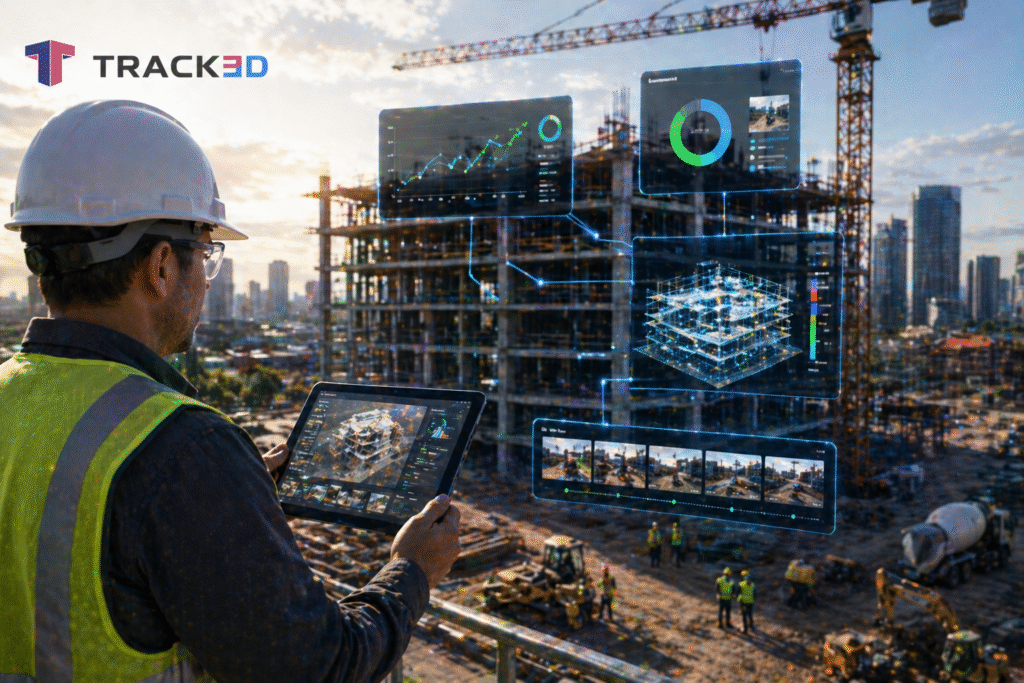
AI-powered construction progress reporting automatically connects spatial site monitoring to the progress reporting workflow. It generates verified data with evidence. Here’s what it looks like in action:
- AI analyzes physical site conditions from 360-degree imagery on a regular basis – daily or weekly, depending on the pace of the project.
- It processes the captured data and identifies the completed tasks, their location, and their present condition.
- It generates verified percentage complete figures by work package and location.
- Next, it consistently compares the data against the project model and automatically flags any deviations.
- Lastly, it produces a structured progress report with verified data that is ready for review before the OAC meeting or the payment cycle.
Thus, you’re looking at a complete end-to-end lifecycle that generates a report grounded in physical site evidence. Clearly, the advantages of an AI-powered system are far and wide. However, it also poses a few challenges. Before we explore how to fix them, let’s take a look at what they are:
| Advantages of AI-Powered Progress Reporting | Disadvantages of AI-Powered Progress Reporting |
| Verified data replaces subjective self-reporting. | It requires consistent capturing of site imagery. The quality of data produced heavily depends on the frequency and discipline of capture. |
| It provides near-real-time visibility between formal reporting cycles. | It requires an initial setup to connect imagery to the model. |
| Spatially referenced evidence is available to support payment claims. | All site conditions may not suit image-based detection. |
| Report compilation time is reduced, and the project manager does not need to spend a large amount of time on progress reporting. | It needs subcontractor and owner buy-in for verified reporting. |
“Many teams also use centralized construction visual documentation platforms to organize site photos, walkthroughs, and field captures for reporting and verification.”
How to Produce an AI-Powered Construction Progress Report?
To help you get started, here are the detailed steps of producing an AI-powered construction progress report:
- Define the reporting cycle by aligning it to the other aspects of the construction project.
- Conduct site walks, drone flights, or 360° imagery sessions to capture site data that is dated and location-referenced for every work package.
- Compare the physical site evidence against the planned program to generate verified figures of percentage complete. Do not rely solely on subcontractor self-reporting.
- Keep the program updated by updating completed activities, in-progress percentages, and delays with recovery plans.
- Compile financial performance by updating EVM metrics and forecasting the final cost based on the current verified performance.
- Review the risk register and document mitigation actions taken to keep everyone updated about the risks and issues.
- Compile all sections and distribute to the respective stakeholders within the agreed reporting period.
What should you NOT do? What are the common mistakes to avoid?
- Do NOT accept unverified data and self-reported percentages, as this data will flow into payment applications and EVM calculations, creating inaccuracies throughout the project.
- Do NOT report only the overall project-level figures. This will hide the details about individual trades and work packages, thereby reducing visibility.
- Do NOT report too randomly. Match the pace of your project. Monthly reporting on a fast-moving project means the problems are already old when they’re noticed.
Tools & Tech for AI-Powered Progress Reporting
As the field of construction continues to expand, teams are actively digitizing to keep abreast of the current developments. Similarly, here are some of the tools and tech that might help you:
- Construction management software: It is a centralized platform used for assembling, distributing, and archiving progress reports.
- Mobile field reporting tools: These provide near real-time data capture for progress, quality, and safety directly from the jobsite.
- BIM and 3D project models: These models connect progress reporting to specific elements and locations in the spatial project model.
- Reality capture and drone mapping: Through this technology, you get independent visual evidence of site conditions for each reporting period.
- AI-powered progress monitoring platforms: These are designed to automatically generate verified, location-referenced percentage complete figures from captured site imagery.
“Modern AI in construction workflows combine computer vision, automated reporting, and site intelligence to improve decision-making and reduce project risks.”
Final Thoughts
A construction progress report can only be a solid source when the data behind it is verified and structured. Self-reported percentages cause inaccuracies in the project data that compound into long-term problems. Thus, what you need instead is AI-powered reporting that provides verified, site-backed imagery. And by connecting this imagery with the project models and performance data, you create a reliable decision-making tool.
Want to see it in action? Explore how Track3d generates AI-powered, spatially verified progress reports, so every percentage complete figure reflects what is actually on site.
FAQs
Q1. What should a construction progress report include?
Ans: A construction progress report includes an overview, an executive summary, program status with percentage complete, cost and commercial performance, quality and safety updates, a risk and issues update, upcoming activities, and dated photographic evidence supporting progress claims.
Q2. How often should a construction progress report be produced?
Ans: Reporting frequency depends on project pace and contract requirements. Depending on the pace and demands of the project, you can opt for daily, weekly, monthly, or milestone-based reports.
Q3. What is the difference between a daily site report and a construction progress report?
Ans: A daily site report records what happened on site today for labor, weather, and observations. A construction progress report is a formal, structured document generated at regular intervals that summarizes cumulative progress against the plan.
Q4. How does a construction progress report connect to the payment application?
Ans: The percentage complete figures in a progress report directly feed the schedule of values payment claim. When progress is overstated in the report, payment applications claim more than what has been delivered. This creates disputes, retention issues, and program misrepresentation. Thus, verified progress data protects both contractors and owners from these discrepancies.
Q5. How does AI improve a construction progress report?
Ans: AI replaces self-reported percentage-complete estimates with independently verified figures derived from physical site imagery. Each completion percentage is spatially referenced to its location by providing evidence-based data that supports payment applications, reduces disputes, and reflects what is actually on site.