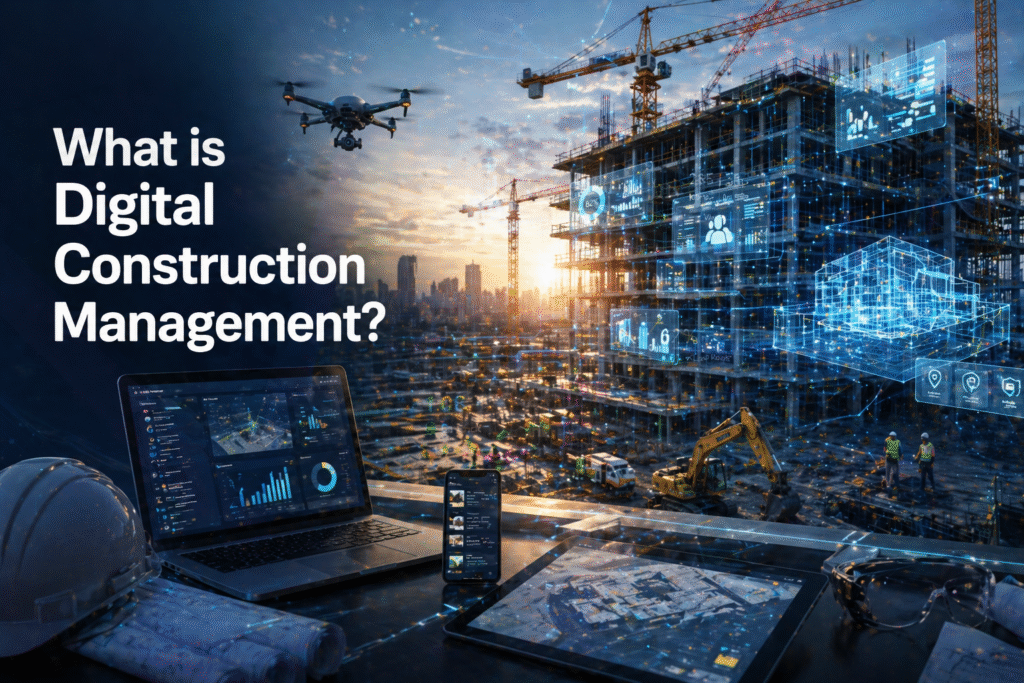
Digital construction management is basically the process where construction teams move away from paper-based documentation, manual data entry, and email exchanges towards managing their operations using interconnected digital technology.
In contrast to operating based on an individual team member’s version of the project, digital construction management puts the project under one roof. It enables owners, GCs, subs, and designers to access and work on the project simultaneously without the need to chase information updates or revisions in drawings.
In fact, according to McKinsey, large construction projects tend to end up 20% behind schedule and an eyebrow-raising 80% over budget – largely due to these disconnected workflows and information flow issues. That’s exactly the problem that digital construction management is trying to solve.
Key Takeaways
- Digital construction management is not a single tool. It is a connected ecosystem of platforms replacing information silos with shared project intelligence.
- The five layers of the digital construction management stack are BIM, project management, field management, financial management, and site intelligence.
- The office-to-site gap is the challenge most implementations have not yet fully solved.
- Spatial monitoring is the layer that closes that gap.
- Successful implementation requires workflow redesign, not just tool adoption.
What Is Digital Construction Management?
Digital construction management covers the entire project lifecycle. It spans from the pre-construction phase right on through to delivery, handover, and the final closeout.
Instead of paper drawings, scattered meeting notes and endless spreadsheets, teams use connected systems that keep all your project data in one tidy spot. The biggest advantage of digital construction management is simply that it gets everyone looking at the same page.
Properly implemented digital construction management brings positive changes in:
- Pre-construction activities that include BIM coordination, clash detection, digital estimating, and other activities.
- Delivery activities that consist of RFI, submittal, revisions of drawings, daily reporting, progress tracking, safety management, and others.
- Handover and closeout activities that involve as-built drawings, O&M manuals, warranties, and asset management.
The Digital Construction Management Technology Stack
A lot of people think digital construction management is just “using Procore” or “working in BIM.” But it is bigger than that. Most modern setups fall into five layers. Each layer solves a different part of the project.
Layer 1: Design and Coordination (BIM)
Building Information Modelling provides the spatial foundation. It captures design intent in a data-rich 3D model, supports clash detection, and serves as the reference point for every construction decision. BIM implementation cuts design errors by 30% and project timelines by 20% on average.
Layer 2: Project and Document Management
Cloud-based platforms centralise documents, RFIs, submittals, contracts, and programme data. Every stakeholder accesses current information without email chains or physical document transfer. Eight in ten construction professionals now use cloud computing to collaborate on models, specifications, and documents, an 11% increase in just two years.
Layer 3: Field and Workforce Management
Mobile-first field platforms let site teams capture attendance, progress updates, quality observations, and safety data directly from site. This eliminates the gap between what happens on site and when management finds out about it.
Layer 4: Financial and Commercial Management
Digital cost management tools connected to the schedule of values, EVM calculations, and procurement workflows give commercial teams a near real-time view of financial performance against budget. Without this, 35% of construction professionals’ time is spent on non-productive activities, including manual reconciliation and chasing approvals.
Layer 5: Site Intelligence and Spatial Progress Monitoring
This is the newest and fastest-evolving layer. These platforms capture verified physical site conditions and compare them against the design model, giving teams spatially grounded, near real-time intelligence about what has actually been built. It is also the layer most implementations skip, which is where the real problems begin.
The Office-to-Site Gap: The Challenge Most Implementations Miss
This is where most digital construction management efforts fall short. The office may be fully digital. The BIM model is updated. RFIs are logged. The schedule is tracked. The project management platform looks clean. But the jobsite reality can still be very different. That is the office-to-site gap. It is the difference between what the systems say and what is physically happening in the field.
Here is what that gap often looks like on real projects:
- Progress is marked “complete” in the system, but the work has not even started.
- The model shows a clean coordinated layout, but in the field the install is drifting.
- The schedule says the project is on track, but crews are struggling to hit production targets.
- A payment claim shows 75% complete, but the actual work on site is closer to 60%.
This gap exists because most platforms still depend on manual reporting. People enter data late, or they estimate progress, or they report what they hope is happening instead of what is actually happening. And it is not always intentional. It is just the nature of construction. Site teams are busy. Reporting becomes a second priority.
But the impact is huge. If the management team is making decisions based on outdated progress, the project becomes reactive. Problems are found late. Recovery becomes expensive. Closing this gap requires one missing piece: verified site visibility. That is why spatial monitoring and progress verification tools are becoming more important. They help confirm real conditions and connect them back to the digital systems.
How to Implement Digital Construction Management: Step by Step
Digital construction management works best when implementation is treated like a process change, not a software rollout. Here is the approach most successful teams follow.
Step 1: Assess current workflows first
Before buying tools, identify where information breaks down. Look for repeated issues like missing updates, unclear responsibilities, slow approvals, or poor document control.
Step 2: Define the full technology stack
Do not choose tools in isolation. A BIM platform alone is not enough. A document system alone is not enough. Pick tools that cover the main layers and connect well.
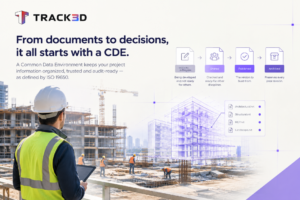
Step 3: Set up a common data environment
This means one shared home for drawings, logs, documents, and project data. Everyone should know where the truth lives.
Step 4: Train every stakeholder
Digital construction management only works if everyone participates. That includes subcontractors. If subs refuse to use the system, your data will always be incomplete.
Step 5: Connect site reporting to office systems
Field capture needs to be easy. If it takes too long, it will not happen consistently. Mobile-first tools help reduce the friction.
Step 6: Track results and adjust
Measure things like RFI response times, rework rates, schedule performance, and dispute volume. If the numbers are not improving, the workflows need adjustment.
Tools and Technologies in Digital Construction Management
Tools for digital construction management vary from software to software. Every tool has its own importance.
- BIM platforms: assist in coordinating designs, detecting clashes, and generating models in 3D format.
- Construction management platforms: help in managing RFIs, submittals, document control, and communication between schedules.
- Field reporting platforms: provide data on site updates, quality information, man power, and safety measures.
- Project controls and earned value systems: connect progress to schedule and cost performance.
- Spatial progress monitoring tools: capture verified site conditions and compare them to the model.
When evaluating platforms, the most important questions are not about features. They are about reality. Do the tools integrate cleanly, or do they create more silos? Does field data come in quickly, or is it delayed by days? Does the system help verify what is happening on site, or does it only store reported updates? And Does it work for subs and site teams, or only for the office? If the answers are weak, the tools will not deliver full value.
Pros and Cons of Digital Construction Management
Digital construction management can surely help you run projects smoothly and swiftly. But it’s not a magic wand. It comes with its own set of strengths and challenges.
Benefits of Digital Construction Management
- The biggest benefit is shared project visibility. Everyone works from the same information.
- It also improves speed. Decisions happen faster because updates are not delayed by weekly meetings.
- It reduces rework. Design clashes and scope issues are identified earlier.
- It improves schedule control. When progress is tracked consistently, teams can spot risk before it becomes a crisis.
- It also supports a cleaner closeout. Digital as-builts and warranty documentation are easier to organize and transfer.
Challenges of Digital Construction Management
The biggest challenge is adoption. If subs do not use the tools, the system becomes incomplete. Data quality is another issue. If people enter inaccurate updates, the project dashboard becomes misleading. Integration is also a headache. Many companies use five different tools that do not talk to each other properly. And finally, digital systems require workflow discipline. If the team refuses to change habits, the tools will not fix anything.
When Digital Construction Management May Not Deliver Full Value
It does not suit every situation. Projects with fragmented subcontractor participation create gaps in data that undermine the whole system. Also, if you’ve short-duration or single-trade projects, then you may find the implementation overhead outweighs the benefit. Organisations without data discipline will find that technology cannot fix a culture of inconsistent data entry. And implementations without change management tend to produce digitised versions of existing broken processes, not better ones.
Common Digital Construction Management Mistakes
Mistake 1: Selecting tools before defining workflows.
Fix: Map your information flows and identify gaps before choosing any platform. Technology amplifies broken processes rather than fixing them.
Mistake 2: Digitising the office without connecting the site.
Fix: Spatial monitoring and field data capture need to go in alongside office management tools, not added later as an afterthought.
Mistake 3: Treating implementation as a technology project.
Fix: The real transformation is in how people share information, make decisions, and respond to what the data is telling them. Technology is the enabler. It is not the solution.
Final Thoughts
Digital construction management has altered the planning and delivery process for modern projects. However, its benefits lie not in the greater number of software solutions. Rather, they consist in gaining a higher degree of visibility. What does one mean by saying this? Well, the key thing is that all decisions should be made based on current events, not outdated reports prepared last week.
Those organizations that excel at this are those which have managed to narrow the gap between offices and construction sites. They have achieved this through connectivity of platforms, verified site information, and actual progress data, thus enabling them to detect problems earlier and prevent delays and costs.
Do you want to know how this is done? Learn how Track3D makes it possible to bridge the office-to-site gap in construction by linking verified spatial site information with digital construction management solutions.
FAQs: Digital Construction Management
Q1. What is digital construction management?
Digital construction management is the use of connected digital platforms to plan, run, track, and close construction projects. It replaces paper-based processes with shared systems that keep everyone working from the same project data.
Q2. What is the difference between BIM and digital construction management?
BIM focuses on design and coordination through a 3D model. Digital construction management is broader. It includes BIM, but also covers project documentation, field reporting, financial control, and site progress monitoring.
Q3. What is the office-to-site gap in digital construction management?
The office-to-site gap is the difference between what the digital system says is happening and what is actually happening on site. It usually exists because site updates are delayed or based on estimates rather than verified progress.
Q4. What are the biggest challenges in digital construction management?
The biggest challenges include subcontractor adoption, inconsistent data entry, integration issues between tools, and weak site visibility. Many projects go digital on paper but still struggle to track real field progress accurately.
Q5. How does spatial intelligence improve digital construction management?
Spatial intelligence improves digital construction management by capturing verified site conditions and linking them back to the model. It helps teams confirm what has actually been built and where, reducing reliance on guesswork and manual reporting.