
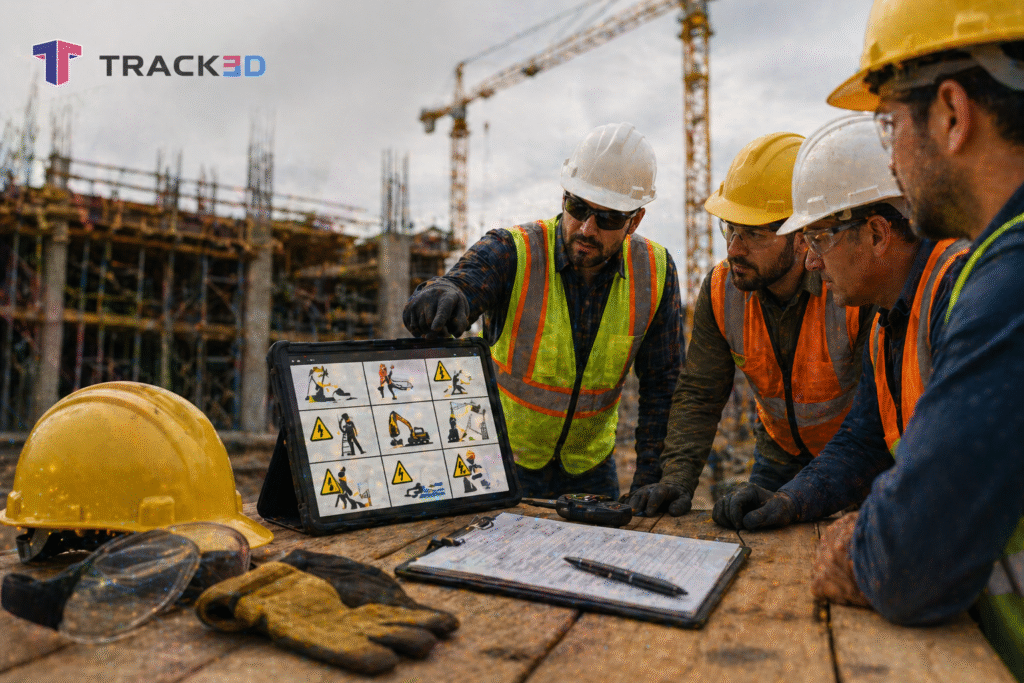
A Job Hazard Analysis (JHA) is a systematic method for identifying hazards associated with a particular task before work starts. The task is divided into individual tasks, any possible problems in each of the steps are identified, and control measures to minimize risks to an acceptable level are documented.
JHA is not a generic construction site safety document. Rather, it addresses actual activities within the construction work that could lead to harm. Curious about the nitty-gritty of JHA? Let’s dive in right away!
Key Takeaways
- JHA in construction breaks down a job into various steps and examines the hazard and control measures associated with each step.
- JHA and JSA refer to the same process. Terminology varies by region and contract. SWMS is the Australian equivalent.
- The most common JHA Failure in construction is not a poorly written form. It is a correctly written form whose controls are never verified as in place before work starts.
- OSHA requires hazard analysis for high-risk construction activities including work at height, excavation, crane lifts, and confined space entry.
- Progress site monitoring is closing the gap between what a JHA documents and what is actually happening on site.
The JHA That Did Not Save Anyone
The scaffolding crew had a signed JHA. Every box ticked. Fall arrest required, anchor points to be installed before work starts, exclusion zone below, all documented. Three hours in, a near miss. A worker at the leading edge, no harness. The anchor points were never actually installed. The JHA was perfect. Nobody verified the controls were physically in place. That single missing step is what this guide is about.
JHA Checklist for Construction Teams
A JHA is a task-based safety process. It focuses on one job, one work activity, and one set of risks. Unlike a general safety plan, a JHA is meant to be specific. It asks: what does this task look like step by step, and what could hurt someone along the way?
What separates a JHA from other safety documents comes down to:
- Task-specific: One JHA per high-risk task, not a general site document
- Sequential: Analyses every step of the task, not just the task as a whole
- Hazard-control paired: Every identified hazard must have a documented control measure
- Pre-work: Completed before the task begins, briefed to every worker on that task.
A good JHA reads like the job is actually happening. It should not feel like a template that was copied from the last project.
OSHA’s guidance is clear on where JHAs matter most. Priority should go to tasks with the highest injury potential, tasks where a single human mistake could cause a serious incident, and tasks that are new or changed on site.
Understanding the broader range of construction risks can also help teams prioritize which activities require a detailed JHA.
JHA vs. JSA vs. SWMS: Are They Actually Different?
If you’ve worked across teams, projects, and countries, you’d have noticed something confusing, One company calls it a JHA. Another calls it a JSA. And if you are working with Australian teams, you will hear SWMS. It can sound like three different safety systems, but in most cases, they all mean the same thing.
Let’s give you a quick breakdown:
| Term | Full Name | Where You’ll Usually See It |
| JHA | Job Hazard Analysis | United States (OSHA language) |
| JSA | Job Safety Analysis | US, Canada, and international projects |
| SWMS | Safe Work Method Statement | Australia |
| RAM | Risk Assessment Method | UK and some Middle East contracts |
When Is a JHA Actually Required?
Not every task on a construction site has to be followed by a JHA, but those high-risk ones inevitably do. It’s a pretty simple rule of thumb: if one tiny mistake on that job could send someone to the hospital, then you need a JHA before work starts.
| Task Type | Why The JHA is a Must |
| Work at height | Scaffolding, working off the edge, roof access, and elevated platforms all carry a very real fall risk |
| Crane lifts and rigging | When lifting or slinging heavy loads, there are all sorts of ways things can go wrong |
| Excavation and trenching | Collapse risk is a nightmare, but when you’re not sure what’s buried underground, it’s a real roulette |
| Confined space entry | When you can’t even get a rescue team in, the risks of mistakes being fatal are much higher |
| Demolition | When you’re taking down a building, you have to worry about structural instability, flying dust, and hazardous materials all adding up to a whole lot of danger |
| Hot works | Welding, cutting, or grinding near something that can catch fire makes for a very short window of error before disaster strikes |
| New or changed tasks | Any time something new comes on site, or a process changes, you have to look at the whole risk picture all over again |
These task-level assessments should work alongside regular construction safety inspections and continuous hazard monitoring.
How to Conduct a JHA in Construction (Step by Step)
Step 1: Choose your job: Begin with the jobs that have the most risk. Jobs that include activities such as falls, lifting, excavation, confined space, or any jobs that have had near-misses in the past.
Step 2: Segment the job into sequential steps: Most of the time, this is where people tend to get sloppy and try to pass off “install scaffolding” as one single step.
Rather, you should break down this task: unload materials, lay base plates, assemble frames, install platforms, check guardrails, etc. Each JHA should have no more than 10-15 steps involved in its completion.
Step 3: List potential hazards related to each step: Asking yourself an important question when developing a JHA will help significantly. For every step in the list you have generated, pose a simple question, “What could go wrong here?”
Step 4: Apply the hierarchy of controls: Hierarchy of controls means starting with the best option first: Eliminate the hazard, Substitute the hazard, Use engineering controls, Add administrative controls, and Use PPE (last resort)
Step 5: Involve the workers doing the job: This step is non-negotiable. The guys actually doing the work will tell you what the real risks are. Supervisors can miss things because they are not the ones holding the tools.
Step 6: Brief all workers before work starts: A JHA that sits in a folder does nothing. The crew needs to understand the hazards and controls before the task begins.
Step 7: Verify controls are actually in place: This is the step that prevents accidents. Do not just write “guardrails installed.” Go look and confirm.
Consistent construction visual documentation can provide timestamped evidence that barriers, guardrails, signage, and other controls were present before work began.
Step 8: Review and update: If conditions change, the JHA must change. A JHA is not a one-time document. It is a living plan.
Construction JHA Example: Working at Height on Scaffolding
Here is what a properly specific JHA looks like for one of the most common high-risk tasks in construction.
| Task Step | Hazard | Control Measure |
| Access scaffold via ladder | Fall from ladder | Three-point contact enforced, ladder secured at top and bottom before use |
| Work on scaffold platform | Fall from leading edge | Full perimeter guardrail inspected before work begins. Harness required if guardrail is incomplete |
| Use power tools on platform | Dropped tools striking workers below | Tool lanyards required for all equipment. Exclusion zone established, signed, and enforced below |
| Handle materials on platform | Loss of balance, fall | Mechanical lifting to platform, maximum bay load posted and enforced |
Why JHAs Fail (The Documentation vs. Implementation Gap)
Here are the most common reasons JHAs fail on real job sites:
- Completed after the fact: The form is signed in the morning, but written later in the afternoon. That is not safety. That is damage control.
- Generic hazard descriptions: Writing “fall hazard” means nothing unless you explain where the fall risk is and what triggers it
- Controls listed but never verified: The form says guardrails are installed, but the platform is still open on one side.
- Workers never briefed: If the crew has not read it or discussed it, the JHA is useless.
- Never updated: New equipment arrives, weather changes, the work zone shifts, but the JHA stays the same.
How Progress Monitoring Helps Close the JHA Verification Gap
It’s simply impossible for any supervisor to manually check everything in every zone all the time. It can be attempted, but jobsites are hectic. In such cases, progress monitoring becomes increasingly relevant. Rather than just doing manual verification, it allows workers to compare what the JHA says should be there and what is actually there.
For instance, if your JHA states there needs to be an exclusion zone at the bottom of the scaffold platform, Progress monitoring makes sure this requirement is actually met.
Tools and Technologies for JHA Management
Most JHAs are still done using paper or PDFs, which is fine, until the project gets busy and paperwork starts falling behind. Technology makes JHA management easier because it reduces friction. It also makes tracking and auditing much cleaner.
Here is a clear breakdown.
| Tool/Tech | What It Does | Why It Matters for JHAs |
| Mobile JHA platforms | Lets supervisors complete and sign JHAs on phones or tablets | Faster completion and cleaner audit trails |
| Safety Management Software | Stores JHAs, permits, toolbox talks, and incident reports | Keeps safety records organized and searchable |
| BIM and Spatial AI | Links hazards to zones, floors, and building areas | Makes risk location clearer for crews |
| Near real-time site monitoring | Captures site conditions and compares them to documented controls | Helps confirm controls are in place before work starts |
| Permit-to-work systems | Connects JHAs to hot work, confined space, and lifting permits | Stops work from starting until requirements are met |
| QR-code access boards | Lets workers scan and view the current JHA in the field | Prevents crews using outdated paperwork |
Benefits of JHAs Without the “Paperwork Trap”
A JHA is meant to be a practical safety tool, not a paperwork exercise. When it is done right, it can prevent near misses, injuries, and serious incidents before they happen.
A good JHA helps crews:
- Plan safer task sequences
- Catch hazards tied to equipment, access, or work positioning
- Clarify who is responsible for controls like barricades or permits
- Reduce confusion on site, especially with new workers or subcontractors
- Create a clear safety record for audits and compliance checks
Common JHA Mistakes in Construction
Most JHAs fail for the same predictable reasons. The good news is that they are easy to fix if the site takes them seriously.
#Mistake 1: Generic hazard descriptions
Writing “fall hazard” without detail does not help anyone.
Fix: describe the hazard clearly including location, trigger, and consequence.
#Mistake 2: JHA completed after work starts
A JHA written after the job is already underway is pointless and dangerous legally.
Fix: Treat JHA sign-off as a hard stop. No JHA, no work.
#Mistake 3: Workers excluded from the process
Supervisors writing JHAs alone often miss real risks.
Fix: Involve at least one experienced worker in every JHA review.
Final Thoughts
A JHA is one of the most powerful tools a construction team has for keeping people safe. But the gap between what the JHA says and what is physically on site is where preventable incidents happen.
Closing that gap takes consistent worker briefing, named verification responsibility, and increasingly, progress monitoring technology that can confirm site conditions independently rather than relying entirely on a single pre-shift check.
Want to see how it works? At Track3d, we connect progress site monitoring to construction safety workflows, so your JHA hazard controls are verified on site, not just documented on paper. Explore now!
FAQs: JHA in Construction
Q1. What is a JHA in construction?
Ans. A job hazard analysis (JHA) is the safety assessment of a construction process before performing the activity. The process is broken down into steps, identifying potential hazards during each of these steps, and documenting control measures.
Q2. What is the difference between a JHA and a JSA in construction?
Ans. They do not differ. JHA is the name OSHA uses for the pre-task safety practice. Other regions use terms such as JSA or SWMS.
Q3. What is construction JHA examples of high-priority tasks?
Ans. The most common ones are working at heights, crane operations, entry into confined spaces, excavations, demolition tasks, and “hot works.” Any new task or site condition change must trigger a JHA.
Q4. How often should a construction JHA be reviewed?
Ans. A JHA should be updated whenever there is a change in the site or environmental conditions, new equipment used, change in the way of performing the work, and after any near-miss incident. For high-hazard activities, it should be reviewed at the beginning of each phase.
Q5. What happens if a JHA is not completed before work starts?
Ans. High-risk work performed without a JHA before the task will put you at high risk of accidents and incidents, apart from exposing you to huge liabilities under OSHA laws.