Construction quality control is the process of ensuring that all project deliverables meet client expectations, specifications, and predefined quality standards. Maintaining good project quality reduces the chance of unnecessary rework and expedites closeout for projects. Although this is a conventional norm expected out of every project and project manager, it can often become a challenge to complete.
The varying aspects of any project, meeting the checkpoints for each, and proceeding with all at the same time, is a huge task. Small missteps and minor errors can push your project into a downward spiral that will force you to lose time, add to costs, and schedule rework. Then how can you match and achieve ideal construction quality control? Continue reading to find out!
Key Points
- Construction quality control involves a systematic method that ensures the deliverables meet certain specified criteria and requirements.
- The primary cause of defects and rework is the absence of proper documentation on the QA/QC processes on-site.
- Technology is essential for the implementation of quality control, and methods such as 360 reality capture, issue tagging, and AI-based progress analysis have transformed the industry.
- Quality control may be attained using an effective quality control plan that includes certain procedures, actions, and duties.
- Documentations related to floor planning and scheduling enhance accountability, resolve issues faster, and avoid conflicts among all parties involved.
- The future of construction quality control depends on integrated platforms that incorporate image capturing, checklists, BIM analysis, and predictive analytics.
Why Does Construction Quality Control Still Fail?
With the advent of digital tools and ever-rising tech support, one would think that we have QA/QC marked down to the T. Then, in spite of these, why does construction quality control still fail? Several basic issues can affect the quality control process, like paperwork getting lost, photos without context, subjective inspections, or late visibility on major issues. By the time a deviation is flagged, it’s too late to fix even a minor one without incurring hefty costs or time delays.
Therefore, it is crucial to understand that construction quality control needs more than mere documentation. As a superintendent or project manager, you need to maintain a foolproof structure and exercise visual clarity. To do that, begin with understanding the core issues behind failing quality control and exploring new-age tools that can help you combat them.
Fragmented QA/QC Processes: The Biggest Challenge
Conventionally, the QA/QC practices followed are incomplete and inconsistent. Understand how: one person prefers paper logs to make routine entries, while someone else stores their data in PDFs. One crew member snaps a picture without context, whereas the superintendent makes its entry in a completely different log. You might think that using one format, such as digital logs, will help streamline all of this, but that’s not the core issue! The main issue here is inconsistency!
Since none of the information is visually connected to the other, anyone who refers to these notes will always walk away with incomplete information. Lack of context can create huge holes in knowledge, and this disconnection will lead to:
- Incomplete trend tracking
- Delayed issue resolution
- Gaps in auditability
And generally, it will lead to delayed or inadequate construction quality control. But how can we avoid this? Read on!
Introducing Smarter Solutions: From Reality Capture to Digital QA
As we recognised the core issues above, it’s time to explore some of the best solutions to tackle them. Listed below are a few key technologies that can enable you to transform how modern construction QA/QC is conducted. Note that these won’t replace your field walkthroughs or inspections, but they will enhance field QA and help you maintain structure in your data for better collaboration.
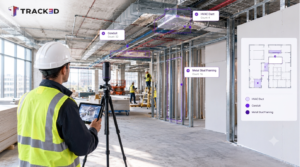
- Reality Capture: 360° cameras and drones capture site conditions, mapped to floor plans for precise visual context.
- Digital Issue Tagging: Teams tag issues directly on walkthroughs, assign tasks, and track resolution visibly.
- Progress-to-Plan Comparison: AI-based tools compare captured visuals to models or drawings to surface deviations early.
How Can Visual Documentation Prevent Rework?
Consider this situation. You get a claim from one of your trade partners about incomplete framing. One of your crew members assures you that this task was completed, but you, unfortunately, cannot vouch for it yourself. How do you proceed from here? Situations like this drive up the cost of rework in construction, which is exactly what strong documentation helps prevent.
Imagine you have a 360° camera at work every week, which captures a searchable timeline of every task that was done, when, and by whom. You can now pull up images from a couple of weeks back, which show the block to be clearly missing.
How did this method help you?
- Quicker issue resolution
- Minimized rework
- Added accountability
Structured visual documentation helps you build a loop of feedback, based on which you can resolve issues faster and build efficiency. Moreover, the on-field team can verify their work, you can spot risks early, and stakeholders can ensure absolute transparency.
Best Practices for Enhancing Construction Quality Control
Here are some of the general steps that you can take as a project manager to ensure optimal construction quality control:
- Standardize visual capture: Set consistent routes for site documentation. Geotag and map each image you take.
- Set consistent practices across teams: This includes aligning teams on workflows, defining how issues are to be identified, verified, and fixed.
- Make QA a standard practice: Construction quality control should never be a one-man job. Build it as a standard, consistent practice among all crew members.
- Elevate visibility: The best way to ensure you can track everything is by connecting everyone’s logs, site visuals, and project plans. Choose your platforms and digital tools accordingly.
- Keep an eye out for patterns: Repetitive task failures or errors point toward underlying patterns. Identify the root cause and fix the issue at its core.
Quality Control in the Context of Construction
The term “quality control in construction” is defined by the range of practical methods and processes applied to ensure that completed construction work complies with the design documentation and contractual requirements. This type of practice is characterized by its practical nature and focuses on one key question: Does the constructed object correspond to the documentation and specifications?
The concepts of quality control and quality assurance are frequently confused, as they are similar in nature. However, each concept carries its own meaning, which should be noted. In essence, quality assurance refers to the development of policies and procedures before initiating construction, whereas quality control ensures that they are properly implemented.
In actuality, construction quality control comprises several different but related processes:
- Material checking: Ensuring that the materials that reach the construction site match the submitted specifications in terms of grade, size, and factory information.
- Inspection during the construction process: Inspecting the construction process at certain phases before covering or encasement of a particular construction step, for example, inspection of the reinforcement before pouring of the concrete, or rough plumbing installation before installing the drywall.
- Field testing and sampling: Conducting the field tests like concrete cylinder breaking, compaction tests, welding inspection, and air barrier tests, and generating objective, measurable data.
- Deficiency recording and fixing: Noting all discrepancies, writing deficiency notices, and ensuring that the deficiency is fixed before proceeding with construction.
- Documentation and record keeping: Keeping all of the above data, along with photos, in an easily accessible way.
A properly organized quality control system is not the responsibility of one individual. Rather, it includes the superintendent, trade foremen, independent inspectors, and even the client representative in a predetermined system. The absence of the system means reactive rather than preventive quality control, which costs dearly.
Tips for Creating a Construction Quality Control Plan
A quality control plan (QCP) is a project-specific document describing the management, monitoring, and validation of quality control processes at different stages. It is more than just a set of checklists. It is a construction roadmap that determines who performs quality control operations, what needs to be tested, how the results should be documented, and what defects should be addressed. The following tips are intended to make the process of creation easier and more efficient.
Start with the contract and specifications
Your QCP must be developed based on the contractual documents and technical specifications for your project. Make sure you cover all the parts that deal with the testing procedure, approved materials list, inspection hold points, and quality requirements.
Define roles and assign clear ownership
A QCP without assigned tasks and responsibilities is simply an abstract concept. Figure out who will perform particular inspections, who is authorized to sign off on work completion, and who will keep records and report the results.
Establish inspection and hold points
All tasks have equal weight as far as mistakes are concerned. Classify the work into three categories: review points (work can continue after creating an entry), hold points (a successful inspection will have to precede the continuation of work), and witness points (an owner’s agent or inspector has the right to witness).
Use standardized inspection forms
Random notes on a daily report cannot substitute for an inspection. Develop your own forms or use existing inspection forms for various types of work, such as concrete placement forms, masonry inspection reports, roof daily report, or mechanical equipment installation checklist. Every report must include the following information: date, location (coordinates or floor plan location), specification section, inspector’s name, results (pass/fail), and if applicable, corrective actions. A standardized QA QC checklist helps ensure none of these details are missed during inspections.
Integrate photographic documentation
A picture by itself isn’t worth much. Define the standards that should be used in taking pictures according to the Quality Control Plan (QCP) requirements. The pictures need to have the geotags or floor plan location, date, and a label with inspection type; also, all pictures should have a consistent naming scheme and be located at specified places within the project management software.
Quality Documentation Examples
Reading about a quality control plan is one thing, seeing what the actual paperwork looks like is another. Here are some of the most common QC documents used on active construction sites, along with what each one typically captures.
Daily QC Inspection Log
Filled out by the QA/QC lead or superintendent at the end of each shift. It typically records the date and location, work performed, weather conditions, materials received, tests conducted, and any deficiencies observed along with the corrective action taken.
Non-Conformance Report (NCR)
Raised the moment work falls outside the approved specification. A good NCR captures the location and trade responsible, a description of the defect, supporting photos, the root cause, the proposed correction, and a sign-off once the fix is verified.
Inspection Request Form (IRF)
Submitted by the subcontractor before covering up work such as rebar, waterproofing, or MEP rough-in. It lists the activity that is ready for inspection, the specification section it needs to meet, and space for the inspector’s approval or rejection.
Punch List
Compiled during walkthroughs near substantial completion. Each line item notes the location, trade, description of the deficiency, and target closeout date, so nothing gets missed before handover.
Material Test and Submittal Log
Tracks every material or product submitted for approval, including concrete cylinder breaks, rebar mill certificates, and weld test reports, along with the approval status and date so procurement and QA stay aligned.
Standardizing these forms, and storing them alongside photos and progress data instead of scattered spreadsheets, is what turns quality control from a paperwork exercise into a searchable project record.
The Future of Quality Control in Construction
Traditionally, QA/QC invokes the idea of rigorous inspections and maintaining detailed checklists. However, construction quality control is no longer just that. As we move toward a more digital age, it’s about detecting and resolving issues as fast as possible, avoiding costly rework, and building consistent trust and accountability with stakeholders. Here’s what we’re looking at, in the long run:
- AI-powered issue detection: We can train AI and computer vision systems to scan images, detect potential deviations, and flag anomalies.
- Predictive QA analysis: Pattern recognition that enables tools to show errors before they occur, so managers can fix the quality and get ahead of the curve.
- Unified quality platforms: Image captures, checklists, BIM comparisons, and issue tracking all in one environment – so you can have complete and absolute visibility.
Along with these, we can expect many more tools that will move construction quality control from a non-negotiable task to a strategic advantage for prudent firms. These visual tools and structured workflows have the potential to transform QA/QC into a tool for success.
subscribe to our blog
- Benefits