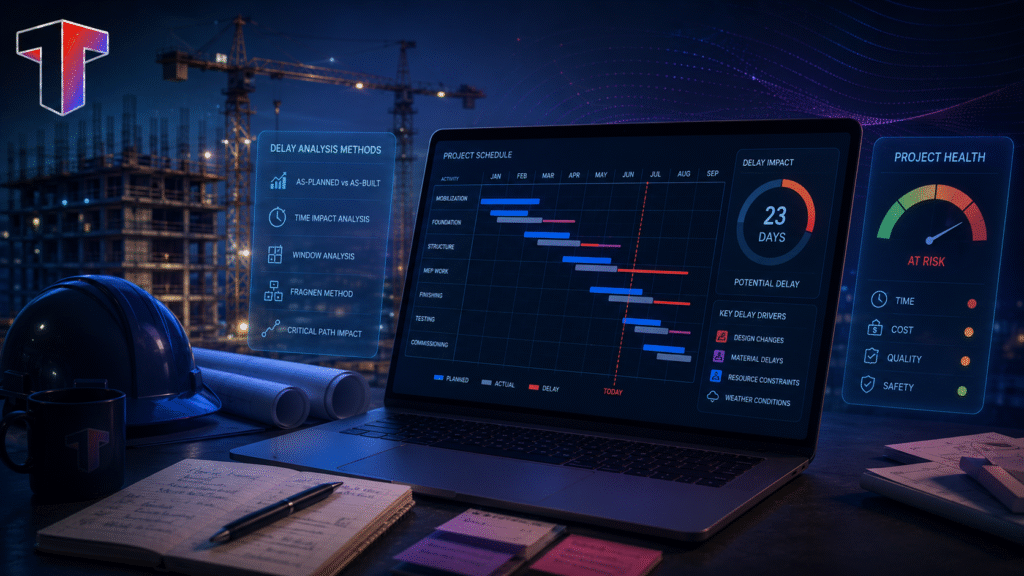
Delays are a common recurrence for most construction projects. When the project is complex and has multiple trades, discrepancies are bound to occur. However, the problem escalates in magnitude when a small delay amplifies into several weeks of falling off the track. As the project manager or superintendent, you must have encountered these situations too. The industry standard dictates that teams use delay analysis methods to identify the root of the problem. So we might have a potential solution, but the path to it often looks complicated. If you’re stuck at this stage, this is the right guide for you.
In this guide, we explore the different delay analysis methods, their complementary issues, the need for accurate documentation, and how Track3D’s Reality Intelligence can help your teams exponentially. Keep reading to learn more!
Key Takeaways
- Construction delays impact the project’s schedule, budget, and resources, and often cause major disputes.
- The four main delay analysis methods are As-Planned vs. As-Built, Impacted as Planned, Window Analysis, and Time Impact Analysis. Each is suitable for different project complexities.
- Time Impact Analysis is the most accurate and preferred method because it measures each delay based on the exact time in the schedule when it occurs.
- Common complications like float ownership, concurrent delays, and schedule constraints can make delay analysis more complex, even with the right methods.
- Accurate, consistent, and timestamped documentation is essential for precise delay analysis and dispute resolution.
- Drone mapping and real-time site monitoring are non-negotiables for teams to build strong documentation. They also help in detecting schedule slippage before it becomes a major issue.
- Track3D’s Reality Intelligence can directly enable teams with documentation and identify discrepancies.
What Are Delay Analysis Methods in Construction and Why Do They Matter?
On construction projects, a delay is rarely defined just in terms of time. It also comes with cost surges, material waste, and undue use of other resources. Thus, a system that examines the root cause is essential, and this is where delay analysis comes into the picture. Delay analysis is the process through which construction teams inspect delays to understand what went wrong, when, and who is responsible.
But why is it important? The answer lies in the impact: the real cost of a construction delay. A two-week delay can trigger resequencing, idle labor, equipment standby costs, acceleration measures, and liquidated damages that exceed the value of the original disruption. So what started as a minor two-week slip-up snowballs into a six-month-long dispute. In conventional construction teams, the analytical work of “why” often occurs long after anyone could do anything to prevent it or minimize its effects. Teams take weeks to figure out when the issue occurred or who’s accountable for it. So something that could have been avoided with enhanced visibility becomes an unnecessary blow to the project’s schedule and budget.
It’s crucial to understand that the gap between when delays happen and when teams respond to them is where most of the damage occurs, and delay analysis methods aim to target this precise gap.
The Four Main Delay Analysis Methods
In this section, we look at the four major delay analysis methods employed by construction teams.

#1 As-Planned vs. As-Built
We start with the simplest approach, which is also the best method for small-scale projects or straightforward disputes. As the name suggests, you compare what the original designs and schedule said with what was actually built on the jobsite. The discrepancy between the two becomes proof and the basis of the claim.
This method is fast and inexpensive, but often unreliable for large-scale projects. It treats the project as if the critical path never changed. But in any complex project, it almost always does. Hence, using this method on a multi-trade project with many shifting sequences can produce conclusions that look effective on paper but actually miss what happened around the delay.
#2 Impacted as Planned
This method takes your original schedule and chronologically adds delay events to it to show how each one pushed the completion date. It is effective because it does not require a fully reconstructed record of as-built data, meaning that it works even when that information is limited. All you need is a baseline and documentation of delay events.
You might have caught the shortcoming of this method already: the impact is analyzed against the plan, not the reality. So in any project where the as-built conditions deviate from the plan, this delay analysis method fails to continue working, and the results can be misleading. It’s a great starting point, but it is often not enough for complex projects and significant claims.
#3 Window Analysis
One of the most reliable methods of delay analysis, Window Analysis, is well-suited to complex projects. Rather than looking at the whole project at once, it divides the timeline into defined periods and individually examines delays in each. If your project is simultaneously experiencing multiple delays, also known as “concurrent delays,” Window Analysis is your pick. It allows analysts to isolate and assess the contribution of each party at the same time.
Also, one of the biggest advantages of Window Analysis is that it tracks how the critical path changed over time rather than assuming it stayed as planned. The only snag one might come across is that it needs detailed records of each window. Without comprehensive records, the windows lack the information they need to make sense.
#4 Time Impact Analysis
This is, by far, the most preferred and impactful method of delay analysis. The main reason is its high precision. Rather than analyzing the project as a whole or in chunks, it takes a snapshot of the schedule at the moment each delay occurs and measures its specific impact from that point forward. This approach makes the analysis more accurate and defensible. It reflects the actual state of the project, derived directly from the jobsite, and accounts for the dynamic nature of the critical path.
Thus, the findings of Time Impact Analysis are much harder to challenge. However, it also requires complete project records. Documentation needs to be flawless, without any gaps or discrepancies from the reality of the jobsite. In turn, continuous site monitoring becomes a side effect of this method.
Which Issues Complicate Every Method?
In spite of all preventative measures and delay analysis methods, there are a few issues that are beyond the scope of analysis. Even with the right documentation and techniques, these structural disputes are inevitable.
Pairing delay analysis with automated construction progress tracking flags schedule slippage within days rather than weeks.
Delays also flow through to payment applications, where an accurate schedule of values keeps claims defensible.
- Float ownership
“Float” refers to the amount of time that a non-critical task can be delayed in the project without affecting the timeline of other tasks. Float ownership, subsequently, refers to who gets to claim the float time. In most cases, the contract doesn’t specify who gets to use this buffer time, meaning that disputes are bound to occur. The contractor may want it to absorb a small delay on their end, or the employer may want to utilize it to cover late instructions or approvals. Although the float belongs to the project, for whoever needs it first, it can become complicated without a proper contract clause in place. - Concurrent delays
Concurrent delays are when both parties – the employer and the contractor – are contributing to the slippage during the same period. These are the hardest to resolve. Some teams believe it should result in an extension of time, whereas others believe that there should be full cost compensation. Some teams prefer assigning liability based on detailed forensic analysis. Unfortunately, there’s no single right answer for this. - Schedule constraints
Sometimes, predecided schedule constraints produce artificially inflated or deflated float, which obscures the genuinely critical tasks. This is particularly problematic because it can easily lead analysts to the wrong critical path entirely. So what looks like a minor theoretical problem is a real one with a major long-term impact.
The most challenging part is that none of these issues are edge cases. They’re regular obstacles that crop up every once in a while on all construction projects. And handling them wisely is just as important as tackling delay analysis methods, because how they are handled determines the outcome of a claim more than the underlying facts do.
Why Is Documentation Important?
After exploring the delay analysis methods, it’s clearly evident that documentation holds a crucial value for all. In each method, some form of detailed documentation certainly comes into the picture. You need the original planned schedule, accurate as-built records, and comprehensive progress records captured during execution. The more detailed the documentation is, the easier and more precise the analysis becomes. With inaccurate or incomplete records, you’ll be forced to rely on inference and assumptions – something that will rarely ever lead to impactful solutions.
Continuous reality capture builds the timestamped record that credible delay analysis depends on.
A reliable construction daily log is the backbone of the timestamped record delay analysis depends on.
And that’s a pattern worth noticing! Even the simplest delay analysis methods require some form of accurate documentation. Time Impact Analysis only works perfectly when there are detailed records to feed into it. Similarly, Window Analysis requires detailed period-by-period data. When the gap between your documentation increases, analysis becomes tougher, and issues like float, concurrency, and schedule constraints, which are already controversial, become significantly harder to resolve.
It leads us to the realization that more than the choice of analysis method, it is the difficulty of maintaining accurate, consistent, timestamped records that poses the real challenge. What’s the solution to this? Continue reading into the next section.
Closing the Documentation Gap with Drone Mapping for Construction
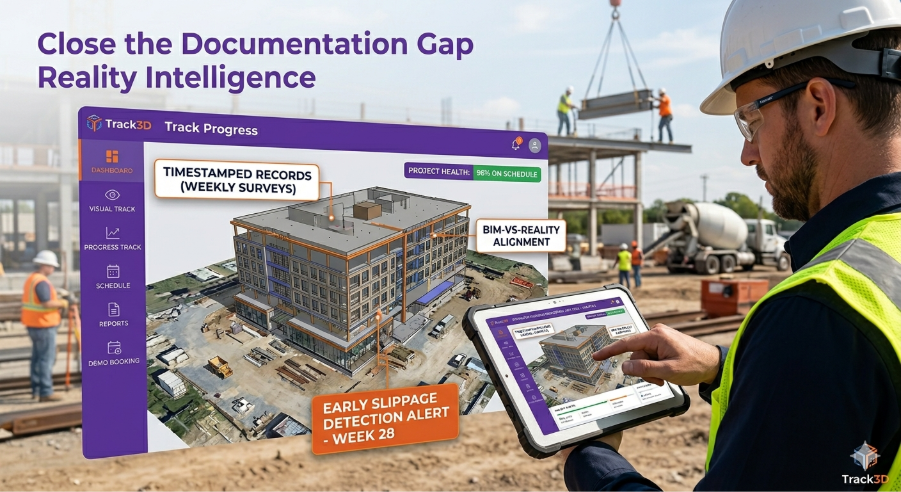
Teams with impeccable documentation are often best positioned to navigate delay disputes and avoid them in the future. And you can achieve this too, with continuous drone mapping. It enables teams to build a timestamped record of work as it happens, tied to the schedule, without relying on manual inputs or periodic site walks. Going one step further, Track3D’s Reality Intelligence is built to address this exact problem.
Choosing the right drone mapping software makes it far easier to build the timestamped record delay analysis depends on.
To start with, each aerial survey produces a georeferenced, schedule-linked model of the actual progress. This gives project managers a clear, running picture of what’s happening on the jobsite in almost real-time. It also consistently compares the as-built conditions to the planned designs and schedule to flag any discrepancies and generate actionable insights. This way, slippage or delays that would have gone unnoticed until a monthly catch-up meeting are caught almost immediately, within a few days. Through Reality Intelligence, documentation automatically becomes a byproduct of visibility, not a separate exercise.
This system is perfect for creating accurate documentation for delay analysis methods, because when a dispute/delay does arise, all necessary records are already there, built week by week over the life of the entire project.
Final Thoughts
Delay analysis is a crucial method that all construction teams must employ to figure out the root cause, point in the schedule, and accountability of delays. The four major methods are As-Planned vs. As-Built, Impacted as Planned, Window Analysis, and Time Impact Analysis. However, teams may also face issues like float ownership, concurrent delays, and schedule constraints that increase the difficulty of analysis. The best backup and resolution for smooth delay analysis is impeccable documentation. A comprehensive record of everything that occurs on the jobsite is a fail-safe tool that will help you navigate through delay analysis.
Track3D’s Reality Intelligence is designed to give teams an accurate picture of visibility and transparency of where their project stands, week by week, against the schedule and plans. This system does away with reconstructing the schedule after a mishap occurs, but rather constructs documentation alongside the project in near real-time. See how Track3D keeps you ahead of delays by booking a demo today!
FAQs
Q1: What is the most preferred delay analysis method in construction?
Ans: Time Impact Analysis is the most accurate and preferred method of delay analysis when complete project records are available. It evaluates each delay event individually against the schedule at the exact time it occurred, making it both precise and defensible.
Q2: How does drone mapping for construction support delay analysis?
Ans: Regular drone surveys create a timestamped, georeferenced record of the actual progress of the jobsite over time. This documentation is a non-negotiable prerequisite for the most reliable delay analysis methods. Additionally, it also allows teams to catch schedule slippage before it becomes a full-blown dispute.
Q3: Who has the preference of ownership when it comes to float on a construction project?
Ans: According to the widely held industry view, when a contract does not specify float ownership, it belongs to the project and is available on a first-come, first-served basis. Neither the contractor nor the employer has a unilateral claim to it unless the contract says otherwise.
Q4: What makes concurrent delay disputes so difficult to resolve?
Ans: Concurrent delays refer to situations when both parties are contributing to schedule overruns during the same period. Assigning liability requires careful forensic analysis of exactly what each party did and when. Even then, disagreements about the appropriate remedy often arise, ranging from extension of time to full cost compensation.
Q5: Can a contractor refuse to accelerate work if the employer has not compensated them for delays?
Ans: This is often a common problem at construction sites. Many professionals believe contractors should secure compensation before agreeing to accelerate, even at the risk of liquidated damages. The right approach depends on contract terms and the specific circumstances of the delay.