
McKinsey tracked 16,000 projects. Only 8.5% hit both. The root cause isn’t bad execution – it’s decisions made without objective field data.
A McKinsey analysis of more than 16,000 construction projects found that only 8.5% met both their cost and schedule targets. Of the same portfolio, just 0.5% achieved all their originally promised benefits.
These are not outlier projects. They span every size, every region, every contract type. And in a separate review of more than 300 billion-dollar megaprojects, McKinsey found average cost overruns of 80% and schedule delays of 50%.
The industry has spent years treating this as a planning problem or a people problem. McKinsey’s own diagnosis points elsewhere: rosy assumptions about productivity levels and work-hour requirements – the belief, repeated project after project, that the field will perform as planned without objective verification that the conditions for that performance actually exist.
One of the most common and costly manifestations of that gap plays out dozens of times a day on commercial job sites. It doesn’t look like a strategic failure. It looks like a drywall crew in the wrong zone.
The Scenario That Keeps Repeating
A drywaller closes a wall. An inspector arrives. The electrical rough-in behind that wall wasn’t complete. The wall comes down.
This is not a rare edge case. It’s the out-of-sequence install problem – one of the most persistent and expensive sources of rework in commercial construction – and it happens because no one had objective visibility into whether the preceding scope was actually done in that specific zone before the next trade moved in.
The math of what follows is punishing. Tear-out plus re-install is a minimum of two times the original labor cost. The failed inspection creates a delay. That delay pushes every downstream trade that was counting on zone clearance. The schedule slip compounds. The owner asks why. The GC has no documented proof of which trade’s incomplete scope triggered the chain. The blame dispute follows.
All of it traceable back to a single question no one could answer with certainty before the crew was deployed: is this zone actually ready?
Why Progress Percentages Fail at the Zone Level
The construction industry has invested heavily in progress monitoring. You can scan a floor, upload it to a platform, and know that electrical is 45% complete across the building.
That number is accurate. It is also insufficient for crew deployment decisions.
Electrical could be 45% complete across the floor – and 0% complete in the exact zones where the drywall crew is scheduled to work tomorrow. The percentage averages across the whole floor. It tells you nothing about zone-level readiness. And zone-level readiness is the only thing that matters when you’re deciding where to send a crew in the morning.
This is the structural flaw in every progress-only tool: progress measures what has been done. It cannot measure what has NOT been done in a specific location, because it has no baseline to compare against. You need to know what should be there to identify what’s missing. And knowing what should be there requires a takeoff.
What Done vs. Not Done Actually Solves
Track3D’s Done vs. Not Done capability addresses this at the source by combining two data sets that have historically lived in separate systems:
Takeoff – what should be installed. Every scope element, every category, every planned quantity across all 200+ tracked construction categories, derived directly from drawings and specifications.
Progress – what has been installed. Derived from reality captures in the field. Not verbal updates from foremen. Not estimates from supers. What is physically on the ground, verified.
Done vs Not Done overlays what has been installed directly on top of what was planned. Where the two align – the work is done. Where planned scope exists with nothing installed against it – that is the gap. That zone is not ready. And now you can see it, by zone, before a single crew is misdirected.
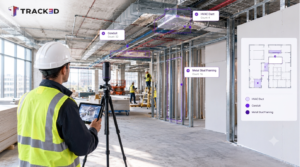
A superintendent checking the platform at 6 AM doesn’t see a floor-level percentage. They see a zone-level answer: electrical is incomplete in Zone E, Zone F, and Zone H. The drywall crew goes to Zones A, B, and C – the zones that are clear. No wasted mobilization. No failed inspection. No tear-out.
The answer changes from a percentage to a decision.
Prevention vs. Reaction
Every other tool in the market surfaces a problem after it has already been buried – after the wall is up, after the crew has mobilized, after the rework clock has started.
Done vs Not Done surfaces the problem before it becomes one. That timing shift is the entire value. Projects don’t fail because teams don’t work hard. They fail because teams work hard in the wrong zones, at the wrong time, based on unverified assumptions about what’s ready.
When 91.5% of projects miss their cost or schedule target, and McKinsey attributes the root cause to unfounded assumptions about productivity and work-hour requirements, the solution is not to plan better on paper. It’s to replace assumptions with verified zone-level visibility before deployment decisions are made.
The 6 AM Decision
Every morning, a superintendent makes the same call: where do I send my crews today? On most projects, that decision runs on yesterday’s verbal updates, a progress percentage that averages across the whole floor, and experience-based gut feel.
Done vs. Not Done changes what that superintendent has in front of them. Not a report. Not a percentage. A zone-by-zone view of what’s ready and what isn’t – built from verified field captures against the takeoff baseline – before anyone has left the yard.
That one decision, made correctly and repeatedly across a project, is the difference between a project that compounds delays and one that doesn’t.