
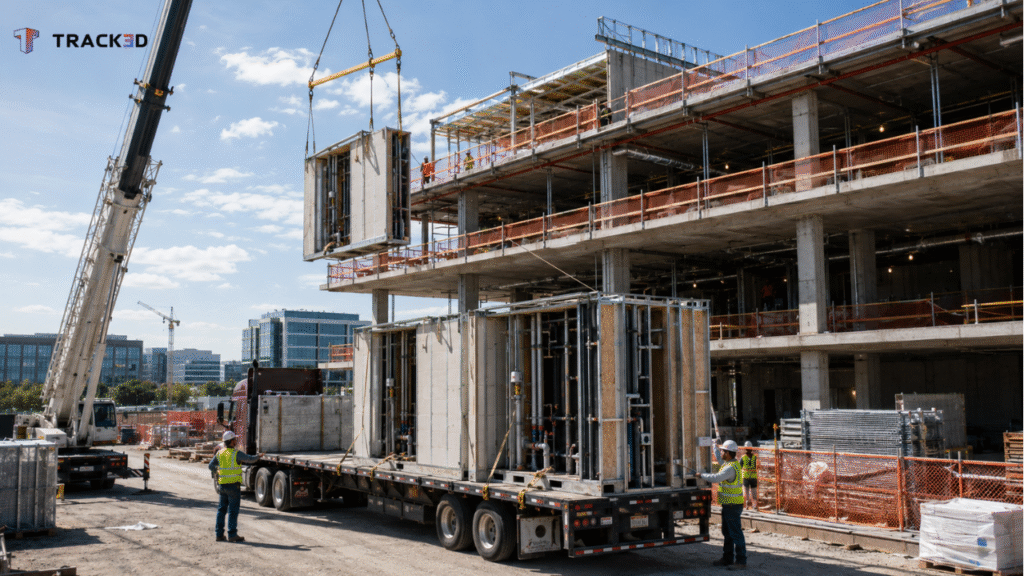
A prefabricated bathroom pod arrives on a mid-rise jobsite with a factory quality stamp already on it. A crew sets it in place. Only during rough-in does an electrician notice the panel box sits on the wrong wall. The factory finished its job, and the verification on site never happened.
A 2026 systematic review published in Sustainability studied modular construction defects. On-site assembly accounted for 44.1 percent of the root causes, while manufacturing errors made up only 26.8 percent. Building a component correctly in a controlled factory does not guarantee it lands right on the jobsite.
Key Takeaways
Prefabrication in construction means building components off-site in a factory, then delivering and installing them on the jobsite.
Factory quality control cannot catch a problem that only shows up during on-site handling, storage, or installation.
On-site assembly, not manufacturing, causes the largest share of defects in prefabricated modular builds.
Prefabricated house construction, panelized walls, and other prefabricated building components all carry the same factory-to-field verification gap across construction projects of every size.
Verifying a delivered component against its design intent and its actual installed position closes that gap.
A documented visual record settles disputes over whether a component arrived correct and landed in the right spot.
What Is Prefabrication in Construction?
It means building components, panels, or entire modules in a factory, then shipping them to the jobsite for installation. A factory can build a wall panel, a bathroom pod, or a structural steel assembly this way, long before a crew touches them on site.
Prefabricated construction covers a wide range of scope. A single precast concrete panel and a fully finished mechanical room, built off-site and craned into place, both qualify. So does a curtain wall unit, a bathroom pod, or an electrical rack pre-wired on a factory floor.
Compared to traditional building methods, a controlled factory environment gives a manufacturer tighter control over tolerances, weather, and labor conditions than a typical jobsite offers. A crew building a wall panel indoors works under consistent lighting and never loses a shift to weather. That steadier setting produces more consistent work than the same crew would manage on an open frame six stories up.
That control is real, but it stops at the factory door. Once a component ships, transport, staging, and installation each introduce their own chance for something to go wrong. A controlled setting also tends to cut material waste, a plus for owners tracking a project’s environmental impact.
A general contractor, a trade partner, and the manufacturer all share responsibility for a component’s condition. Nobody checks the component again after it leaves the factory floor. Pinning down who owns a problem grows harder the longer it sits unverified on site.
Why Prefabricated Components Still Need Field Verification
Prefabrication is one of several methods of construction that move work off the critical path. It changes building processes enough that field teams need a different verification approach.
Prefabrication earns its place in the construction industry’s project schedules because it is often more cost effective than traditional building methods. As per a SmartMarket Report hosted by NIST, 66 percent of contractors using it reported a positive schedule impact. Over a third cut four weeks or more of construction time off their timeline.
That speed only holds up if what arrives on site matches the model and the spec. Transit can still damage a panel that shipped correctly. A crew can stage it out of sequence, or set it a few inches off its intended location. None of that shows up on a factory inspection report, since the factory never sees the jobsite.
That same review found lifting and handling issues responsible for 11 percent of defect root causes, with transportation damage accounting for another 4.7 percent. Those numbers only surface once someone checks the installed component against the design, weeks after the component has left the plant. A factory inspection stamp never covers it.
A verification check has to answer two separate questions. Did the correct component arrive, matching the shop drawing’s dimensions and specifications? Did the crew install it in the correct location, orientation, and sequence relative to the rest of the model? A factory stamp only ever answers the first question.
Common Applications: From Prefabricated House Construction to Commercial Modules
Prefabricated house construction, sometimes marketed as prefab homes, ranges from panelized wall systems to fully modular units. A panelized system ships flat, and a crew assembles it on a foundation on site. A modular home arrives built almost entirely off-site, and a crane sets it in place in a single day.
A homebuilder faces the same factory-to-field gap as a commercial contractor, just at a smaller scale. A foundation out of square by even half an inch can throw off how a panelized wall or a modular box sets. That mismatch only shows up once the crew tries to land the piece.
Commercial and industrial projects lean on prefabricated structures for MEP racks, structural steel assemblies, and full bathroom or mechanical pods. A data center or hospital project might prefabricate dozens of identical mechanical skids.
A single undetected installation error on the first skid can repeat across every floor before anyone notices. Later crews often copy the position of the one already installed, so the mistake travels with it.
Multifamily and hospitality projects add another wrinkle. A hotel might repeat the same bathroom pod design across 150 rooms. A school district might standardize a classroom’s structural steel across a dozen buildings.
That repetition cuts cost, but it also means a missed verification step compounds fast. Catching an error on the third installed unit, instead of the fortieth, is the difference between a quick fix and a floor-wide rework order.
How to Track and Verify Components On Site

Start with a receiving inspection that checks each component against its shop drawing before it leaves the laydown yard, not after it is already installed. A documented submittal tells a team what the component should look like, and a receiving check confirms what showed up. That check should also verify the construction materials meet the required building codes.
Log the inspection date, the component’s condition, and any visible damage. That record becomes the baseline for every check that follows.
Track installed components against the model or drawing set as work happens, not only at a scheduled QA/QC audit. At Rycon Construction, misplaced columns had already passed submittal review and subcontractor inspection. An ongoing site capture caught the error anyway. Catching it before drywall went up prevented $75,000 in rework, real cost savings from a single catch.
Pair that ongoing capture with AI-based site inspection so a flagged discrepancy reaches the right trade fast, while the fix is still cheap. A documented visual record also settles any later dispute over a component’s arrival condition or final position.
Track3D closes the factory-to-field gap by comparing what a crew actually installs against the model. A misplaced or mismatched component surfaces before it costs real money to fix.
Frequently Asked Questions
What is prefabrication in construction?
Prefabrication in construction is the practice of building components, panels, or full modules off-site in a factory, as part of the broader construction process. A crew then ships and installs them on the jobsite. It covers everything from a single precast panel to a fully finished mechanical room.
Why does prefabrication still need field verification if factory quality control already checked it?
Factory quality control only confirms the factory built a component correctly before shipping it. It cannot catch transport damage, incorrect staging, or an installation error. Those three issues together cause most of the defects found in these builds. A field verification step, run at receiving and again after installation, closes that gap. It adds a layer of quality assurance factory checks alone cannot provide.
What is prefabricated house construction?
It includes panelized wall systems and fully modular homes. A crew assembles a panelized system on site, while modular homes are built almost entirely off-site before a crane sets them in place. Both still require checking the delivered components against the design once they reach the site.