
A progress payment in construction is a partial payment for work already done, not one lump sum at the end of a project. An owner or general contractor pays it to a contractor or subcontractor as work moves forward. This keeps cash flowing through construction projects that might last months or years. It also ties every payment to work crews have actually finished on site.
Key Takeaways
- A progress payment covers completed work, not the finished project.
- Owners pay on a progress payment schedule, usually monthly, tied to percent complete or project milestones.
- A construction draw request (or pay application) is the paperwork that triggers each payment.
- Progress billing depends on proof. Photos, reports, and schedule data all support the claim.
What Is a Progress Payment in Construction?
A superintendent walks a half-built structure every week, watching crews raise studs, run pipe, and close in drywall behind them. No one pays for that work until someone puts a number on it. That is what a progress payment does.
Instead of waiting until crews finish a building to collect a single payment, contractors bill for work as it happens. Most private and commercial contracts use a progress payment schedule that runs on a monthly cycle. The contractor submits a construction draw request, sometimes called a pay application, that lists the completed work and the amount owed for that period. These partial payments keep money moving to the people actually doing the work.
This is the backbone of progress billing in construction. It is not a bonus or an advance. It pays the contractor for work already in the ground, framed, or installed.
Why Progress Payments Matter to the People Doing the Work
Here is the part a purely technical explanation often misses. A contractor’s payroll runs on a two-week cycle, and material costs come due on their own schedule too. None of that waits for the project to finish.
If you have ever run a crew and watched a payment slip from week 60 to week 75, you already know this pain. Someone could not confirm how much drywall was actually up, and that uncertainty is what stalled the check. It is not just paperwork. It is the difference between making payroll on time and scrambling to cover it.
Industry data backs this up. According to construction economics research, a typical payment cycle runs 60 to 90 days. That is the gap between the day crews perform the work and the day cash lands in a contractor’s account. Retainage, the 5 to 10 percent an owner withholds from every payment until substantial completion, only adds to the strain. For a subcontractor with an 8 to 10 percent profit margin, retainage can equal or exceed the entire profit on a job. That is real pressure on a business that has already covered the costs incurred and is still waiting for cash. Across a large job, retainage alone can tie up a meaningful share of total project costs. A general contractor holding retainage from twenty subcontractors carries that same strain twenty times over, even before the owner releases the GC’s own retainage.
The conflict is simple to state and hard to live with. Contractors need payment for what they have built. Owners and general contractors need proof of what crews actually built before they release funds. That gap between the two needs is where a lot of time disappears.
How a Progress Payment Schedule Works
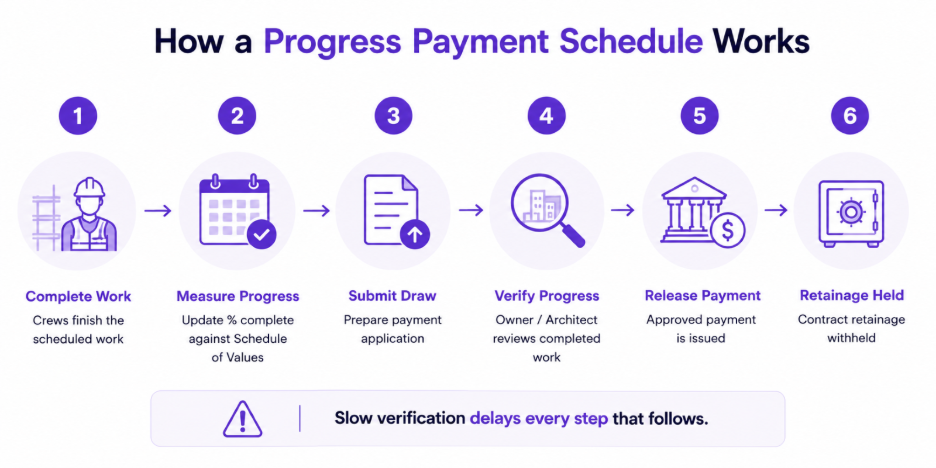
An owner and contractor agree on a progress payment schedule as the rhythm for billing and paying on a project. The owner calculates each payment based on the percentage of work complete, not a flat monthly amount. Banks use a similar draw process for construction loans, releasing funds as a project progresses. Most schedules follow a similar path from completed work to cash in hand.
- Crews perform the work. They complete a defined scope during the billing period, usually a calendar month.
- The billing period closes. The contractor tallies percent complete against the schedule of values, an itemized breakdown of the contract by task.
- The contractor prepares the draw request. This is the construction draw request, built on a standard form such as the AIA G702 application, or a similar custom form.
- The owner or architect reviews it. Here, the owner or architect checks progress billing construction claims against the evidence. This step is often the slowest part of the process.
- The owner approves and issues payment. Standard net terms mean payment can land 30 days or more after approval.
- The owner withholds retainage. They hold back a percentage of each payment until later in the project, per the contract terms.
Every step depends on the one before it. If verification is slow, everything downstream slows with it.
What Goes Into a Construction Draw Request
Every project has its own documentation requirements, but a strong draw request usually includes:
- Schedule of values: an itemized breakdown of the contract into billable line items.
- Percent complete per line item: the portion of each task the crew has finished.
- Site photos or progress reports: visual evidence that backs up the completion claims.
- Approved change orders: any changes to the scope of work since the last bill.
- Lien waivers: proof that the contractor properly distributed prior payments.
- Retainage calculation: the percentage the owner is withholding, and why.
Missing or weak documentation causes most progress billing construction delays. When a reviewer cannot quickly confirm the claimed percentage, someone has to verify it in person, and that extra step costs everyone time.
A weak submission does more than slow the current payment. It can also make the next month’s reviewer second-guess numbers that used to sail through without question.
Common Mistakes That Slow Down Progress Payments
- Relying on subjective estimates. When one person’s walk-through produces an “about 80 percent done” estimate, a reviewer has every reason to double-check it. That double-check is where weeks disappear.
- Skipping documentation until billing day. Photos and reports that a team gathers only at the end of the month rarely tell the full story of how work progressed.
- Treating verification as a separate task. Field verification often means a project manager or owner’s rep spends three to four hours walking a site just to confirm a single pay application. That figure comes from a Track3D industry analysis, and it is time no one on a construction team has to spare.
- Inconsistent terminology across submissions. When teams use different terms for the same work item from one month to the next, reviewers lose confidence in the numbers.
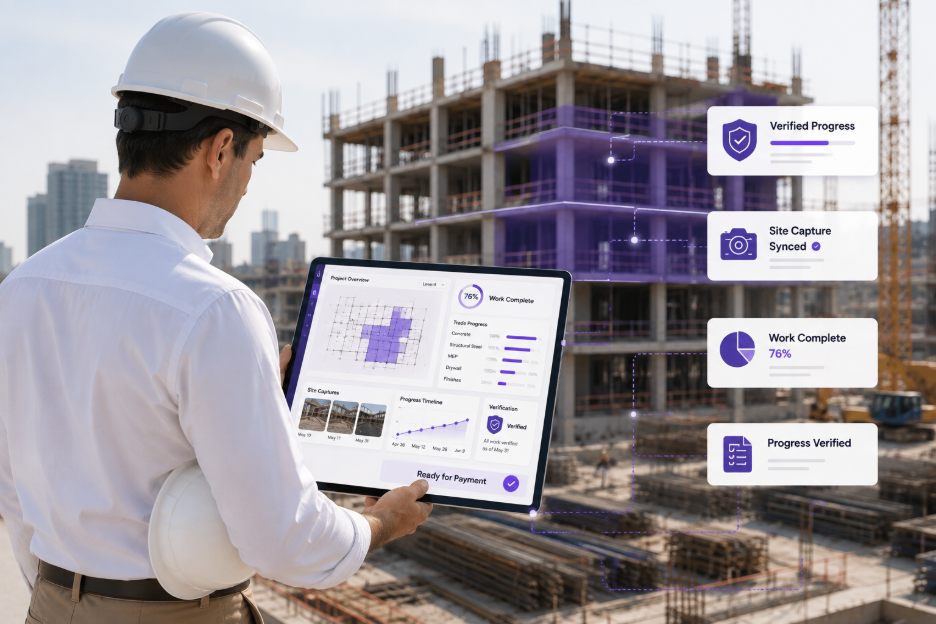
A lot of construction teams have started rethinking how they document progress in the first place. Instead of relying on a single walk-through and a stack of photos, some teams now capture site conditions on a regular cadence. They use that visual record to support every draw request.
Track3D’s Reality Intelligence platform for example, quantifies percent complete by trade, floor, and zone directly from site captures. A reviewer can then check a claimed 90 percent against measured data in minutes instead of hours. According to Track3D’s own project data, manual field verification walks dropped from three to four hours to 30 to 45 minutes on one documented project. The result is not just a faster approval. It is fewer arguments about whose estimate is right, because everyone is looking at the same objective record.
When Extra Documentation Isn’t Necessary
Not every project needs a heavier verification process. A short-duration job with a single trade, a small budget, and one straightforward draw request may not justify additional tools or documentation layers.
A four-week tenant improvement job with one subcontractor rarely needs more than a phone camera and a monthly check-in. Smaller jobs with simple scopes are often fine with a standard monthly walk and a phone camera. The complexity should scale with the size and duration of the project, not the other way around.
Ready to Simplify Your Progress Payment Process?
If verifying draw requests is eating into your week, there is a better way to see what is actually happening on site. Track3D can show you how objective progress data speeds up pay application approval.
Schedule a discovery session with Track3D and see how it works on a project like yours.
Frequently Asked Questions
Q1. What is a progress payment in construction?
A progress payment is a partial payment an owner pays a contractor for work completed during a billing period. It is not a lump sum paid at project completion.
Q2. How often do owners make progress payments?
Most progress payment schedules run monthly, though the exact frequency depends on the contract terms.
Q3. What is the difference between a progress payment and a draw request?
A construction draw request is the document a contractor submits to claim a progress payment. The draw request is the paperwork. The progress payment is the money that follows once the owner approves it.
Q4. Why do progress payments take so long to process?
Verification is usually the bottleneck. Reviewers need to confirm the claimed percent complete before releasing funds, and manual field checks can take hours.
Q5. Does retainage apply to every progress payment?
In most contracts, yes. The owner withholds a percentage, typically 5 to 10 percent, from each payment and releases it once the project is complete or reaches substantial completion.