Following the advent of artificial intelligence and the latest monitoring tools, all construction teams have been integrating these into their workflows. Today, drones and 360° cameras capture thousands of images and record every inch of the construction site. But is this leap of tech truly improving the efficiency of your work? Because when it comes to tracking the progress of the jobsite, you’ll still need days to put everything together and find out the jobsite status. Here’s what the common misconception is: this tech makes people believe that they have Reality Intelligence, when truly, what they have is Reality Capture.
The difference between Reality Capture vs Reality Intelligence is as subtle as keeping records and comprehending them. Let’s look at each one by one and understand how they can elevate construction project monitoring.
What Is Reality Capture?
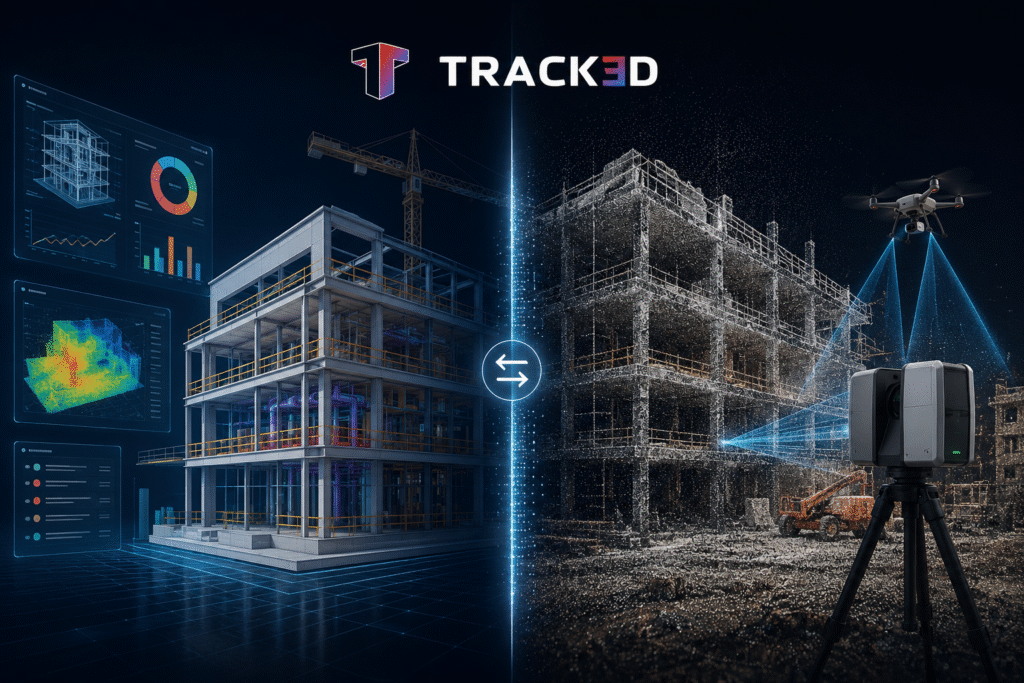
As the name suggests, Reality Capture is the technology that documents jobsite conditions. Teams can use drones to capture site imagery aerially, 360° cameras for detailed walkthroughs, and laser scanners that can create precise point clouds. These tools inadvertently lead people to believe that they’re transforming their project into an efficient marvel of technology. But just having the tools doesn’t necessarily mean that they’ll make your job easier.
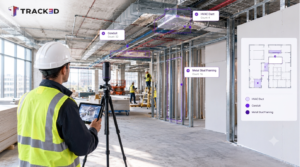
Track3D’s VisualTrack consolidates this captured documentation into one platform.
Teams use drones for construction projects to capture site imagery aerially.
It isn’t that Reality Capture has no merit. The visual records will provide a comprehensive view of what’s been built so far. This creates better historical documentation, thanks to the visual archive. And the digital documentation enables remote access and better collaboration for the stakeholders. But Reality Capture can only take you so far. It cannot analyze or compare the images. Neither can it measure progress. To take your setup even further, you need Reality Intelligence.
What Is Reality Intelligence?
It’s essential to understand that Reality Capture and Reality Intelligence go hand-in-hand. Where the limitations of Reality Capture arise, Reality Intelligence resolves them. Its main objective is to take the visual data collected by Reality Capture, use artificial intelligence to analyze, measure, and contextualize it, and ultimately, generate insights that you can work with. Here’s how we can define Reality Intelligence in a gist:
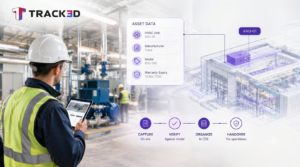
Track3D’s DeviationTrack automates this deviation detection against the plan.
This automated measurement is the core of Track3D’s construction progress tracking.
Reality Intelligence = Reality Capture + AI Analysis + Actionable Insights
Why do we call it Reality “Intelligence”? Because it gives you information and insights beyond documentation. Here’s how:
- Automated Recognition: AI automatically identifies what’s been installed without manual review. For instance, concrete pours, framed walls, and MEP systems.
- Automated Measurement: Estimates are no longer required. The system automatically calculates the progress in measurable quantities. For example, linear feet installed, cubic yards poured, or square footage completed.
- Change Detection: The AI tool will not only compare the progress with previous documentation but also indicate exactly which parts of the project have changed and progressed.
- Deviation Detection: All your captured documentation is constantly compared to the original plan and design intent, so even minor deviations are immediately caught and flagged.
- Trend Analysis: Every construction project will have trends and patterns that may be difficult to catch sometimes. But Reality Intelligence draws up these trends and indicates which zones are moving fast and which are too slow.
The key idea of Reality Intelligence is that it moves away from mere documentation and towards automated analysis and smart understanding. It saves the time and effort required to manually interpret the data and images while providing insights that act as tools to push your project ahead.
What Creates the Market Confusion?
We’ve now understood the foundational idea of Reality Capture and Reality Intelligence. But what leads to the market confusion? Why do so many teams and project managers believe that they already have Reality Intelligence?
The main hiccup arises because of marketing. Most tools of smart documentation, like drones and 360° cameras, are sold as “AI-powered solutions” or “intelligent tools.” Moreover, the technology actually feels cutting-edge. Point clouds, digital twins, and laser scans seem like impressive, futuristic tools that hold the potential to transform everything, right from the trade partners’ work to the owners’ visibility. Suddenly, teams expect shorter work times, more efficiency, and less need for resources. But all of these are only tools of documentation. And sophisticated documentation is still only documentation.
What you need beyond that is Reality Intelligence to analyze this documentation and give you insights. If you’re still confused, here’s how to determine how your team is currently equipped.
| Reality Capture features: | Reality Intelligence features: |
| Drones, 360° cameras, and laser scanners. | Automatic progress measurement from the documentation. |
| Comprehensive visual documentation. | Change detection without manual intervention. |
| Remote access and visibility to the stakeholders. | Schedule deviation alerts without consistent manual comparison. |
| Organized historical records. | Automatic generation of quality reports without exhaustive spreadsheet work. |
The simple question to ask is, “How fast can we determine the current progress?” If your answer is more than 3 days, you have Reality Capture. If your answer is less than 24 hours, you have Reality Intelligence. Most construction teams are still stuck on the first. But, in the long run, this will end up costing you more money, time, resources, and control over projects.
Why Do You Need Reality Intelligence?
Consider this simple example to understand the impact of Reality Intelligence. It’s the weekly standup call on Monday, and you need to present the progress from last week. There are thousands of pictures and hundreds of panoramas captured by the phones, 360-cameras, and drones over the last week. But to find out, “What’s the progress?” you still need to invest at least 5 – 6 hours.
Answering this one question requires you to download the entire capture, compare it manually to the previous week’s pictures, cross-reference photos with on-field notes and drawings to verify alignment between teams, and estimate the progress by taking a shot in the dark. By the time you’ve completed this analysis and presented it to the owners and stakeholders, the project has already moved on. This means you’re virtually putting in days’ worth of work to generate rough estimates that will no longer stand true to the actual progress on the jobsite.
At this stage of the construction project, you do have all the Reality Capture tools. But they’re not servicing you adequately. The expected insights, saved time, and quick decision-making are still absent from the picture, leading to only frustration. Once you realize that you only have Reality Capture, you can:
- Understand why compiling reports and updates is still time-consuming.
- Invest in the right technology with Reality Intelligence to get the best value out of your reality captures. Generate a clear picture of expectations from vendors and subcontractors.
- Use Reality Intelligence to transform smart documentation into tools that save resources every week.
Reality Capture vs. Reality Intelligence: At-a-Glance Comparison
Let us look at some real-world examples to understand how Reality Capture and Reality Intelligence will each equip you to tackle everyday issues.
| Everyday Questions | Solutions via Reality Capture | Solutions via Reality Intelligence |
| “How much concrete have we poured so far?” | Search through images and estimate visually. | Generate precise answers based on the latest captures, like 847 cubic yards, measured automatically. |
| “What zones or trades of the jobsite have changed since last week?” | Compare manually and note differences by hand. | Assess the automatic change detection highlights. |
| “Are we on schedule for each zone?” | Compare captures with the timeline and manually generate reports. | Generation of automated progress reports |
| “What’s the progress percentage?” | Assess the documentation and estimate randomly. | Receive calculated measurements and accurate numbers based on installed quantities, like 67%. |
| “How much time will it take to generate reports?” | Smart capture, but manual review, compilation, and reporting take 3 to 4 days. | Smart capture, auto-analysis, and insights are live within hours. |
| “How quickly can we make a decision?” | Assess all the documentation manually, and take reactive decisions based on what has happened already. | Analyze instant actionable insights, and take proactive decisions based on trends and patterns for better risk management and resource allocation. |
This side-by-side comparison makes it crystal clear. Whatever Reality Capture facilitates, Reality Intelligence can do better, faster, and more efficiently, all the while saving time and resources.
Final Thoughts: What Does Your Construction Project Need?
Reality Capture and Reality Intelligence aren’t competing technologies or interchangeable tools. They’re distinct stages of digital evolution in any construction monitoring work. While the former gives you a visual record of the site, the latter gives you a brain to process what’s seen. Through capture, you get smart documentation. But through Reality Intelligence, you get objective progress insights and schedule deviation alerts along with smart documentation.
So the answer to this question is simple: your construction project needs Reality Intelligence. You need tools that will make the job more efficient without wasting excess resources. And Reality Intelligence does just that. While Reality Capture solves the problem of “Can I see the site consistently?” Reality Intelligence takes it one step further, smartly analyzes the jobsite, and solves the hassle of “What does this data tell me?”
And if your current system fails to go beyond smart documentation, you need to bridge the gap and bring Intelligence into the picture.
Want to see how Reality Intelligence transforms the data you’re already capturing? [Explore what intelligence looks like in practice →]