When managing a construction project, in theory, everything looks perfectly in place. Schedules are updated regularly, budgets are aligned, and tasks are progressing as expected. But a single visit to the job site introduces the contractors and project managers to something completely different! For instance, work that was marked complete is still in progress, small deviations that should be caught keep getting overlooked, and so on. This isn’t happening because you don’t have the best construction management software – it’s happening because the gaps caused by the CMS are not being addressed.
What construction teams need to fulfill the limitations of the best construction management software is AI progress monitoring. It helps verify reality, removes manual intervention, and ensures that there’s no gap in the as-built conditions and reports. In this guide, we explore more about CMS and how it interacts with AI progress monitoring. Continue reading to find out more!
Key Takeaways
- Even the best construction management software relies on human input and manual intervention. Because of this, it cannot verify on-site reality.
- A major blind spot of construction management software is the lack of real-time visibility into what is actually built vs. what is reported.
- A visibility gap leads to rework, delayed decisions, missed deviations, and inaccurate progress tracking.
- AI progress monitoring is built to capture and verify site conditions independently using real-time visual data.
- The AI system adds spatial context, detects deviations early, and feeds accurate data back into the CMS.
- CMS and AI progress monitoring together create a complete, reliable system for modern construction management.
What the Best Construction Management Software Is Built to Do
The best place to start is to understand the pros of conventional methods. Thus, let’s begin by understanding what the best construction management software of the market is designed to do. For instance, tools like Procore, Autodesk Construction Cloud, and BuilderTrend are some of the most popular ones that manage the following:
- Schedules and programs: Gantt charts, milestone tracking, lookahead planning.
- Document control: Drawing management, version control, RFI, and submittal workflows.
- Budget and cost tracking: CVR, cost forecasting, and subcontractor payment management.
- Team communication: Centralized information that connects the office and field teams.
- Compliance and reporting: Inspection records, safety logs, and audit trails.
For a domain as dynamic as construction, managing these things is not easy. For several decades, this information predominantly resided in filing cabinets, email threads, and people’s memories. So the fact that construction management software was able to pull everything together is a huge deal. But unfortunately, even the best tools have their limitations. In this case, it’s the site boundary.
How to Choose the Best Construction Management Software?
Before we move on to exploring the limitations of CMS and how they’re addressed, let’s take a quick detour to understand how we can pick the best construction software. This is an important step, since the idea is not to replace CMS but to complement it.
Here are a few questions you can ask to ensure that you’re getting the best construction management software:
- Does the platform support independent progress verification, or does it rely entirely on self-reporting?
- Can it ingest spatially referenced site data and connect it to the project model?
- Does it integrate with AI progress monitoring tools, or does it create a separate data silo?
- How current is the progress data driving the dashboard? Hours, days, or weeks old?
- Can the system distinguish between what was reported as complete and what was independently verified as complete?
Some of these questions, and how they relate to progress management, might not entirely make sense. But they are certainly extremely important. As we discuss more about AI progress monitoring further into the guide, you’ll get a better idea of why it is so crucial to choose the best construction management software!
Limitations of Construction Management Software: The Blind Spot
The biggest limitation of even the best construction management software lies in the fact that all its information comes from human input. Tasks are marked complete by the respective stakeholders. Progress percentages are entered by subcontractor foremen. Budget figures are updated by the commercial team. Documents are uploaded by whoever remembers to upload them. Basically, the entire system works around human-entered data.
This implies that the physical job site and things pertaining to it, like what has been installed, where it has been installed, what quantities have been used, and whether it matches the coordinated design, remain largely invisible to the construction management software. Because of this, it creates three major hurdles:
- It cannot verify physical progress independently.
All information in the CMS comes strictly from what the teams report. So if a subcontractor marks a job done, it will reflect the work done. The software has no way of knowing or displaying whether the work is actually done, half-done, or not even started.
- It cannot understand spatial context.
If something is input into the system, it cannot provide more spatial context to that piece of data. For instance, if you input an error, the system will only show the information you entered. It cannot add more context, like where exactly did the defect occur, which trades and elements does it relate to, how does it connect to the 3D model, etc. Because the CMS does not have any visibility of the job site, it cannot add these spatial references.
- It cannot detect deviations automatically.
Because even the best construction management software does not constantly compare what is being built vs. what was planned, it cannot flag any deviations. In fact, when CMS is the only tool in the picture, the only way deviations come to notice is when someone physically compares the as-built conditions to the drawings and plans at handover. Unfortunately, until then, it is almost always too late.
Because of these limitations, certain types of data never make it into the construction management software, like thousands of site photos taken on personal phones but never logged in, verbal progress updates from foremen, clashes and deviations spotted on site walks, etc. How are these limitations costing your project? Keep reading on to the next section.
What Are These Limitations Costing Your Project?
This discrepancy between what the construction management software shows you and what’s actually happening on the job site is not just on paper. It’s an actual problem that comes with a hefty price tag. Some of the different ways that it directly affects the project are:
- Rework costs: It is estimated that the global construction industry loses up to $625 billion annually, just because of avoidable rework. And a significant percentage of this figure comes from deviations that weren’t captured by the CMS, because it simply can’t see them.
- The 1:10 rule of late detection: A defect caught during construction costs approximately one-tenth of the same defect caught at handover. Thus, this makes it extremely crucial to catch errors as early as possible.
- Self-reported progress inflation: Sometimes, to show a healthier progress percentage, crews input numbers that don’t necessarily match the progress on the job site. To avoid this, whatever system you use needs to verify completion percentage independently – something that can occur only when there’s job site visibility.
- Handover surprises: The list of errors that came up at the handover stage almost always existed several weeks prior but never came up because it was invisible to the system and the data were never verified physically against the design models.
- Decision lag: When the data available in the construction management software is days old and unreliable, it will affect the project in the weakest spot possible – decision-making. Decisions need to be made based on accurate information and complete visibility, not guesswork.
The Solution: AI Progress Monitoring in Construction
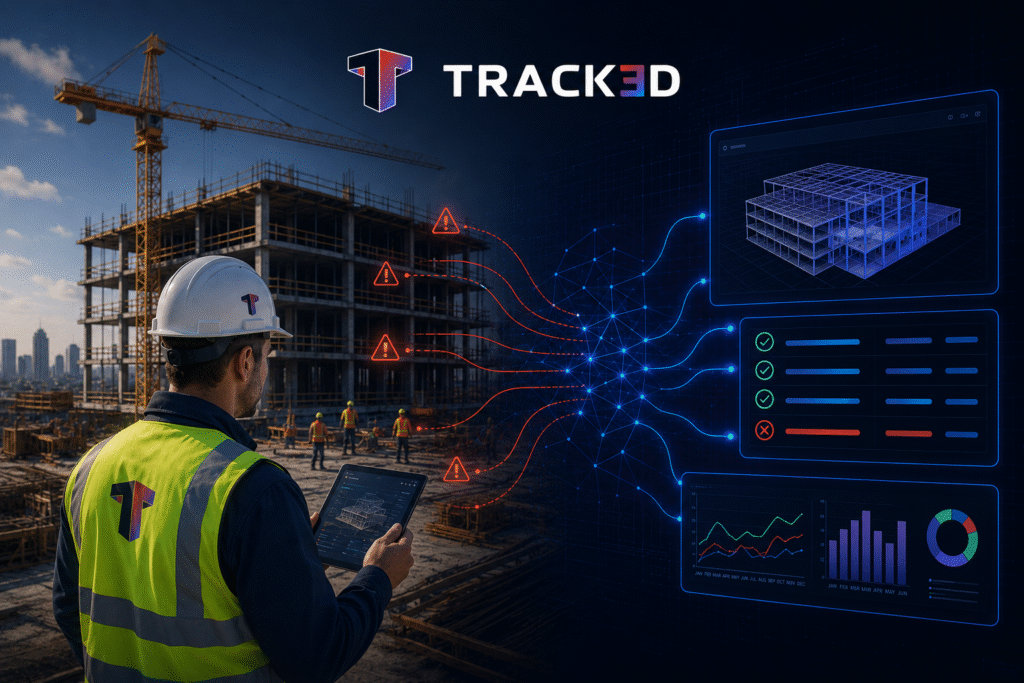
AI progress monitoring is the use of artificial intelligence to automatically capture, interpret, and report on the physical state of a construction site. It also compares what has been built on the job site against what was planned initially, without relying on manual data entry.
Understand that AI progress monitoring differs from construction management software because it does not intend to replace it. It is a useful addition that fulfills the gap posed by the CMS. To better comprehend how it works, take a look at these pointers about what AI progress monitoring looks like in action:
- AI processes site imagery from 360° cameras, drones, or smartphones.
- It interprets what has been completed, identifies what is missing or incorrect, and locates every finding spatially within the building model.
- Progress data is updated in near real-time, independently of subcontractor self-reporting.
- Verified site intelligence feeds directly back into the CMS and project controls workflow.
Thus, AI progress monitoring reads reality. It is designed to reach the physical site in near real-time while being grounded in spatial data that removes all ambiguity and makes accountability measurable.
How AI Progress Monitoring Fills Each Gap
In this section, we look at how AI progress monitoring fulfills and overcomes each limitation created by even the best construction management software. Here’s an at-a-glance comparison:
| Gap | Construction Management Software | AI Progress Monitoring | Outcome |
| Self-Reported Progress | A subcontractor or trade owner marks the certain job as done. The CMS will reflect it as is, regardless of whether it’s done or not. | The AI system compares the physical site conditions against the model. Whether completion is actually done or not is verified without human intervention. | Program data reflects what has actually been built and not what teams said they have built. |
| Lack of Spatial Context and Location | A small error, like a ceiling grid defect, is logged into the system as “Level 3, north side, near column C4.” But it reads differently for different people. | This system logs every error with precise location in the 3D model, leaving no room for ambiguity. | A spatial audit trail that protects all parties and leads to faster resolution and cleaner accountability. |
| Deviation Detection | When reporting is done manually, it takes time to find deviations from the design because someone needs to physically go inspect it. | Since AI progress monitoring involves continuously verifying the as-built conditions, deviations are flagged almost immediately. | Deviations are caught during construction and not at handover, when they cost ten times more to fix. |
| Old Data | When someone is manually entering information into the construction management software, the data is going to be weeks old and irrelevant. | Since site conditions are updated in near real-time, whatever data is updated is always very recent and up-to-date. | Decisions are made on current data and not the last manual entry. |
| Siloed Site Data | More often than not, updates given by the on-ground team don’t even make it into the system, meaning that the information in the CMS almost always provides an incomplete picture. | AI progress monitoring captures all information from the job site, organizes it spatially, and then feeds it back into the CMS. | This system creates a singular source of truth that actually reflects site reality. |
The Construction Technology Stack: How Does This Fit Together?
As mentioned before, AI progress monitoring is not meant to replace the conventional means of project management. Your project still deserves the best construction management software. At the end of the day, modern construction works as a mix of all, with three distinct technology layers. Here’s what they are:
- Layer 1: Design and coordination (BIM): It handles 3D design, clash detection, and pre-construction coordination. However, its limitation is that it cannot track what is physically built after the project begins on site.
- Layer 2: Project and Business Management (Construction Management Software): It handles schedules, documents, budgets, communications, and compliance. Its limitation is that it cannot independently verify physical progress or automatically detect site deviations.
- Layer 3: Site Intelligence (AI Progress Monitoring): It handles physical site reality, what has been built, spatial context, its quality and standard, and deviations from the original plans. Then, it feeds verified progress data into the CMS in order to keep layer 2 grounded in layer 3 reality.
The three layers together create the entire picture. The best construction teams do not choose between these but understand that they all need to work together in order to experience smooth project management and progress monitoring.
Construction Management Software: 2026 and Beyond
The future of construction management software is closely linked to AI progress monitoring. One cannot evolve without the other. Here are some of the key aspects that reflect how the construction field is expected to move into the future:
- AI-native progress tracking: The next generation of construction management software will not wait for humans to report progress. It will read site conditions automatically and update the program in near real-time.
- Spatial data will be the standard: The best construction management software is expected to log location-referenced issues, automatically verify as-built conditions, and compare 3D models.
- Predictive project control: AI will identify schedule and cost risks from spatial progress patterns before they show up in the program as overruns.
- Closed-loop construction management: Site intelligence obtained by constantly observing the job site will trigger CMS workflows. Then, in turn, teams can take advantage of complete automation of procurement orders, subcontractor scheduling, and inspection signoffs – all based on verified physical progress rather than reported completion.
- The convergence of BIM, CMS, and AI: In the future, the three-layer construction technology stack must converge into a single, spatially aware project intelligence platform, where design intent, project management, and site reality are always in sync.
Final Thoughts
Construction management software was built to organize, track, and manage project information. However, its biggest limitation is that it cannot see or interpret what’s physically happening on the job site. This gap is where AI progress monitoring comes to the rescue.
It verifies progress independently, adds spatial context, and detects deviations in near real-time, all without the need for manual intervention. AI progress monitoring is not a replacement for CMS but a reinforcement that grounds the project data in reality. It feeds verified site intelligence back into the CMS, thus turning decision-making into a faster, clearer, and more reliable process. Together, the best construction management software and AI progress monitoring form a connected system and a powerful tool for project management.
Want to see what this looks like in practice? Explore how modern tools like Track3D bring AI progress monitoring to construction teams so your construction management software finally knows what’s happening on the job site.
FAQs
Q1: What is the difference between construction management software and AI progress monitoring?
Ans: Construction management software manages structured, human-entered information, like schedules, budgets, documents, and communications. On the other hand, AI progress monitoring independently monitors the physical site to verify what has actually been built against the design model. The former manages the plan, whereas the latter reads the reality.
Q2: Does AI progress monitoring replace construction management software?
Ans: Not at all! AI progress monitoring fulfills the limitations of construction management software. Neither is meant to be a replacement. In fact, the two are supposed to work as complementary layers: the CMS manages project data and workflows, while AI progress monitoring feeds verified, spatially referenced site intelligence into it.
Q3: How does AI progress monitoring work on a construction site?
Ans: The AI system captures site imagery via 360° cameras, drones, and smartphones. Then, it interprets which tasks have been completed, identifies deviations from the design model, and adds a precise location in the 3D model to every finding. The best part is that it does all this without relying on manual data entry from subcontractors or site teams.
Q4: How much does rework cost the construction industry?
Ans: It has been estimated that the global construction industry loses around $625 billion annually to rework. The worst part is that a significant portion of this stems from deviations that go undetected because construction management software cannot independently verify physical site conditions and only records what people report.
Q5: What is the 1:10 rule in construction quality control?
Ans: The 1:10 rule of construction quality control states that a defect caught during construction costs approximately one-tenth of the same defect caught at the handover stage.
Q6: What should construction teams look for in construction management software in 2026?
Ans: Beyond the standard checklist of schedule management, document control, and budget tracking, teams should ask whether the platform supports independent progress verification, integrates with AI progress monitoring tools, ingests spatially referenced site data, and can distinguish between self-reported and independently verified completion.