Construction projects generate massive amounts of information every day. Unfortunately, only a small amount is properly documented. As all project managers experience, inconsistent and incomplete information can become confusing during delays, disputes, and payment discussions. To counter this, what you need is a construction daily report. They provide a clear record of what happened in a structured format that teams can use.
In this guide, we look at what a construction daily report is, everything it should include, its supplementary digital tools, and why it matters for construction projects. Keep reading to find out more!
Key Takeaways
- A construction daily report is a structured, day-by-day record of site activities, workforce, materials, safety observations, and delays.
- Detailed and consistent reports are critical for dispute resolution, payment claims, and subsequent issues.
- Digital reporting tools improve accuracy by providing timestamped, searchable, and centrally stored records.
- 360° reality capture and BIM integration add visual context and improve progress tracking across large projects.
- Vague descriptions, missing photos, and delayed completion are common mistakes that reduce the credibility of reports.
What Is a Construction Daily Report?
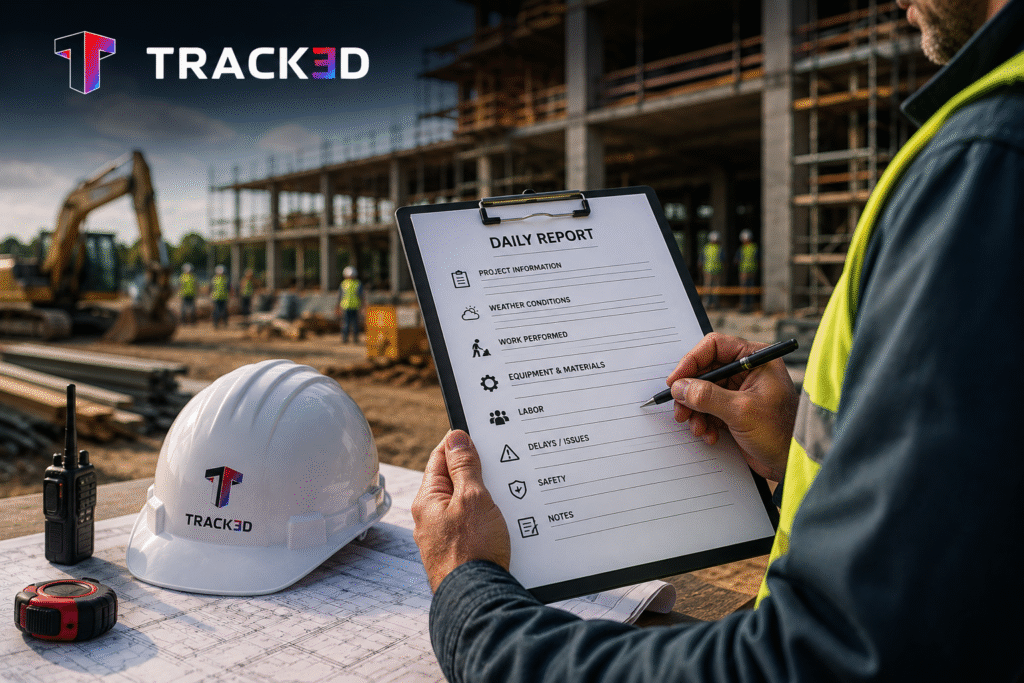
A construction daily report is a comprehensive record of what happened on the jobsite: who was there, what work was done, which materials arrived, and what problems arose. Typically, the superintendent or site manager undertakes completing a construction daily report. However, the respective foremen take over for individual trades on larger projects, and safety officers for safety-specific records.
Having a structured construction daily report is incredibly important as it serves as a centralized document containing all necessary information.
What Should You Include in a Construction Daily Report?
Let’s answer the ultimate question: what should be included in a construction daily report? In the following table, we’ve included a detailed list for reference. Ensure that you structure each section consistently so that every report looks the same and is easy to comprehend.
This includes any rfi in construction that could affect the schedule.
| Category | Subcategory |
| Date, Project, and Location | Date, project name and number, site location or zone. |
| Report number (sequential for filing). | |
| Completed by (name, role, signature). | |
| Weather Conditions (Critical evidence for when delays are disputed.) | Temperature (morning and afternoon). |
| Precipitation type and duration. | |
| Wind conditions, if relevant to crane or elevated work. | |
| Any weather-related work delays. | |
| Workforce on Site | Subcontractor names and worker numbers per trade. |
| Supervisors and foremen present. | |
| Visitors, inspectors, or owner representatives on site. | |
| Work Completed (Shouldn’t be skipped! Specific details are far more useful than a vague category.) | Areas worked and scope of work performed. |
| Quantities installed in precise measurements. | |
| Percentage completion against program milestones, where applicable. | |
| Any work that was planned but not executed, with the reason. | |
| Materials Delivered | Supplier, description, and quantity received. |
| Condition on delivery – any damage, shortages, or rejections. | |
| Equipment on Site | Equipment type, identification, and operational status. |
| Breakdowns or maintenance issues. | |
| Equipment arriving or leaving the site. | |
| Safety Observations | Toolbox talks conducted (topic and attendees). |
| Inspection results and corrective actions. | |
| Near misses or incidents, even if minor. | |
| Unsafe conditions identified and actions taken. | |
| Instructions and Correspondence (Noting a verbal instruction to proceed with additional work is the basis of a change order claim.) | Instructions received from the owner, architect, or engineer. |
| RFIs submitted or responses received. | |
| Change order instructions (verbal or written). | |
| Issues, Delays, and Constraints | Factors preventing planned work, including trade coordination issues. |
| Design conflicts or access constraints. | |
| Decisions deferred and to whom. | |
| Visual Documentation (Photos stored with the daily report are better evidence than separate ones.) | Number of photos and reference numbers. |
| Description of what each photo documents. | |
| 360° walkthrough captured (yes/no, area covered). |
Why Do Construction Daily Reports Matter?
According to the Construction Management Association of America (CMAA), documentation disputes are one of the most common sources of construction claims. And a construction daily report is often the first document a claims team will request. In fact, if you ask any superintendent who has been through a payment dispute whether daily reports need to be efficient, they’ll instantly say yes.
Pair daily reporting with a construction documentation checklist so nothing critical is missed.
By maintaining structured daily reporting, you’re looking at the following advantages:
- A comprehensive, legally credible record of site events.
- Proactive management through daily visibility of labor and progress.
- Support for payment applications and change order claims.
- Reduction in the time of dispute resolution when the records are complete.
Additionally, here are a few practical applications:
- Legal and Claims Protection: A structured and comprehensive construction daily report is great evidence in any dispute. Regardless of the issue, a report completed on the same day is far more credible than recalling the details from memory.
- Project Management Intelligence: A well-structured daily report also tells where the project stands, for instance, labor deployed, on-site materials, and progress against the predetermined program. It gives the PMs complete information to make sound decisions.
- Payment and Change Order Support: Daily reports provide fast resolution for varied instructions and disputed quantities, as what was instructed and completed are documented well.
How Does Digital Daily Reporting Work?
Digitalization has the potential to make construction daily reporting more efficient. Paperwork can be vague, illegible, or filed away. Digital tools, on the contrary, provide a structured, timestamped, and immediately accessible record. Here’s how the workflow for basic digital reporting functions:
- Open the reporting app at the end of the shift.
- Complete structured sections, like weather, workforce, work done, materials, safety details, etc.
- Attach photos to relevant entries.
- Submit the report.
- It automatically gets timestamped and filed.
- The project manager receives instant access to the day’s report.
- It’s easily searchable by date, location, or keyword.
Tools and Technologies for Construction Daily Reporting
To utilize the benefits of digital daily reporting, here are some of the best tools that you can implement and integrate into your workflows:
Track3D’s VisualTrack links those 360 walkthroughs to each daily report entry.
Track3D adds construction progress tracking that ties each report to verified site progress.
- Mobile Field Reporting Apps: These are purpose-built apps containing structured templates that guide the superintendent through each section. They also timestamp submissions automatically and sync the data to a central project record.
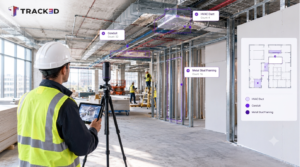
- Progress Monitoring & Reality Capture Tools: Reality capture tools enable 360° site walkthroughs, which, coupled with daily reporting, create a visual record that supplements the written report. Track3D is one such progress monitoring platform that links 360° site imagery to specific locations and dates. So when a report shows a concrete pour conducted in zone B3, the corresponding 360° capture will show exactly what was there.
- BIM Integration: For large projects, teams can link daily report quantities to BIM model elements, so the model’s status consistently updates against the program.
- Cloud Document Management: This is recommended to maintain a centralized storage place. Cloud-stored reports are also more defensible and reliable than locally stored folders.
Common Mistakes in Construction Daily Reporting
To ensure that you gain the best out of the practice of construction daily reporting, we’ve listed some of the most common mistakes here:
- Completing reports retrospectively: Each construction daily report must be completed on the same day, since writing it days after reduces its credibility. Make it a mandatory task at the end of the day and ensure it gets filled properly.
- Writing vague descriptions: Precise details, like “poured 45m³ to ground floor slab, zones B1-B3, by 14:30,” prove the most useful. Vague notes, such as “Concrete work continues,” are not helpful in the long run. Thus, ensure the supervisors are trained to record specific quantities and locations.
- Not attaching photos: Without images, reports cannot serve as credible evidence in disputes. If you fix a minimum number of required images per report that are linked to specific entries, you will obtain a more comprehensive daily report.
- Not adding weather delay info: When program claims arise later in the project, weather delay records prove helpful. Hence, ensure that the weather and constraint sections are mandatorily filled.
- Not reviewing reports: If reports are only filed but never reviewed, they will not add the required value to project management. Thus, there needs to be an established process for the PM to regularly review reports.
When Is a Daily Report Not Necessary?
Construction daily reporting may also pose certain tradeoffs. For instance, it requires daily discipline, as inconsistent completion will undermine the entire record. In the beginning, detailed reporting at the end of a long shift may take time. Also, integrating digital tools often requires onboarding before efficiency gains can be noticed. And lastly, if reports are completed under pressure, they might be vague. But quality matters just as much as the frequency of reporting.
These tradeoffs, in addition to other situations, sometimes imply that structured daily reporting may not be a good investment. For example:
- When it’s a small two-day repair job with a single tradesperson.
- When client relationships are informal, and arrangements are trust-based.
- When the project is still in early planning phases.
But other than these situations, in all commercial, civil, and industrial projects above a certain scale, daily reporting is a contractual obligation.
Conclusion
As projects become more complex, relying on memory or scattered notes isn’t viable. What you need is a well-structured construction daily report. It does wonders for maintaining a record of site activity. It creates accountability, improves coordination, increases visibility, and provides evidence for claims and disputes. And teams can make faster decisions as well. While the initial setup may require time and discipline, the long-term value is always worth it!
Track3D extends daily reporting into visual intelligence by linking 360° site walkthroughs to the project record, so every entry has a corresponding visual record that is searchable, timestamped, and defensible. Want to see how it works? Book a demo today!
How to Write a Construction Daily Report (Step by Step)
A good daily report takes five minutes when you follow a consistent routine. Here is a simple step-by-step process any crew can adopt:
- Log the basics first: date, project name, weather, and temperature.
- Record labor: crews on site, headcount, and hours worked by trade.
- List work completed: activities, locations, and quantities installed.
- Note equipment and materials: what was used, delivered, or idle.
- Flag issues and delays: RFIs, safety incidents, inspections, and anything that could affect the schedule.
- Attach visual evidence: photos or captures that back up the written record.
- Sign and submit the same day, while details are still fresh.
Construction Daily Report Template (Example)
Use this filled-in example as a template for your own reports:
| Field | Example Entry |
|---|---|
| Date / Weather | 12 Mar 2026 / Clear, 18°C |
| Crews on site | Concrete (6), Electrical (3), Site (2) |
| Labor hours | 88 total |
| Work completed | Poured Level 2 slab (Grid A–D); pulled conduit east wing |
| Equipment | Concrete pump, 1 telehandler (idle 2 hrs – late delivery) |
| Delays / Issues | Rebar delivery 2 hrs late; RFI-042 opened on beam detail |
| Photos attached | 6 (slab pour, conduit runs) |
Daily Report vs Daily Log: What’s the Difference?
The terms are often used interchangeably, but they serve slightly different purposes. A daily report is a formal, shareable summary of the day — labor, work completed, delays — usually sent to owners or the office. A daily log is the running field record the superintendent keeps, capturing observations and events as they happen. In practice the log feeds the report. For a deeper look at keeping that field record accurate, see our guide to the construction daily log.
FAQs
1. What is a construction daily report?
A construction daily report is a structured record completed each day that documents site activities, workforce, weather conditions, materials, safety observations, and project issues. It serves as a detailed record of what occurred on the project and can be used as supporting evidence when needed.
2. Who completes a construction daily report?
Typically, the site superintendent or project manager completes the daily report. On larger projects, trade foremen or discipline supervisors may also submit supplementary reports covering their specific work areas.
3. How detailed should a construction daily report be?
A construction daily report should be detailed enough to serve as reliable project documentation. Key information often includes workforce numbers, installed quantities, weather conditions, equipment usage, delays, safety incidents, and corrective actions taken during the day.
4. Can a construction daily report be used in legal disputes?
Yes. A contemporaneous daily report completed and signed on the same day the events occurred is often considered one of the most credible forms of evidence in construction claims, disputes, and litigation.
5. What is the difference between a daily report and a progress report?
A daily report records activities and events that occur each day on the job site. A progress report is a periodic summary that tracks overall project performance, progress against the schedule, and budget status. Daily reports often serve as the source data used to prepare progress reports.