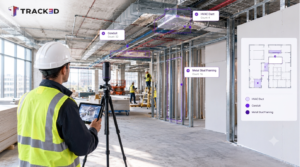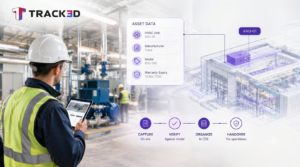
With the launch of Track3D Daily Logs, the construction industry’s most critical document is no longer written from memory. It is built from what actually happened.
Ask any project manager what happens when a dispute goes to arbitration and they will tell you the same thing. Everything comes down to the daily log.
Who was on site. What work was done. What conditions existed. What was said, flagged, observed, or missed. The daily log is the timestamped record of what actually happened on a construction project. It is the document that protects schedules, substantiates claims, defends pay applications, and keeps every party accountable to every other.
It is, by any measure, the most important document produced on a job site. It is also, by any honest assessment, the least reliable.
Not because the people writing it are careless. Not because the tools are bad. But because of a structural problem that every person who has ever worked on a construction project understands and almost nobody says out loud. The daily log is written from memory, at the end of a long day, by someone who spent that day doing something far more urgent than writing.
That is the daily log problem. It has existed for as long as construction has. Today, we are changing it.
Why This Problem Has Persisted
A superintendent arrives on site before 7am. Morning huddles, trade coordination, problem-solving across floors and zones. By 3pm she has made hundreds of observations and dozens of decisions. Conditions that should be documented. Conversations that should be on record. Deviations that will matter in six months when someone asks what the site looked like on this specific day.
By 5pm she is writing a daily log from memory.
She writes what she can recall. The decisions. The major events. A record that reflects the 20% of her day she can document, not the 80% that happened in between.
This is not a failure of the superintendent. It is the design of the system. The daily log, as it has always existed, requires someone to stop doing their job to document their job. The act of documentation is separated from the act of doing. By hours. By fatigue. By the impossibility of filling out multiple fields on a mobile device in a noisy, time-pressured environment. That friction always loses to the urgency of the field.
What Daily Logs Changes
Track3D Daily Logs is not an improvement to the daily log workflow. It is a replacement for the assumption that the daily log workflow is where documentation should happen.
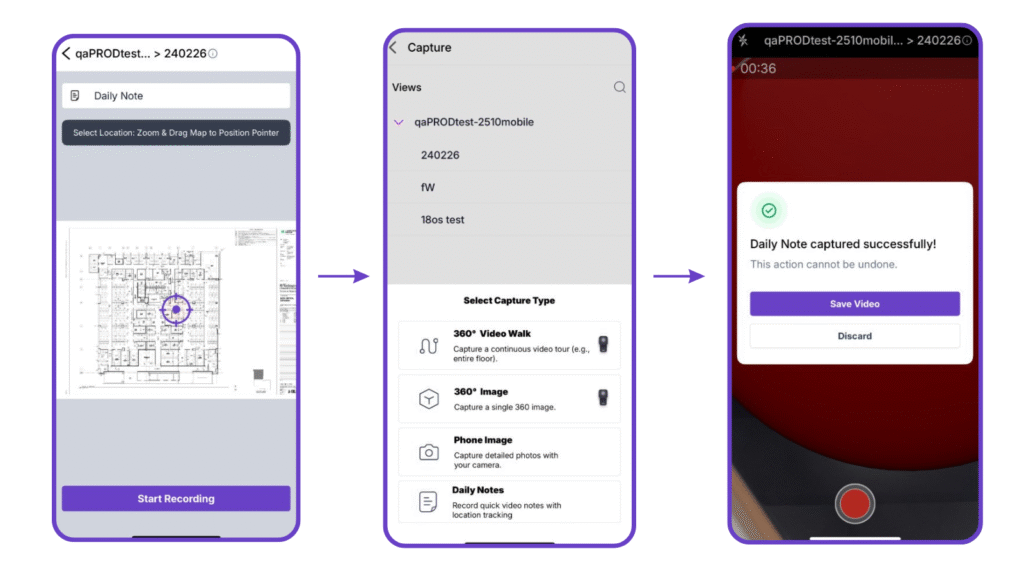
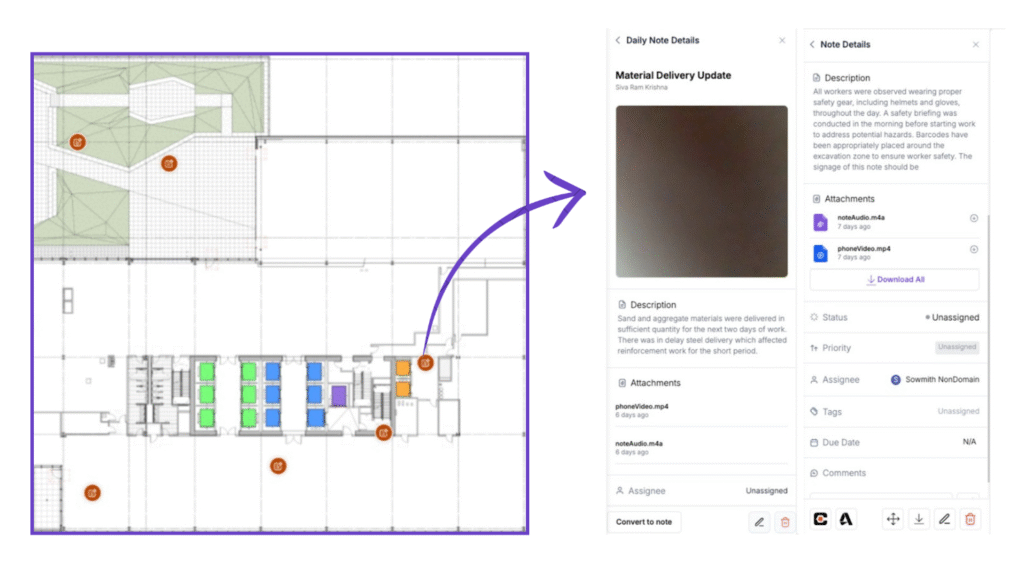
A field engineer spots an issue. MEP rough-in on level 3 east is behind. She opens Track3D, taps Daily Note, taps a point on the floor plan, and the camera opens. She records while speaking. “Duct installation incomplete here. John needs to finish before Friday or the framing crew cannot move in.” That is the entire documentation act. Fifteen seconds. One tap, one recording, one observation.
The voice recording is transcribed. AI processes the transcript and extracts a structured note. Title. Description. Priority. Category. The note is automatically tagged with the floor plan location, the trade, and the timestamp. It goes live on the web platform immediately.
She did not stop work. She did not fill in a form. She spoke a sentence while standing in front of the condition she was describing. The documentation exists because the friction of creating it dropped below the threshold of what a busy field team will tolerate.
The AI Daily Field Report
At the end of the day, or on demand at any point, someone on the project team requests the daily report.
What they receive is not a stack of individual entries to read through and mentally synthesise. It is a structured, AI-generated summary of everything that was captured during the day. Organised by trade. By location. By issue type. The key risks. The notable progress. The outstanding items requiring attention.
For the superintendent and field engineer, documentation now happens as work happens. The log is a byproduct of doing the job, not a separate task at the end of a twelve-hour day.
For the project manager, a synthesised report replaces the manual work of reading through individual entries. Issues that need attention surface. The PM is no longer bounded by what field teams remembered to write down at 5pm.
For the project executive, daily logs are now a real input to project intelligence rather than a compliance artefact. Production rates, field observations, and emerging risks flow from actual site activity into the same intelligence layer that tracks progress across the portfolio.
For the owner, progress reporting grounded in real observations is fundamentally more credible than reporting built on end-of-day recall. When a pay application claims a certain level of completion, the Daily Logs from the relevant period are the ground-truth record.
Why This Matters for the Platform We Are Building
Track3D is a construction intelligence platform. Its purpose is to give project teams the ability to see what is happening across their sites, surface risks before they become problems, and maintain accountability across every layer of the organisation.
That intelligence is only as good as the data feeding it. And the most important data has always been the most unreliable: what actually happened on site today.
Daily Logs solves that problem at the source. It integrates documentation into the workflows that already exist on site, so that every observation feeds back into the platform and every insight reaches the people who can act on it.
Daily Logs is how the field’s knowledge flows in. Every voice note, every location-pinned capture, every observation structured by AI enriches the intelligence layer with ground-truth context that no automated system can generate on its own. The superintendent who records that MEP is behind on level 3 east is not just creating a log entry. She is feeding the same intelligence layer that tracks schedule adherence and surfaces risk across the portfolio.
The reconstruction era is over.
What Is Available Today
Daily Logs is live across all Track3D projects.
Field teams walk their sites as they always have. When they observe something worth documenting, they tap Daily Note, select a location on the floor plan, and record while speaking. AI transcribes and structures the note immediately. Every note carries the visual capture, the audio recording, the AI-generated title and description, the extracted assignee and due date, the floor plan location, the trade if inferable from context, and the full timestamp and creator metadata. Nothing entered manually.
Notes that require follow-up convert to Work Items, persistent and trackable tasks that carry forward across dates as part of project execution.
At end of day, the AI Daily Field Report compiles everything and the PDF is delivered to all project admins.
The End of End-of-Day Reconstruction
For years, daily logs have existed as a compliance task. Something teams completed because projects required it, not because the process reflected how work actually happens in the field.
Track3D Daily Logs changes that assumption. Documentation becomes an act of speaking, not writing. The daily log becomes a byproduct of doing the job, not a separate exercise at the end of it. The AI Daily Field Report becomes the synthesis layer that turns field observations into project intelligence.
The daily log will always matter. What changes is how it gets built.