

Construction projects are messy. Even when everything is carefully planned, things can still go wrong on-site. A trade misses a deadline. Work gets done incorrectly. Someone damages finished work, and suddenly another crew has to step in to fix the problem.
That is where back charges come in.
In fact, as per industry numbers, rework and avoidable errors can amount to up to 9% of the total cost of the project, meaning that even minor errors can subtly contribute to reducing already narrow margins. On high-pressure projects, this can happen very quickly.
This is exactly why understanding back charges in construction matters. If handled properly, they help protect budgets and keep accountability clear. If handled poorly, they quickly turn into disputes, delayed payments, and damaged subcontractor relationships.
Key Takeaways
- Back charges help recover costs caused by subcontractor mistakes or project delays
- Common reasons include defective work, delays, site damage, and poor cleanup practices
- Back charges are handled through contract deductions, not direct payments
- Documentation often determines whether disputes escalate or get resolved quickly
- Poorly managed back charges can quietly affect project cash flow and profitability
What Is a Back Charge in Construction?
At its simplest, a back charge is a way of recovering money when one contractor creates a problem that another party has to fix.
Let’s say a subcontractor makes a mistake on site. Maybe work does not meet specifications, maybe something gets damaged, or maybe tasks are left unfinished. The general contractor then spends additional money correcting that issue.
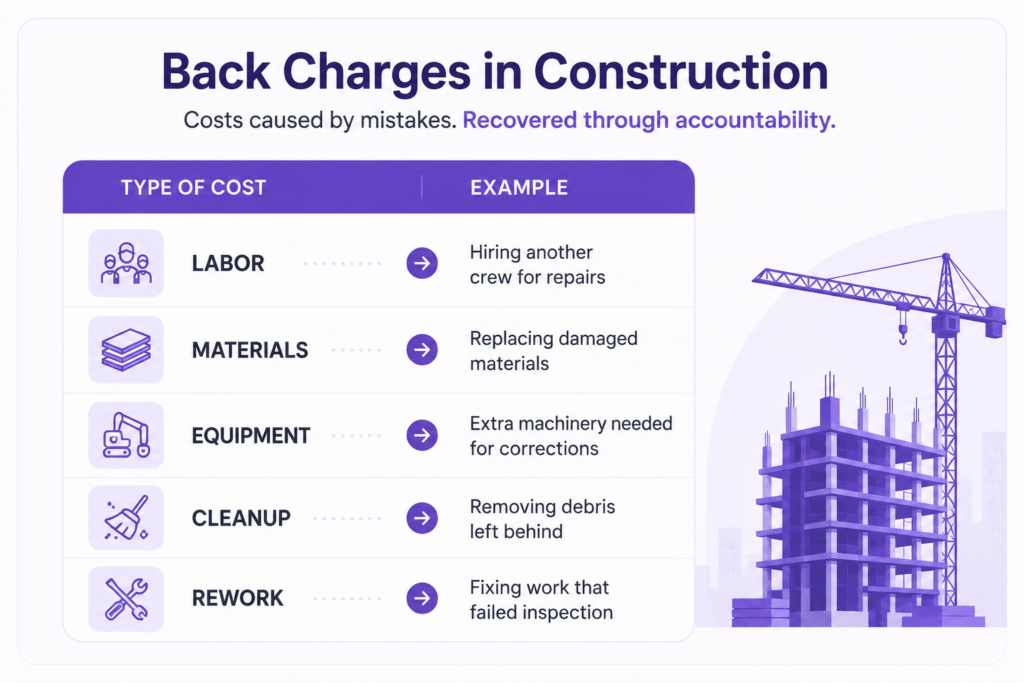
| Type of Cost | Example |
| Labor | Hiring another crew for repairs |
| Materials | Replacing damaged materials |
| Equipment | Extra machinery needed for corrections |
| Cleanup | Removing debris left behind |
| Rework | Fixing work that failed inspection |
On large projects where multiple subcontractors work together, back charges are extremely common. The real challenge is not issuing them. It is proving them.
Why Are Back Charges Issued in Construction?
Most back charges happen because one contractor failed to meet part of their responsibility on site. Although every construction project is unique, there are some common instances when back charges occur.
1. Poor Quality of Work
There may be cases when the work is done, but it fails to meet the necessary requirements of specifications, contract, or building codes. For example, the placement of concrete could have been uneven or the electrical work failed the inspection. Someone will need to do it again and those costs will go against the subcontractor who caused it.
2. Unfinished Work
A subcontractor can delay the work, which results in additional effort of the general contractor to hire someone else or use additional resources to complete the work. It usually leads to additional costs and that cost becomes a back charge.
3. Damage To Property
Construction sites are hectic places. Mistakes occur. A plumber contractor may accidentally damage floor surfaces that are already completed. Equipment may damage existing landscaping works. Fixing such damage comes at a cost, which is then incurred by whoever caused the damage.
4. Issues with Site Cleanliness and Safety
Site cleanliness is far more important than one may think. Subcontractors that fail to maintain cleanliness, neglect site safety or cause dangerous conditions may force a contractor to address this problem himself right away. This action has a price, which is typically charged back. To sum up, back charges ensure that unexpected expenses remain with the contractor who caused them.
What Is an Example of a Back Charge in Construction?
It is much clearer what a back charge means when it is demonstrated in construction examples. Below are two common cases of back charges.
Example 1: Drywall Repair
An electrician installs the wiring within a wall. Later, some more work needs to be done and the electrician cuts through the wall in order to reach the wiring. Now the wall is damaged. Since electricians do not handle drywall repair, the general contractor brings back the drywall subcontractor to patch and repaint the damaged section.
Instead of absorbing the cost, the contractor deducts the repair cost from the electrician’s contract. That deduction becomes the back charge.
Example 2: The Schedule Delay
A structural steel subcontractor falls behind schedule by nearly three weeks. Because steel installation is delayed, mechanical and electrical contractors cannot begin their work on time.
To recover lost time, the contractor brings in extra labor crews and approves overtime work. All these additional expenses happened because one subcontractor delayed the project. The contractor documents those costs and issues a back charge against the steel subcontractor.
In both situations, the rule stays the same. The cost follows the party responsible for creating the problem.
5 Best Practices for Managing Back Charges in Construction
Back charges are common, but poorly handled back charges create disputes quickly. The contractors who manage them well usually follow a few simple habits.
1. Establish Clear Contract Language
The contract should clearly explain when back charges apply. It should define responsibilities, notification procedures, and how costs will be calculated. Unclear contract language creates confusion later.
2. Document Everything Immediately
Documentation is everything. Take photos. Record site conditions. Save inspection reports. Maintain daily logs. A back charge without documentation is difficult to defend later. According to research from FMI, poor project data management contributes to billions in avoidable construction inefficiencies every year. Good documentation protects everyone.
3. Notify the Responsible Party Early
Do not wait. As soon as a problem is identified, notify the subcontractor immediately. This gives them an opportunity to correct the issue themselves before additional costs pile up. Late communication often creates unnecessary disputes.
4. Use Detailed Cost Breakdowns
A vague invoice saying “repair costs – $4,000” will almost always get challenged. Every back charge should show exactly where the money went.
Include:
- Labor hours
- Material costs
- Equipment expenses
- Third-party contractor costs
- Administrative costs if applicable
Transparency reduces arguments.
5. Maintain a Financial Buffer
Even when a subcontractor is responsible, the contractor usually pays correction costs upfront first. That creates temporary cash flow pressure. Many project managers keep contingency reserves between 2% and 5% of contract value specifically to absorb unexpected project costs while reimbursement catches up. Strong planning prevents cash flow stress later.
The Documentation Gap: Where Most Back Charges Break Down
This is where many contractors run into trouble. The biggest problem usually is not identifying the mistake. It is proving what happened later.
When schedules become tight, documentation often gets pushed aside. Superintendents are focused on deadlines. Field engineers are juggling multiple tasks. Daily reports become inconsistent. Then a dispute happens. Suddenly teams start searching through old phone photos, scattered spreadsheets, field notes, and half-completed reports, trying to rebuild a timeline.
That process wastes enormous time. Research from PlanGrid found that construction professionals spend over 5 hours every week simply searching for project information. That becomes a serious problem when documentation is needed to support financial claims.
The strongest teams solve this differently. Instead of documenting problems after something goes wrong, they build documentation continuously throughout the project. Routine walkthroughs, timestamped records, site photos, and digital tracking create evidence automatically before anyone even knows they will need it. And when disputes happen later, the record already exists.
Back Charge vs Change Order: Understanding the Difference
A lot of people on construction projects confuse back charges with change orders. On paper, both affect project costs, but they serve completely different purposes.
A change order happens when the scope of work changes. Maybe the owner requests additional work, design revisions happen midway, or project requirements shift after work has already started.
A back charge, on the other hand, happens when extra costs show up because someone failed to do their job properly.
The easiest way to think about it is this:
| Back Charge | Change Order |
| Caused by errors or delays | Caused by scope changes |
| Used to recover unexpected cost | Used to approve new work |
| Paid by responsible subcontractor | Usually paid by owner or project budget |
The confusion becomes dangerous when teams fail to document the difference properly. A scope change is part of normal project execution. A back charge is about accountability. And mixing the two often creates payment disputes later.
Who Pays for Back Charges in Construction?
In most situations, the subcontractor responsible for creating the issue pays for the back charge. But “paying” usually does not mean writing a check immediately.
Instead, the contractor deducts the cost from the subcontractor’s remaining contract balance. If a contractor spends $8,000 fixing defective work caused by a subcontractor, that $8,000 gets deducted from future payments owed.
Simple in theory. But in practice, things are not always so straightforward. Disputes usually happen when responsibility is unclear. This often happens when:
- Contract is vague
- The subcontractor believes the issue was caused by another trade
- Notification was delayed too long
- Multiple teams contributed to the same problem
- The subcontractor disagrees with the repair cost being charged
Once disagreements begin, documentation becomes everything. In construction disputes, the side with better records usually has the stronger position. It is rarely about who feels right. It is about who can prove what happened.

How Do Back Charges Affect Project Budgets?
Back charges may recover money eventually, but they still create short-term financial pressure. This part often gets overlooked.
Here is what usually happens.
The contractor discovers a problem. Corrective work has to happen immediately because the project cannot stop. So the contractor pays upfront first. Only later does the contract adjustment happen against the subcontractor responsible. That creates a temporary gap. The money goes out immediately, but recovery takes time.
Projects that run with slim profits to begin with find even temporary financial strain troublesome. According to research, construction companies work at profit levels ranging from 2% to 6%. Thus, even minor unforeseen expenses have an effect on the bottom line.
Some of the most common budget impacts include:
| Financial Issue | Impact |
| Paying repair costs upfront | Temporary cash flow pressure |
| Delayed deductions | Slower cost recovery |
| Frequent rework | Lower project profitability |
| Legal disputes | Higher administrative cost |
This is why experienced contractors do not look at back charges only as accounting adjustments. They treat them as financial risk management.
A Simple Back Charge Workflow Every GC Should Follow
When back charges are handled inconsistently, disputes become far more likely. The best contractors usually follow a simple process every time.
Step 1: Identifying the Problem
The first thing to do when a problem occurs is to document precisely the nature of that problem.
Step 2: Documenting the Condition
Photograph, date, note and collect all evidence needed before starting any work that corrects the problem.
Step 3: Notifying the Subcontractor
Contact the subcontractor who should be allowed to correct the problem.
Step 4: Calculating Cost
Detail labor, materials, equipment and third party costs associated with the corrections.
Step 5: Process the contract adjustment
Deduct the cost through formal contract adjustment and maintain records for future reference.
The important part here is consistency. A weak process creates disputes. A repeatable process creates accountability.
Build the Paper Trail Before You Need It
Most back charge disputes are not really about who made the mistake. They usually come down to one question: Can you prove what happened?
The contractors who handle these situations best do one thing differently. They document continuously. When project records, site conditions, and field progress are captured regularly, teams are not forced to reconstruct events weeks later.
Track3D helps construction teams build that record automatically through continuous visual documentation and Reality Intelligence. Want to see how stronger documentation helps avoid costly disputes before they escalate? Book a demo session
FAQs
Q: What is a back charge in construction?
A: A back charge is a contract deduction used when a subcontractor causes extra costs because of defective work, delays, damage, or incomplete work. Instead of absorbing the cost, the contractor deducts it from the subcontractor’s payment.
Q: Who is responsible for paying back charges in construction?
A: Usually, the subcontractor whose work caused the issue. The contractor recovers the amount by reducing what is still owed under the contract.
Q: How do you prevent back charges in construction?
A: Clear contracts, early communication, regular documentation, and giving subcontractors the chance to fix issues quickly are the best ways to avoid unnecessary disputes.
Q: Can a subcontractor dispute a back charge?
A: Yes. They can challenge the charge if responsibility is unclear, if contract terms do not support the deduction, or if proper notification procedures were not followed.
Q: How do back charges affect cash flow on a construction project?
A: Contractors usually pay correction costs upfront and recover the money later through contract deductions. That delay can create temporary cash flow pressure, especially on projects operating with tight margins.