Construction sequencing is the process of deciding the order in which construction activities happen, based on how each task depends on the ones before it. It keeps trades from getting in each other’s way and helps the project move forward without costly rework.
Key Takeaways
- Construction sequencing sets the order of individual tasks, while phasing groups those tasks into larger stages of the project.
- A typical building construction sequence moves from site preparation to foundations, structure, envelope, MEP rough-in, finishes, and closeout.
- A strong sequence is built around real dependencies, such as cure times, inspections, and trade handoffs.
- Phasing helps when a project has to be delivered in stages because of budget, occupancy, or site constraints.
- A sequence works best when the team reviews it regularly against what’s happening on site.
At its core, construction sequencing answers one question: what has to happen before the next task can start? Phasing answers a bigger one: how should the whole project be broken into stages? Together, they turn a set of drawings into a buildable plan. This guide covers both methods and habits that make them work in the field.
What Is Construction Sequencing?
Construction sequencing is the logical order of work on a project. It’s built from dependencies, which are the links between tasks that force one to wait for another. For example, drywall can’t go up until the framing is complete, and the in-wall rough-in has passed inspection.
Sequencing works at a detailed level. It covers individual activities, the crews that perform them, and the locations where they happen. On a multi-story building, the same sequence often repeats floor by floor as trades move up the structure.
A well-planned sequence is a core part of good construction field management. It gives superintendents and foremen a shared understanding of what comes next. Construction sequence planning also sits within wider construction project management, alongside budgets, procurement, and quality control.
What Is Construction Phasing?
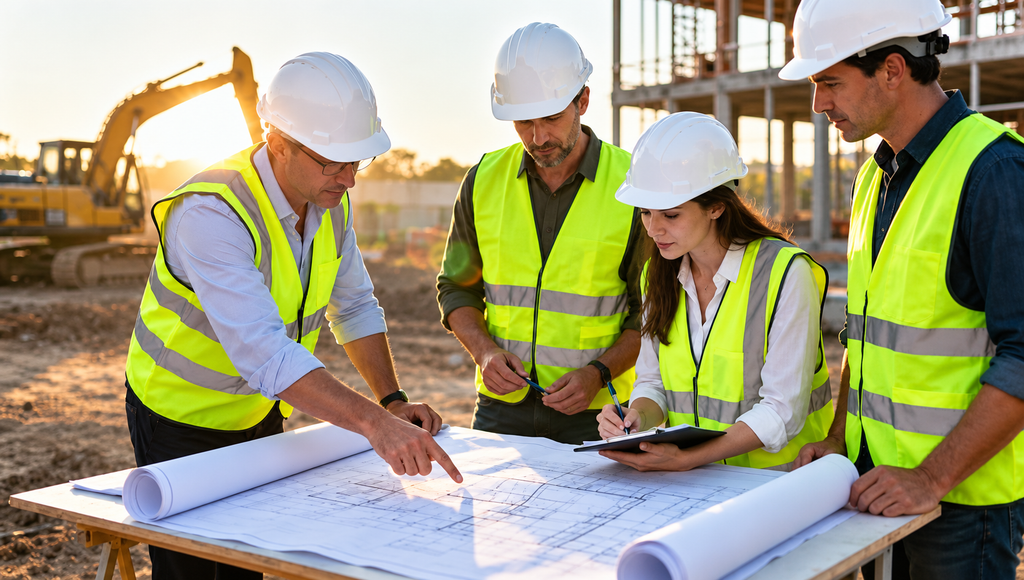
Construction phasing divides a project into major stages that are planned, built, and often delivered separately. Each phase has its own scope, schedule, and milestones.
Phasing is usually driven by constraints outside the building itself. These include funding cycles, the need to keep a facility running, or limited space on site. A hospital that stays open during expansion is a common example. The team might build a new wing in Phase 1, move departments into it in Phase 2, and then renovate the old space in Phase 3. Phasing is just as common on infrastructure projects, such as road or rail upgrades that need to stay in service during construction.
How Do Sequencing and Phasing Differ?
People often use the two terms as if they mean the same thing. They’re closely related, but they work at different levels.
| Construction Sequencing | Construction Phasing | |
| What it defines | The order of individual tasks | The major stages of the project |
| Level of detail | Activity by activity, often by location | Broad blocks of work |
| Example | Framing, then rough-in, then inspection, then drywall | Phase 1: New wing. Phase 2: Renovation of the existing building |
| Main users | Superintendents and trade foremen | Owners, PMs, and planners |
| Typical driver | Task dependencies and crew flow | Budget, occupancy, or site logistics |
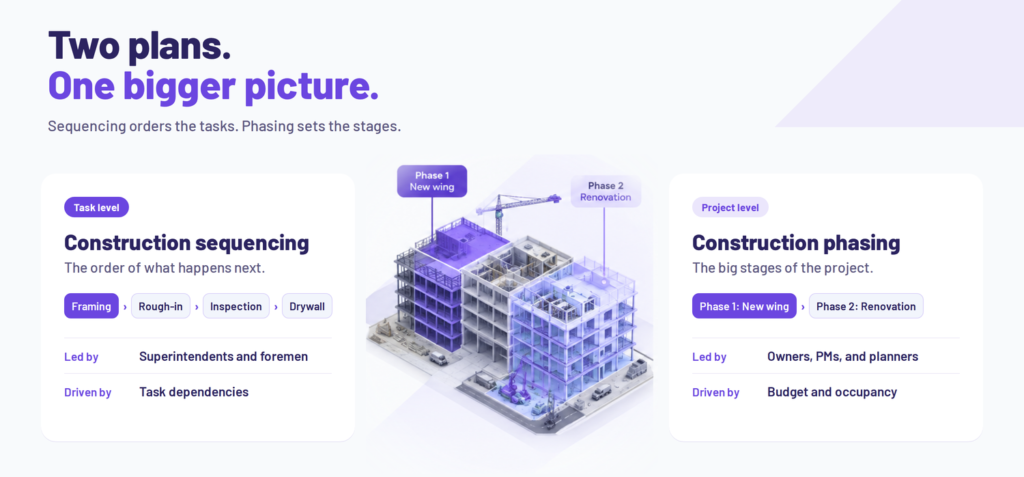
In short, phasing decides the big stages. Sequencing then sets the order of work inside each stage.
What Is the Typical Building Construction Sequence?
Every project is different, but most commercial buildings follow a similar order. The building construction sequence below is a general example, not a template for every job.
| Stage | Typical Activities | What Usually Has to Be Done First |
| 1. Site Preparation | Clearing, grading, excavation, and underground utilities | Permits and site surveys |
| 2. Foundations | Footings, foundation walls, and slab on grade | Excavation and subgrade inspections |
| 3. Structure | Steel or concrete frame, floor decks, and roof structure | Foundations that have reached their required strength |
| 4. Building Envelope | Exterior walls, facades, windows, and roofing | A stable structure to attach to |
| 5. MEP Rough-In | Ductwork, plumbing and electrical lines, and in-wall services | Enclosed or protected floors |
| 6. Interior Finishes | Drywall, ceilings, flooring, paint, and fixtures | Rough-in inspections that have passed |
| 7. Commissioning and Closeout | System testing, punch lists, and handover | Finished spaces and working systems |
These stages often overlap on real projects. Envelope work on the lower floors frequently starts while the structure is still rising above them. Overlapping saves time, but it also means more trades share the site at once.
Why Does Construction Sequencing Matter?
A clear sequence protects the schedule and helps teams avoid delays. When each trade knows what comes before and after its work, crews spend less time waiting for an area to open up.
Sequencing also reduces rework. If finishes go in before a rough-in inspection, the team may have to tear them out to fix a problem behind the wall. The right order prevents that kind of backtracking and helps keep project costs under control.
It improves safety and site logistics as well. Planning the order of work lets teams keep crane zones, delivery routes, and laydown areas clear. It also limits how many trades are stacked in one area at the same time.
What Are the Types of Task Dependencies?
Dependencies are the building blocks of any sequence. Most scheduling tools use four standard types.
| Dependency Type | What It Means | Construction Example |
| Finish-to-Start | Task B starts after Task A finishes | Drywall starts after framing inspection is complete |
| Start-to-Start | Task B starts after Task A starts | Fireproofing starts once steel erection is underway on lower floors |
| Finish-to-Finish | Task B finishes after Task A finishes | Final paint finishes after ceiling installation finishes |
| Start-to-Finish | Task B can’t finish until Task A starts | Temporary power stays on until permanent power is energized |
Finish-to-start is by far the most common. Many dependencies also include lag time, such as the days concrete needs to be cured before loading.
Which Methods Do Teams Use to Plan a Sequence?
Teams use a few common construction scheduling methods, often in combination. The right choice depends on the size and type of the project.
The Critical Path Method (CPM) identifies the longest chain of dependent tasks in the schedule. Any delay on that chain pushes back the finish date. Most commercial project schedules use CPM as their main approach, and the result is usually shown as a Gantt chart, with each task as a bar along a timeline.
Location-based planning organizes work by area, such as floors or zones. Each trade moves through the building in a steady flow, which suits repetitive projects like high-rises and hotels.
Takt planning breaks the building into zones of similar workload. Trades then move through those zones at a fixed rhythm, much like a production line.
4D building information modeling (BIM) links the schedule to the 3D model. Teams can watch the sequence play out visually and spot clashes in the order of work before they happen on site.
How to Plan a Construction Sequence in 6 Steps
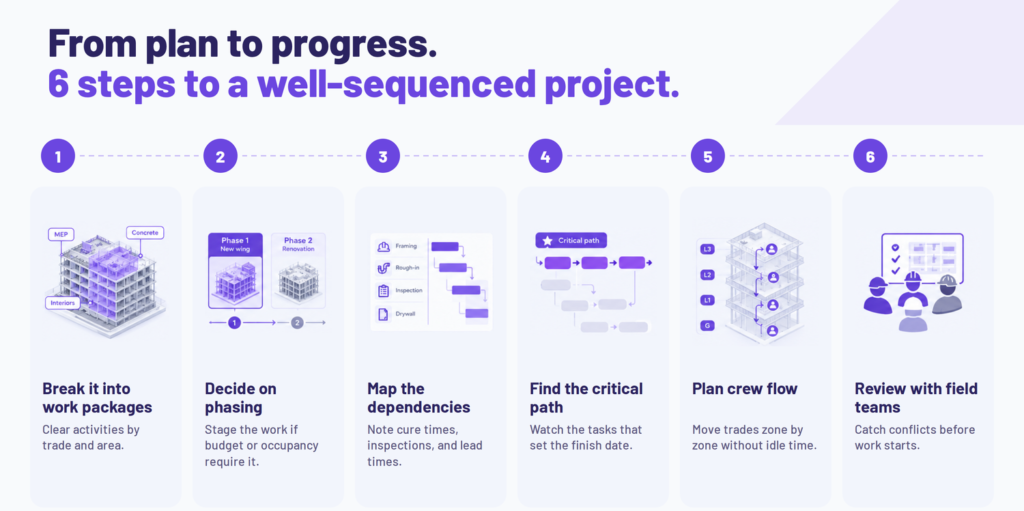
- Break the project into work packages. Divide the scope in the project plans into clear activities for each trade and area. Smaller, well-defined activities are easier to sequence.
- Decide whether the project needs phasing. Look at funding, occupancy, and site constraints. If any of them require staged delivery, set the phases before sequencing the work inside them.
- Map the dependencies between activities. For each task, list what has to be finished first. Include cure times, inspections, and material lead times, since these often drive the order.
- Find the critical path. Identify the chain of tasks that controls the finish date. These activities need the closest attention throughout the project.
- Plan the flow of crews across locations. Decide how each trade will move from floor to floor or zone to zone. A steady flow helps crews avoid idle time and trade stacking.
- Review the plan with field teams. Walk through the sequence with superintendents and trade partners before work starts. They often spot practical conflicts that a schedule alone won’t show.
When Is a Detailed Sequence Not Necessary?
Not every job needs a detailed, location-based sequence. A small tenant improvement with two or three trades can often run well on a simple phased plan. A short weekly coordination meeting may be all the team needs.
Detailed construction sequencing pays off as complexity grows. Multi-story buildings, occupied renovations, and projects with many overlapping trades benefit the most. If you’re unsure, start simple and add details where trades start to collide.
Common Construction Sequencing Mistakes
Treating the sequence as a one-time task is a common mistake. Field conditions change, and the sequence needs to change with them. Review it whenever you update the schedule.
Overlooking hidden dependencies causes many delays. Inspections required by the local building code, cure times, and long-lead materials are easy to miss during planning. Missing them often leaves trades waiting on each other.
Stacking too many trades in one area can backfire. Squeezing crews together to recover time often slows everyone down. It can also create safety risks in tight spaces.
Planning without field input leads to sequences that look right on paper but don’t work on site. Superintendents and foremen know the practical constraints. Bring them in early.
How Do You Keep a Sequence on Track?
A sequence is only useful if the team knows whether the site is following it. Regular construction progress tracking shows which areas are moving as planned and which need attention.
This is where Reality Intelligence from Track3D fits in. Teams capture the site with a 360 camera during their regular walks. ProgressTrack then measures installed quantities across 200+ progress categories. Teams can see how each trade and zone is advancing, which makes it easier to adjust the sequence early.
Ready to See It in Action?
Strong construction sequencing gives your project a clear, buildable plan. Accurate site data helps you keep that plan on course. See how Track3D supports field teams with Reality Intelligence. Book a demo
Frequently Asked Questions
Q: What is construction sequencing in simple terms? A: Construction sequencing is the order in which construction tasks are carried out. It’s based on which tasks need to be finished before others can start.
Q: What is the difference between construction sequencing and phasing? A: Phasing splits a project into major stages, such as a new wing and a later renovation. Sequencing sets the detailed order of tasks within those stages.
Q: What is the correct building construction sequence? A: Most buildings move from site preparation to foundations, structure, envelope, MEP rough-in, interior finishes, and closeout. The exact order depends on the design, site conditions, and contract.
Q: Who is responsible for construction sequencing? A: The general contractor usually owns the overall sequence, led by the project manager, scheduler, and superintendent. Trade partners provide input on how their work fits into it.
Q: Is construction sequencing related to constructing an arithmetic sequence? A: No, these are different topics. Constructing an arithmetic sequence is a math concept, where each number increases by the same fixed amount. Construction sequencing is about ordering the work on a building project.