The Construction Industry runs on tight schedules and tighter margins, with a net revenue margin of 6.3%, one of the lowest sectors in the US economy. The industry tends toward complex cash flows and delayed payment cycles. The contractors face the burden of execution- accounting for raw materials, labor, and rework. Combine that with overhead expenses and you have a project team on the field stretched too thin.
Construction monitoring is a process of continuously monitoring and recording construction developments in the field. It documents real-time progress and reports it to be compared against the planned schedule. It keeps the project within budget and ensures delivery on time. Transparency on the field turns a progress claim into a record.
The liabilities in the field compound when this visibility arrives too late. So far, progress has been marked on design, updated on spreadsheets, or passed on verbally in meetings. The real cost of this system is the sheer amount of time it consumes. A few minutes spent capturing photos here, writing notes there, spread across floors, trades, and weeks, adding up to a substantial portion of project time.
And not having a consolidated record in place leads to fragmented data scattered across various touchpoints. Leading data inconsistency and ill-advised judgement. One erroneous movement and the cost trickles down to every scope.
What Construction Progress Monitoring Measures
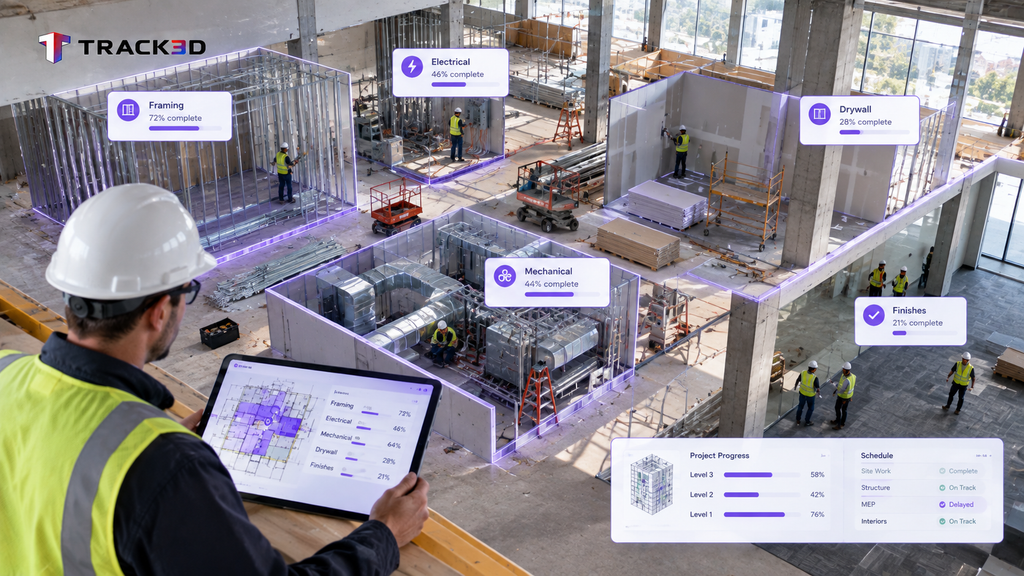
Step into any construction site, and you will see an industry that operates at a faster pace, larger scale, and higher risk across multiple teams and disciplines. With a schedule that runs at this speed, tracking progress at every level, zone and trade is paramount.
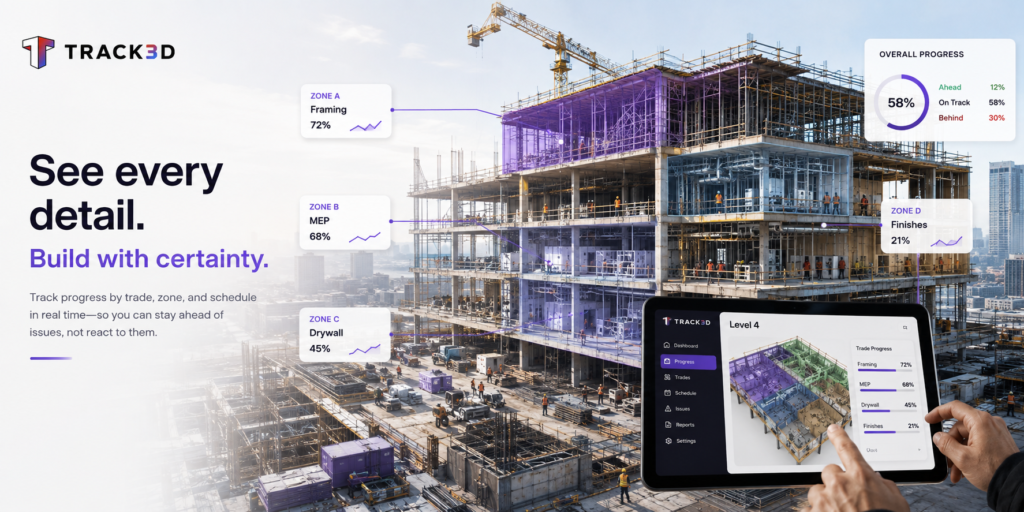
Superintendents, field engineers, and project managers are responsible for tracking progress across multiple trades and locations to keep the project on schedule. This includes raw material allocation, labour deployment, and verifying scopes like framing, MEP, drywall, and finishes. These are the details that translate the status quo of the project to the owner. One piece of misinformation, and you have delays and rework that derail the entire project.
Construction progress tracking is important to make sense of the field, ensure coordination, and create alignment with the schedule. Keeping tabs on every incremental progress on the site, day in and day out validates the schedule and keeps the team accountable.
How Construction Site Monitoring Works
For many contractors, construction site monitoring ritual looks like a patchwork of notes, photos, spreadsheets, WhatsApp messages, and email threads. It works until it doesn’t. One discrepancy and you realize how delicate the system is. Ask five people on the site about the current status, and you will get five different answers. Each confident, but, each also a little out of touch. A WhatsApp text here, an email there– and suddenly nobody is looking at the same site anymore.
Project managers, superintendents, and field engineers spend a huge chunk of their time documenting data. The constant back and forth validating data stalls the progress. And by the time the information arrives, it is already stale. You need information that can be acted on, not that needs to be debated over.
The manual process becomes a bottleneck that further shrinks the margin.
Updates are assembled through walkthroughs, field observations, and photo logs and then compiled into a report. Multiply that by 20 trades across 10 floors; by the time the report reaches the PM desk, it is already history.
A field engineer mapping the site on foot is spending time the project can’t afford to lose. When measurements get eyeballed and progress gets reported from memory, the decisions that follow are only as good as the recollection they came from. That’s not a foundation anyone wants to build a pay app on. The site needs one source of truth.
Real-time construction reporting should render the field as it is. Construction industries have expansive projects, so the developments should be monitored in their entirety. Every level, trade and zone should be viewed holistically to gauge progress. From quantities to measurements, each data point needs to be stamped where it belongs on the map. So, the team gets ahead of the curve.
What does good construction monitoring data enable?
Your construction progress monitoring should leave no room for guesswork or assumptions. Observations should be pulled from the field, not from recollections.
For the field to dictate the next movement, the data should be handy.
Construction site reporting needs to bring the design, the schedule, and what was actually built into one record the team can act on. Answer details about labor allocation and deliverables by trade, not scattered across separate logs. While also ensuring compliance and safety of the team on site. Visual documentation of the site further enriches decisions, as every element is geolocated on the site.
This enables objective decision-making instead of relying on estimates. Consolidating progress data in one place gives one source of truth, so instead of debating the legitimacy of data, teams can spend time deciding the next move.
Construction progress tracking also helps spot deviations from the plan, schedule slippage, and quality issues. It helps catch discrepancies before they derail the project. It allows for every element to be checked against the plan as it is captured. So, installation errors, missed specs, or misaligned framings can be fixed when the crew is still on the site.
Assuring fewer teardowns and delays. It is important to inspect errors before the next trade gets built over them. Construction site monitoring helps you flag issues where they pop up on the site, erasing ambiguity around rework.
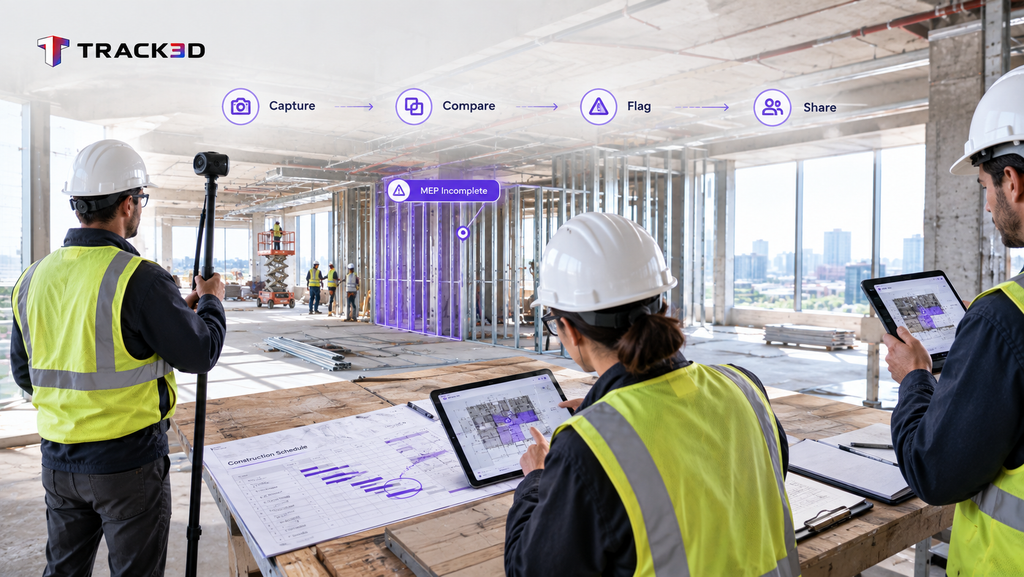
Handovers get easier too. When a verified record exists, the field is confident in its undertakings. A validated record gives geo-tagged evidence of the construction; saving the team from back-and-forth disputes. It also complements pay apps and accelerates payment approvals. And above all, it guides the next steps of the build. Quantifying what is completed and what is left open, by area and by trade, defines the next target.
This clarity not just keeps the project on course but also enables smooth coordination between multiple teams and trades. When everyone works off the same record, no one has anything to debate over. Disputes resolve sooner, and the pace of execution picks up.
For people working on tight deadlines, this is a huge load off their backs. No one loses time; reporting and responding to each stakeholder since the single source of truth is put on the table. The schedules remain intact and issues no longer compound. So, decisions are not made on approximations.
Who Construction Progress Tracking Benefits
Project Managers PMs must approve payments and justify schedule demands, for that they need proof not opinions. Construction Progress Tracking provides quantified and geotagged evidence. So, they can make decisions quickly and act sooner.
Superintendents are responsible for handoffs. They must keep the site running. Without a reliable source, they risk pre-mature handoffs and trades built over unfinished ones. Construction Progress Tracking ensures smooth transition from one trade to another, by giving a verified, time stamped record. So, the supers know when a zone is ready for the next task to begin.
Owners and General Contractors have the most to lose. They need visibility across the portfolio. Not just one trade or Zone. Construction Progress Tracking gives them a schedule-wise and portfolio-wise trend report. Showing where the projects are ahead, and where they are falling behind. Along with impending risks and rework costs. It turns dozens of ongoing activities into a substantiated record.
How to monitor construction site progress
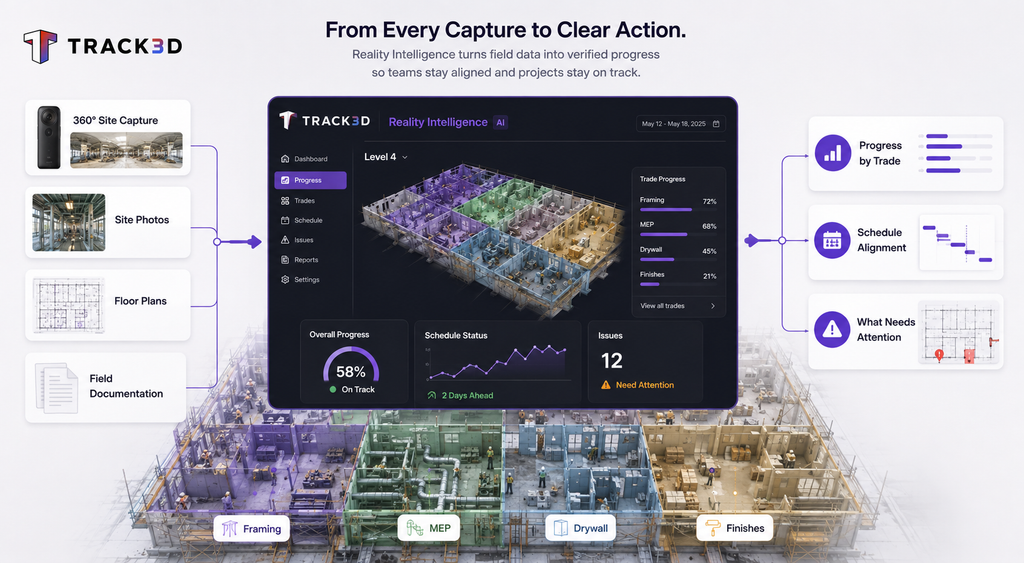
A major block that arises in construction portfolios is that the manual walkthroughs and photo documentation lag the field’s pace. After hours of mapping the site and capturing images, the owners still don’t get the full picture. While the complexity of projects is one reason, logistical challenges also hold back a lot of insights.
Such as:
- Progress tracking was labor-intensive- by custom; you had field engineers walking the floor and capturing the corners of the site. Trades like drywalls, mechanical, electrical, plumbing, and firewall often finish simultaneously across multiple floors and zones. Keeping an eye on every trade and catching bottlenecks is crucial. A time-consuming and exhausting approach to site capture limits the scope of inspection.
- Trade handoffs were clunky- without having a reliable signal for when the next trade is ready to start, two scenarios can play out: either the PM or the superintendent will have to manually trace the site and see for themselves, expending time they can’t afford to lose or the next trade starts prematurely, covering the previous incomplete trade. Setting up for future rework. Topping that, different trade and PMs will bring their own interpretation, which won’t always reach the rest of the team on time. Stalling the project inadvertently and causing friction at every transition point.
- Pay app reviews are slow and manual- the PM needs to verify the work completed before approving the payment bill, and when there is no concrete record, the verification is conducted manually through site visits. Usually taking 3-4 hours and pushes the payment cycle out by weeks. This is a painstaking process. Or relies on subjective estimates. There needs to be concrete proof tethered to the bill. Consistent progress tracking helps verify the account easily.
It speeds up the approval cycle by giving quantified metrics of the job done.
- And as design changes poured in mid-construction- designs change midway, altering the course of the job. In that case, sites may be in different conditions at different levels. Some may be incomplete; some stalled, while some not even begun. Therefore, implementing new changes needs detailed updates of every level. A valid record showcasing the conditions of every level and zone aids execution of the changed target. It helps the team decide if the site is ready to match the changed expectations.
Six steps to do Construction Progress Tracking the right way
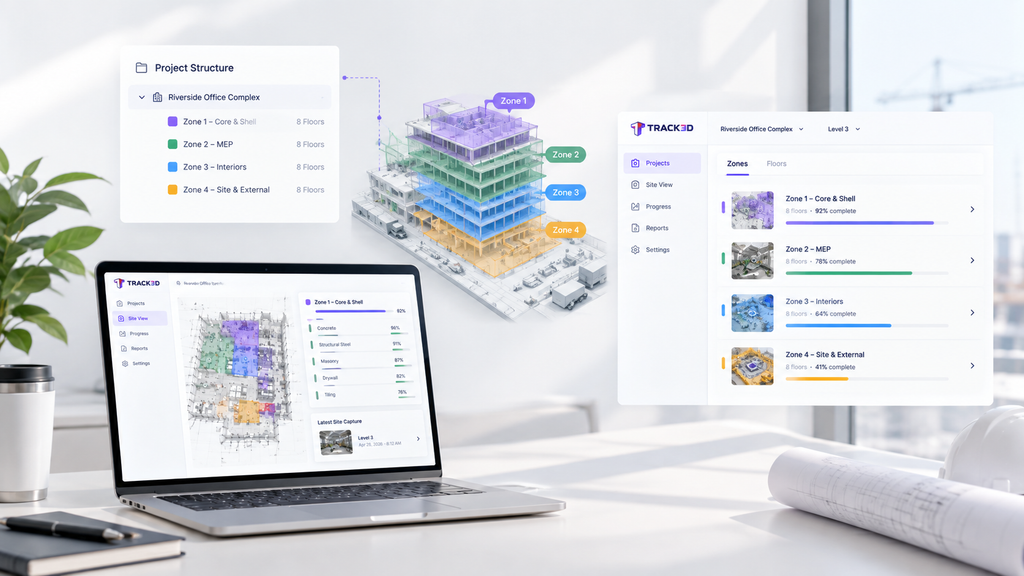
1. Time-stamped and geo-located progress– Every trade and task on the site should be time-stamped, geo- located on the design so that every element, marked on the design or map, corresponds to the happenings on the field.
2. Quantified Materials and Deliverables– Raw materials, equipment and crew assigned should be quantified and reported to track movement. This includes the quantity of raw materials stored, consumed, or installed against the plan. The same applies to equipment; the hours a crane ran and how the outcome maps to the planned schedule give measurable progress. Vendors, supervisors, and trade partners can be held accountable against measurable numbers.
3. Schedule alerts- One of the major expenses comes from rework that could have been avoided. Deviations from the schedule can be foreseen if the team has real-time data about the field. This helps track the developments step by step and flag any variation from the schedule, planting alerts on the record to warn of possible teardown so the team can act on it before it is too late.
4. Objective and shared record- Consolidating real-time data in one place that the team can access and refer to for every instance in the field will reduce ambiguity and vagueness. Because then the decisions will be made on the basis of objective data and not subjective estimates. It will also help in the distribution of responsibilities and later hold the team accountable for their job.
5. Consolidated Designs and Documentation- Collated records of designs, maps, and documentation will give the team one record to carry instead of a myriad scattered across multiple devices. The holistic record tethered to one device ensures no time is lost in assembling the full picture of the site.
6. Before vs After- While real-time data is good to know where the project stands, it is also important to capture the comprehensive progress of the project. Tracking the entire project arc across the timeline will help you analyze progress against historical benchmarks. Watching your project expand week after week and pitting it with the past timelines helps you gauge your team’s capacity. It gives you lead time needed to order raw materials, forecast labour requirements, and plan ahead.
While this promises a well-rounded screening of the site, the requisites don’t here. Your progress tracking should not just narrate the site and its happenings. It also needs to empower your decisions every step of the way. From strategy building, procurement and execution to closeouts, your progress monitoring tool should feed your team the intel and insights to take action. It needs to be an intelligent ecosystem that possesses all the particulars and statistics that lets you survey the site from floor to ceiling.
While also helping identify bottlenecks, support pay applications, maintain schedule adherence and mitigate rework costs.
How Hensel Phelps converts construction progress data into Actionable Insights.
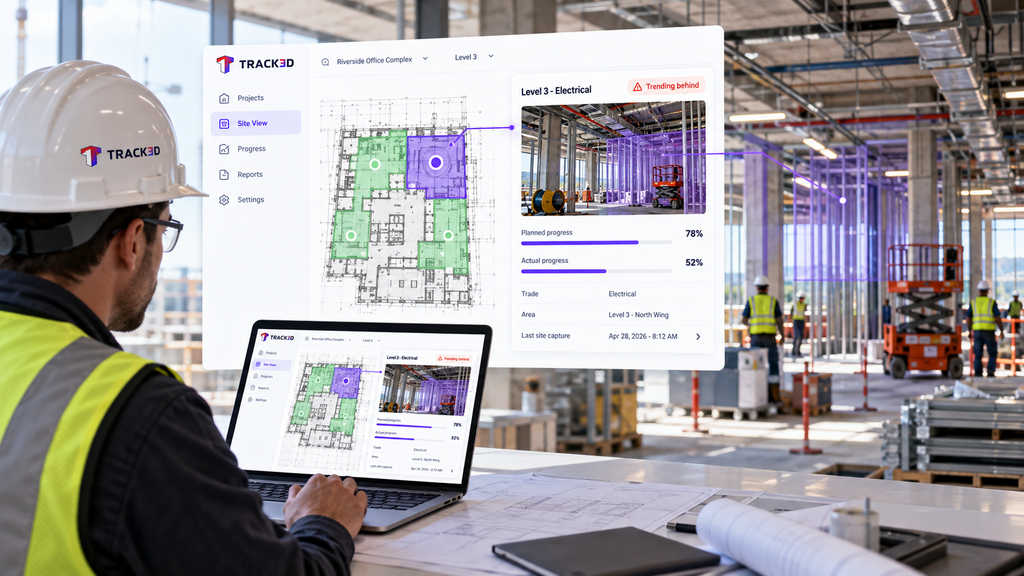
While it is easy to lay out in principle. It is hard to put into action on a highly complex project with real deadlines and real money on the line. That’s what makes Hensel Phelps, One of ENR’s leading general contractors, a case in point. A live Aviation project where stakes are high, and the teams had to actually deliver.
Hensel Phelps deployed Reality Intelligence on their latest SFO aviation projects. It came with the problem most construction sites come with – making sense of all the data they were recording on the site.
Construction sites have been collecting more data than ever but making sense of it is where the gap lies. Track3D’s Reality Intelligence platform, with its progress tracking tool, leveraged that data to draw home the insights that would often take days to surface.
The scope was deployed without asking the team to overhaul their workflows. Field engineers walked the same site, did the same 360-degree capture, but instead of manhandling the intel, it was delegated to Track3D. To be processed and converted to intelligence that can help teams gain unprecedented clarity and put them ahead of the curve.
To Hensel Phelps, Track3D Gave:
1. Objective Metrics- Quantified data on the percent completion of activities by trade, installation rates over time, quantities in place and variance from the schedule. Leaving no room for subjectivity.
2. Schedule alignment- Every aspect tracked on site is mapped against the planned schedule, so the team knows what is installed, what is on track, and what is falling behind.
3. Proactive decision making- Instead of scrambling only when the problem surfaces, Track3d helps you track anomalies when there is still time to act, and the window to fix it hasn’t closed
4. Hardware Agnosticism- Track3D is built on hardware Agnostic foundation, it integrates images from any medium of capture the team uses; 360-degree capture, Li DAR, drones, Laser Scanners. Images captured can be transferred to the Reality Intelligence platform. Processed through AI powered Object Recognition and Classification engine to produce a unified and structured record of site conditions.
Before Reality Intelligence, Hensel Phelps relied on the traditional method of manual walkthroughs and photo logs to track progress across their project – Like most construction teams do. That meant physically re-checking every zone and floor. And pay app review dragged on with nothing solid to point to.
With Reality Intelligence, Hensel Phelps was able to scale back rework cost by 20% from the baseline. Improved on-time completion of the schedule by 12%. Automated progress quantification in 30-45 minutes pay application support. And instead of detecting issues 2-3 weeks after problems began, caught it within 1-2 days as the trends emerged.
Because the goal was never to stop at site documentation, but to use it as a foundation to generate insights that helps sites manage progress proactively.
Reality Capture is the first step; it is the raw documentation of the site. 360-degree camera or laser scans– any camera that captures the site at any given point in time. Then assembled to make a visual record. But this record still needs to be analyzed, interpreted, and then transformed into a decision.
Reality Intelligence is the layer that sits on top of that Capture. It takes the visual record, processes it, and then produces structured and quantified data. The capture shows you how the site looks like, and Reality Intelligence shows you what needs attention.
Frequently Asked Questions
- What’s the actual difference between progress tracking and just taking site photos?
The photo shows you a moment. It doesn’t tell you anything on its own; someone still has to review it, compare it to the plan, and write up what changed. Progress tracking does that translation automatically: every observation gets time-stamped and geo-located against the design, materials and labor get counted against the schedule, and what used to be a folder of photos becomes one record the whole team can act on.
- Do field teams need to change how they capture site data to use Reality Intelligence?
No. Whatever field engineers are already using to capture the site; 360-degree cameras, LiDAR, drones, laser scanners – keep working the same way. Reality Intelligence just processes it afterward, running the imagery through AI object recognition. Nothing changes on the ground. The difference shows up after the footage leaves the site.
- How much time does this save on pay applications?
Enough to matter. Right now, verifying completed work for a pay app usually means a PM doing manual site visits for 3-4 hours, sometimes pushing the whole payment cycle out by weeks. With a geo-tagged record already tied to the schedule, that check drops to 30-45 minutes, because the proof already exists instead of needing to be rebuilt from a fresh walkthrough.
- Can this catch problems before they turn into expensive rework?
This is where it earns its keep. Without real-time tracking, something like a missed spec or misaligned framing can sit undetected for 2-3 weeks- often long enough for the next trade to build right over it. Track it trade-by-trade against the plan instead, and that same issue surfaces in 1-2 days, while it’s still cheap to fix.
- What happens when the design changes mid-construction?
This is exactly the situation a consolidated record was built for. Since every level already has a documented, current condition, the team can see immediately which zones are ahead, stalled, or untouched- and decide whether the site can actually absorb the new scope, instead of re-walking the whole floor to find out.
- How accurate is the AI at identifying what’s actually installed on site?
This is usually the second question, right after “how does it work.” The object recognition engine is trained on construction-specific elements- framing, drywall, MEP components, finishes so, it can tell “drywall hung” apart from “drywall taped and ready for paint.” Not just “wall exists, checkmark.” It also checks every reading against the design itself. So, it’s not an accuracy number you have to trust blindly. If something on site doesn’t match what was actually planned for that spot, it gets flagged. It doesn’t just get logged as correct and left alone.