
At the weekly OAC meeting, the electrical foreman reports Level 4 rough-in at 70% complete. The superintendent estimates 55%, and the owner’s representative, working from last week’s photos, estimates 60%. All three walked the same floor, and none of them can explain how they reached their figure.
As per the KPMG Global Construction Survey, only 25% of projects came within 10% of their original deadlines. Part of the cause is that most teams report project progress before they agree on how to measure it.
The case for construction progress tracking rests on one principle: schedule and payment decisions are only as reliable as the progress data behind them. This guide explains how to track construction site progress scope by scope, so every percent complete on a construction project has a method behind it.
Key Takeaways
- Tracking site progress means measuring installed work against a baseline with an agreed method.
- Schedule activities, takeoff quantities, zones, and measurement rules should exist before the first capture.
- Countable work uses units completed. Multi-step work uses weighted milestones.
- Each construction phase needs its own quantities, capture method, and cadence.
- A progress report compares measured progress with the schedule by zone and trade.
What Does It Mean to Track Construction Site Progress?
Tracking construction site progress means measuring installed work in each zone and trade, recording it against the construction schedule, and repeating that measurement on a fixed cadence. The result is a percent complete that anyone on the team can trace back to a method.
Tracking differs from monitoring. Monitoring is the broader workflow of capturing site conditions, comparing them with the plan, and sharing updates, as described in this guide on how to monitor construction site progress. Tracking is the measurement step inside that workflow, and it determines whether the figures hold up in a pay application review.
What to Set Up Before the First Site Walk
Most progress tracking problems begin before the first capture.
- Break the schedule into measurable activities. “Electrical rough-in, Level 4, Zone B” gives the team a clearer target than “MEP rough-in, Level 4.”
- Attach takeoff quantities to each activity, such as linear feet of conduit or cubic yards of concrete.
- Divide each floor into zones that match how the superintendent sequences crews, following the logic of construction sequencing.
- Agree with each trade partner on how partial work earns credit before the first pay application.
Which Progress Measurement Method Fits Each Scope?
Countable, multi-step, and short-duration work each call for a different method.
| Method | How It Works | Best For | Limitation |
| Units completed | Installed quantity ÷ total quantity | Studs, fixtures, piles, panels | Requires accurate takeoff quantities |
| Weighted milestones | Each step earns a set share of credit | Conduit, ductwork, drywall | Weights need agreement up front |
| 0/50/100 | 0% before start, 50% at start, 100% at finish | Activities lasting one to two weeks | Overstates progress on long tasks |
| Level of effort | Credit follows elapsed time | Supervision, cleanup, general conditions | Does not measure installed work |
| Foreman estimate | A trained judgment of percent complete | Small or unusual scopes | Varies by person and by day |
Many teams assume better cameras will resolve the disagreement in the opening scene. A weighted milestone rule does more. An electrical scope might credit 40% for conduit rough-in, 30% for wire pulled, and 30% for terminations, while drywall might split 50% for hanging, 25% for taping, and 25% for finishing. Each project sets its own weights.
The same crediting rules support earned value management, where progress converts into dollars and an unclear scope-level method becomes a disputed billing figure.
How to Track Construction Site Progress Through Each Phase
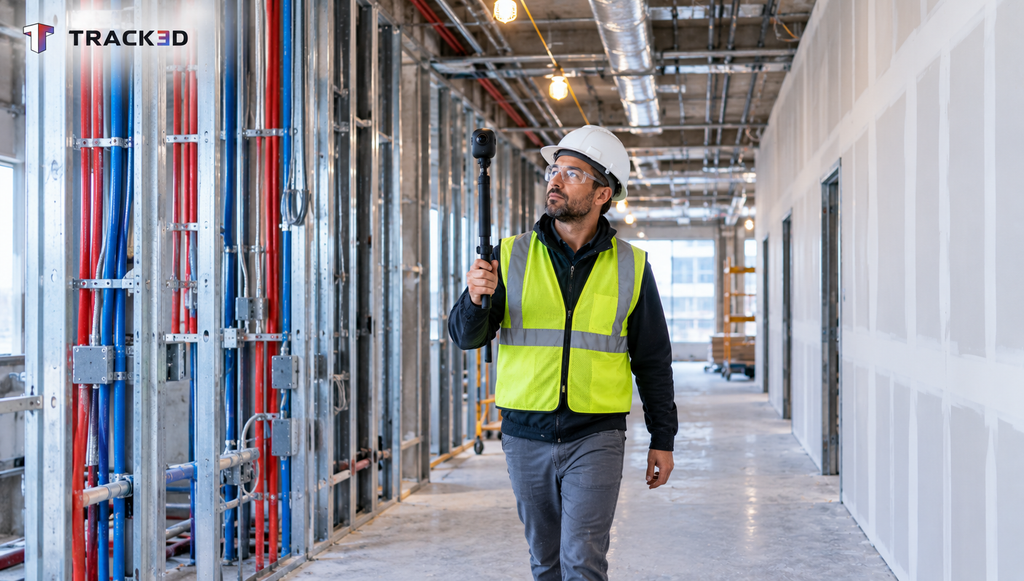
The units and capture tools change as the construction project moves from sitework to finishes.
Sitework and Foundations
Track excavation and fill in cubic yards, piles by count, and foundation pours by placement. Drone orthomaps and surface models measure earthwork volumes across the whole site in one capture.
Structure
Track concrete by floor cycle and steel by tons or pieces erected. Capture embeds, sleeves, and blockouts before each pour, since a missed sleeve often leads to core drilling later.
Exterior Envelope
Track curtain wall, panels, and roofing by count or square feet for each elevation. Drone or exterior photo captures allow a direct comparison of each face from week to week.
MEP Rough-In
MEP rough-in carries the highest tracking risk because walls and ceilings close over the work. Once that happens, the team can no longer verify the installation without opening a wall. Track rough-in by zone with weighted milestones and capture every area before each close-in inspection. Standard walks record at eye level, so overhead work needs separate attention. Aerial 360 capture documents ductwork, conduit, and piping above the grid before the ceiling goes in.
Interior Finishes
Track drywall by square feet, paint and flooring by area, and doors and fixtures by count. Near turnover, punch list items become the main unit of progress.
How Often Should Site Progress Be Tracked?
Cadence should match the pace of the work, and it should stay consistent so captures remain comparable.
| Phase | Suggested Cadence | Typical Capture Method |
| Sitework and foundations | Weekly | Drone flight |
| Structure | Each floor cycle | 360 walk or drone |
| Exterior envelope | Weekly | Drone or exterior photos |
| MEP rough-in | Weekly, plus before each close-in | 360 walk, aerial 360 for overhead |
| Interior finishes | Weekly, then more often near turnover | 360 walk |
How to Turn Site Records Into a Progress Report
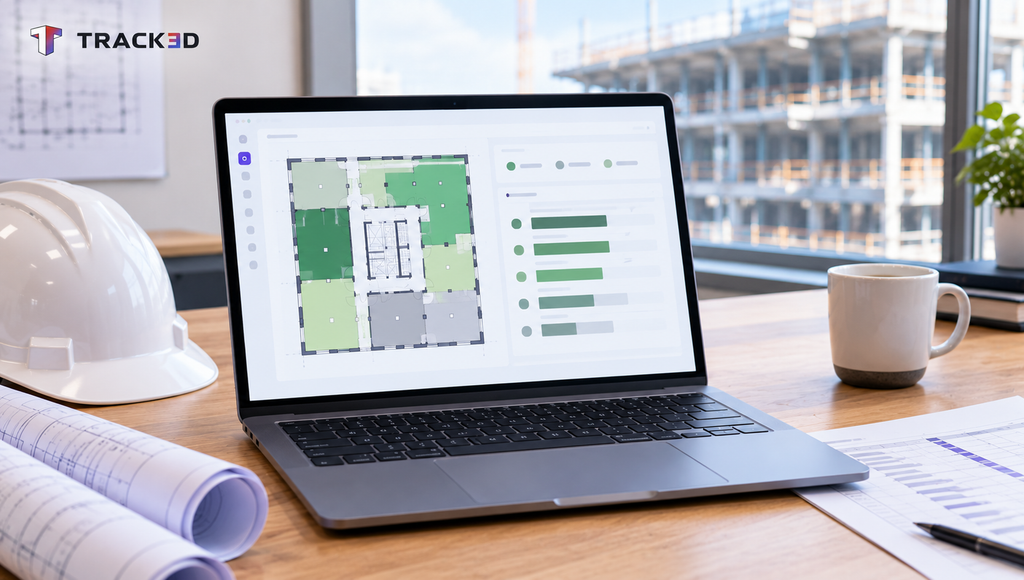
A progress report answers three questions for each zone and trade. What is installed, what did the schedule expect, and where is the gap widest?
Convert measured quantities from the latest capture into percent complete, then place those figures beside the planned percentage for the same date. The project manager flags any zone that trails the plan by more than an agreed margin before the next coordination meeting.
The construction daily log records context such as material delays or inspection holds. Measured progress also supports billing, because a reviewer can compare it with the amounts on a pay application. Paired with labor hours, the same data supports construction productivity tracking.
Common Construction Progress Tracking Mistakes
Switching Methods Between Reports
A scope tracked by units one week and by foreman estimate the next produces a jump that reflects the method rather than the work. Fix the method for each scope at the start.
Reporting Only Floor-Level Totals
A floor at 80% can contain one zone at 40%, and that zone may be delaying the next trade.
Capturing After Close-In
After drywall goes up, the rough-in behind it is no longer visible. Schedule captures before each close-in.
Construction Progress Tracking Tools Compared
Construction progress tracking tools differ mainly in measurement time and consistency.
| Approach | Strengths | Limitations |
| Walkthroughs, photos, and spreadsheets | Low cost, no setup | Slow to compile, results vary by person |
| 360 capture with manual review | Complete visual record by zone | Someone still measures from the images |
| 360 and drone capture with AI quantification | Measured quantities by zone and trade | Requires zone and category setup |
Automation has the largest effect on timing. As per Track3D’s Reality Intelligence whitepaper, issues surface 1 to 2 days after trends emerge, compared with 2 to 3 weeks under manual methods. This explainer on AI construction progress tracking describes how the process works.
At Hensel Phelps, consolidating more than 20 job walks into a single site capture saved 2,964 hours on an aviation project at San Francisco International Airport.
When Automated Progress Tracking Is Not a Fit
A short, single-floor project with a few trades rarely needs more than a structured walkthrough and a spreadsheet. Teams without a schedule and zone map should build those first, since no tool can measure progress against a missing baseline.
Measure the Work, Then Report It
Learning how to track construction site progress starts with consistency, so every percent complete carries the same method each week. Track3D measures installed work by zone and trade from each site capture, so the figure presented at the OAC meeting follows the same method every time.
Frequently Asked Questions
How Do You Track Construction Site Progress?
Break the schedule into activities by zone and trade, assign takeoff quantities, and agree on a measurement method for each scope. Then capture the site on a fixed cadence and compare measured progress with the schedule.
What Is the Best Way to Measure Percent Complete in Construction?
It depends on the scope. Units completed suits countable work, and weighted milestones suit multi-step scopes such as conduit or drywall.
How Often Should Construction Progress Be Updated?
Weekly, on most commercial projects. MEP rough-in also needs a capture before each close-in inspection, and finishes benefit from more frequent updates as turnover approaches.
What Are the Main Construction Progress Tracking Tools?
The main tools are 360 cameras, drones, laser scanners, and the project schedule. Some teams add AI quantification to measure installed work directly from site captures.
What Is the Difference Between Progress Tracking and Progress Monitoring?
Monitoring covers the full loop of capturing, comparing, and sharing. Tracking is the measurement step inside it.