Introduction
You might have noticed that with gradual digitization, your team isn’t struggling to collect data. Yet, the projects face delays, reworks, and constant firefighting. Why is that? What exactly is the root cause of this discrepancy? Fortunately, you don’t have to look too far to find the solution. It lies with Reality Intelligence.
In this guide, we understand how the bottleneck truly arises, how Reality Intelligence can address it, case studies, and its further advantages. Read on to know more!
Key Takeaways
- The real bottleneck in construction monitoring is data interpretation and inconsistent analysis.
- Documentation alone cannot align with schedules or enable timely decisions.
- Manual review is slow, subjective, and often leads to delayed or conflicting insights.
- Reality Intelligence automatically converts visual data into quantified, schedule-linked progress insights.
- Proactive alerts help teams act early, reducing delays, rework, and risk.
- The value lies in extracting actionable insight from existing data.
What Is Construction Progress Tracking?
Construction progress tracking is the practice of measuring how much of the planned work has actually been completed on site, and comparing it against the schedule and budget. Done well, it answers three questions at any moment: what is finished, what is behind, and why. The problem most teams hit is that piling up more site photos and videos does not automatically answer those questions — that gap between raw visual data and real progress tracking is exactly what this article is about. For a broader look at the category of tools involved, see our guide to construction progress tracking software.
What’s The Real Bottleneck?
Most construction teams now have the tools and means to document site conditions efficiently. So clearly, documentation and reality capture are not the issue. What’s truly problematic is that someone still has to review the data and assess what has changed since the last capture, compare observations to the schedule, verify whether the project is on track, and flag anything that’s off track.
Why is this such a big issue? According to the Autodesk report, “The Construction Disconnected,” poor documentation and miscommunication cost the US construction industry $31.3 billion in 2018 alone. Additionally, stakeholders spend an average of 5.5 hours every week just looking for data across disconnected systems. Thus, it’s clear that the real bottleneck is not capture, but insight. The problem arises when multiple people are looking at inconsistent data and inferring different conclusions from it.
The Three Gaps Documentation Cannot Close
Before we jump into the solution, let’s understand the problem. Here, we explore where the documentation-only approach falls short.
- Gap 1: From Images to Answers
Visual data only tells us what the jobsite looked like at a specific point in time. However, the information is missing the percentage of scheduled work completed, the current installation pace, which zones need intervention, etc. Acquiring the answers to all these questions requires someone to compare the data across different time periods, form estimates, and pass judgments. All of this is not only time-consuming but also incredibly subjective.
- Gap 2: From Observation to Schedule Alignment
All visuals captured on the jobsite need to be connected to a scheduled activity, a planned quantity, and a target completion date. Otherwise, if the captures provide no context, they are of virtually no use.
- Gap 3: From Reactive Review to Proactive Alerting
Most conventional methods of documentation look back at the last capture. They only flag errors and deviations after they have already occurred. However, for smart project monitoring, what teams need is proactive alerting. They need a system that assists in monitoring progress, tracking installation rates, and alerting crew members when a zone falls behind. Problems need to be highlighted as soon as possible before they become too expensive to fix.
Reality Intelligence & Its Merits
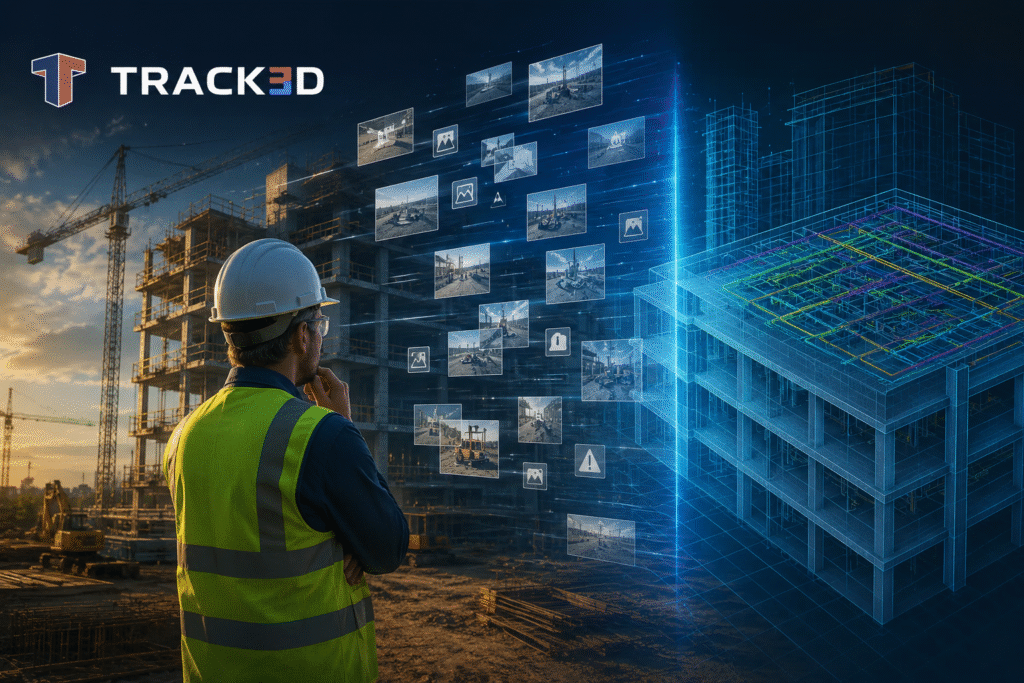
Reality Intelligence is an AI-powered approach that automatically transforms visual site data into quantified, schedule-aligned progress insights, enabling construction teams to identify issues earlier and make better decisions faster. It has three core capabilities as follows:
1: Reality Capture: Unified Input
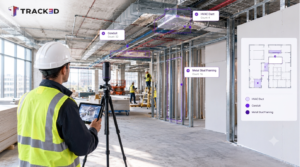
This system is designed so that data from all sources, like 360-degree cameras, drones, laser scanners, and mobile devices, feeds into a single, centralized system. This way, all stakeholders get a consistent view of the site conditions regardless of the capture method. It also helps to eliminate data fragmentation when it’s scattered across various systems.
2: AI-Powered Processing: Automated Analysis
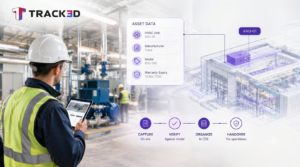
Reality Intelligence’s AI engine automatically detects and classifies installed elements by trade and type. It provides accurate measurements and identifies deviations between BIM model specifications and actual installations. This helps teams figure out what changed between captures, where progress slowed, and where installations are complete. This means analysis no longer comes with reviewer fatigue, gaps from time pressure, and variance in interpretation.
3: Proactive Insight Delivery: From Analysis to Action
Reality Intelligence surfaces proactive insights automatically, without waiting for a request. For instance, if activities fall below the required installation pace, progress rates decline, or the current pace is unsatisfactory, the system will automatically flag an alert. This makes it easy for the project managers and superintendents to move from reactive damage control to proactive risk management.
Ultimately, Reality Intelligence doesn’t concern itself with capturing more data. Its main goal is to extract value from what’s already been captured. Moreover, existing data becomes the input for automated analysis that answers the questions that drive daily project decisions.
When you only have documentation, someone reviews the captured visuals when they have time, progress is assessed subjectively, and insights arrive late, if at all. Instead, when you have Reality Intelligence, the AI system processes imagery, identifies installed elements by trade, measures quantities, compares conditions to BIM models and the schedule, presents insights within hours, and flags at-risk activities before they compound.
What To Expect From Reality Intelligence?
When you shift from conventional methods of data capture to Reality Intelligence, here’s what you can expect from the shift:
- Schedule Adherence: Issues with the pace of the project are identified around 1 to 2 weeks earlier than manual monitoring would have. This naturally increases the range of responses available. For instance, teams using reality intelligence report about 12% improvement in schedule adherence compared to those who still rely on manual project monitoring.
- Rework Reduction: According to research, rework typically accounts for 5 to 10% of the total cost of the project. Moreover, miscommunication and poor data are responsible for 48% of all rework incidents on construction projects. This is where Reality Intelligence can do its magic. It gives all stakeholders the same objectives, generates progress data, and catches installation deviations before the next trade proceeds. Thus, once RI can identify the primary issues, teams can experience up to a 20% reduction in rework costs.
- Coordination and Payment Efficiency: Coordination meetings should not be spent establishing facts. RI assists teams with that. It provides the same automatically generated progress data, based on which teams can start making decisions – saving approximately 15% time. Additionally, pay application verification that previously required multi-hour site walks can be completed using automated quantification in under an hour, accelerating payment cycles by 30 to 50%.
- Claims Defense: According to the Arcadis 2022 Global Construction Disputes Report, the average construction dispute takes 15.4 months to resolve, with average dispute values reaching $52.6 million per case. However, these numbers won’t stand for teams with comprehensively analyzed visual records, as they report faster resolution and stronger outcomes. All evidence is objective, timestamped, and not subject to interpretation.
Proof From The Field: How Well Reality Intelligence Has Worked
In this section, let’s look at a quick case study of how Reality Intelligence truly transformed the way construction teams function. Hensel Phelps, one of the nation’s largest general contractors, deployed a Reality Intelligence platform on the construction of San Francisco International Airport’s integrated operations center, a complex multi-trade project with zero tolerance for delays.
The results were immediate – what previously required hours of manual analysis now happened automatically. The leadership team gained continuous visibility into installation status across all trades and floors through one unified system, giving every stakeholder, from project managers to field engineers and schedulers, a single shared source of truth.
PMs and superintendents could also measure the results. Over time, Track3D saved the Hensel Phelps team 2,964 hours of coordination time, translating to $342,000 in labor cost savings. Documentation time dropped by more than 50%. More than 20 monthly job walks were consolidated into one streamlined workflow. Three major rework incidents were avoided before they compounded into costly corrections. And across the entire build, 26 subcontractor trades were coordinated through a single shared platform, eliminating the fragmentation that had previously made progress verification slow and unreliable.
Following the project’s success, Hensel Phelps expanded deployment across additional complex builds – a clear signal that construction site intelligence had become a part of how they deliver projects.
How to Choose The Right Reality Intelligence Solution?
If you’re confused about choosing the right Reality Intelligence solutions, here are a few questions you can ask to make the smart choice:
- Does the platform automatically measure quantities and calculate percent complete by activity?
- Is the project data automatically correlated to the project schedule?
- Does the system automatically surface issues as soon as they emerge?
- Can the system compare installed conditions against design intent to catch quality issues?
- Can the Reality Intelligence system be integrated with the existing tools that the team uses?
If the answer to any of these questions is no, you’re making the wrong choice. Your Reality Intelligence system should be able to do all of the above. Only then is it capable of making a difference.
The Bottom Line
Ultimately, more data will not solve the visibility problem most construction teams face. The gap lies in how the data is interpreted and acted upon. Thus, teams already have enough data; what they lack and need is a system that converts information into timely, reliable insight – Reality Intelligence. It transforms raw visuals into measurable, schedule-aligned progress and proactive alerts, so teams can act sooner, reduce risk, and deliver projects with more certainty.
Ready to see what your existing site data could tell you with the right intelligence layer applied? Book a demo with Track3D and see how construction teams are turning visual documentation into proactive progress intelligence.
Reality Capture vs Reality Intelligence
It helps to be precise about terms. Reality capture gets visual data off the site; reality intelligence turns that data into decisions. The difference is where the bottleneck actually lives.
| Reality Capture | Reality Intelligence | |
|---|---|---|
| What it does | Collects photos, video, 360°/3D scans | Analyzes captures against the plan |
| Output | A visual record | Progress %, deviations, and alerts |
| Who reviews it | A person, manually | Automated, then verified by the team |
| Effect on tracking | More data to sift through | Faster, objective decisions |
If you want the deeper dive on this concept, read our overview of reality intelligence.
Case Example: From 10,000 Photos to One Decision
Consider a team capturing roughly 10,000 site photos a month across a large project. Manually, a project engineer might spend 6–8 hours a week just organizing and skimming them — and still miss a slab that fell two weeks behind. With reality intelligence, the same captures are compared against the plan automatically, flagging the lagging slab within a day and cutting that weekly review to under an hour. The visual data volume did not change; what changed was how quickly it became a decision.
Frequently Asked Questions
Q1. What is the difference between reality capture and Reality Intelligence?
Ans: Reality capture only creates organized visual records. Reality Intelligence adds an AI layer that automatically quantifies progress, detects deviations, and delivers schedule-aligned insights.
Q2. My team already uses a reality capture platform. Why isn’t it delivering the visibility we need?
Ans: Because documentation and progress insight are different problems! Reality capture solves the problem of documentation. But for progress insight, you need automated analysis of that documentation against the schedule, which can only be done through Reality Intelligence.
Q3. How do we know the AI analysis is accurate enough to rely on for project decisions?
Ans: The answer is in the proven results! At San Francisco International Airport, Hensel Phelps relied on Track3D’s Reality Intelligence to verify progress across 26 active trades, approve pay applications, and avoid three major rework incidents, thereby saving $342,000 in verified labor costs on one project.
Q4. Does RI work with the capture hardware we already have in place?
Ans: Yes, it does. Track3D works with widely used reality capture hardware in the construction industry, including Ricoh Theta, Insta360, and leading iPhone and Android mobile devices. Thus, you’ll barely need any hardware changes.
Q5. Isn’t more visual documentation always better?
Not on its own. More visual documentation improves your record, but it does not automatically improve progress tracking — someone (or something) still has to turn those images into an accurate, plan-aware read on progress. The value comes from analysis, not volume: the goal is fewer blind spots and faster decisions, not simply more photos.