

Percent complete measures the portion of a defined scope that a team has finished. The standard percent complete formula divides actual work completed by total work required, then multiplies by 100. Construction teams apply that formula in three common ways, and each method gives a different answer for the same scope.
The pay app says 62 percent, the schedule says 55 and the superintendent says 70. Each number came from a different method, and none of them came from measuring the work in place. This guide works through all three ways to measure progress with the same example, then explains why each construction percent complete figure differs.
Method 1. Units of work installed
The units method counts what is physically in place. Divide the installed quantity by the total quantity, then multiply by 100.
Take a floor with 4,800 linear feet of conduit in the drawings. Crews have installed 2,640 linear feet so far. Dividing 2,640 by 4,800 gives 0.55, so the conduit scope is 55 percent complete.
This method works best for repetitive scopes with a clear unit, such as linear feet of pipe, square feet of drywall or the number of fixtures set. Its weakness is that the total quantity must be correct, and someone must count the installed quantity in the field.
Method 2. Cost to cost
The cost to cost method compares money spent with the total expected cost. Divide the costs incurred to date by the estimated total cost, then multiply by 100.
Suppose the electrical scope carries an estimated total cost of $1,200,000. The project has incurred $744,000 to date. Dividing 744,000 by 1,200,000 gives 0.62, so the cost to cost method reports 62 percent complete.
Accountants use this approach in the percentage of completion method for revenue recognition, which also drives construction in progress accounting.
Under generally accepted accounting principles (GAAP), contractors on a long term contract often recognize revenue with this completion method. Revenue on the income statement and work in progress on the balance sheet then follow costs incurred to date divided by total estimated costs. Some small contractors use the completed contract method instead, which defers revenue until the job is finished. The accounting method a contractor chooses shapes its financial reporting, so accurate cost estimation matters for every financial statement.
The method measures spending, though, not installed work. Material purchased early or labor billed ahead of installation pushes the number up.
Method 3. Weighted milestones
The weighted milestone method splits a task into steps and assigns each step a share of the value. Once a team completes a step, the task earns the value assigned to that step.
Consider the same conduit scope split into three milestones. Rough-in carries 50 percent of the value, inspection carries 20 percent and finish work carries 30 percent. Rough-in is done and the inspector has signed off, so the task earns 50 plus 20, which is 70 percent complete.
Milestones are simple to track and easy to explain at a meeting. They also overstate progress when a large weight sits on a step that is only partly finished.
Why the numbers disagree
The three methods measure different things, so the gap between them is normal. The common causes are worth knowing before anyone argues about which number is right.
- Billing often runs ahead of the work, because schedules of values front-load early line items.
- Cost lags or leads installed work, depending on when material arrives and when labor posts.
- Milestones overstate progress, because a step counts as finished before every part of it is in place.
- Unit counts depend on an accurate total and a reliable count of what crews installed.
In the example, the cost to cost number sits at 62 percent, the units number at 55 percent and the milestone number at 70 percent. Only the units method ties the answer to work a person can see on the floor.
Measuring instead of estimating
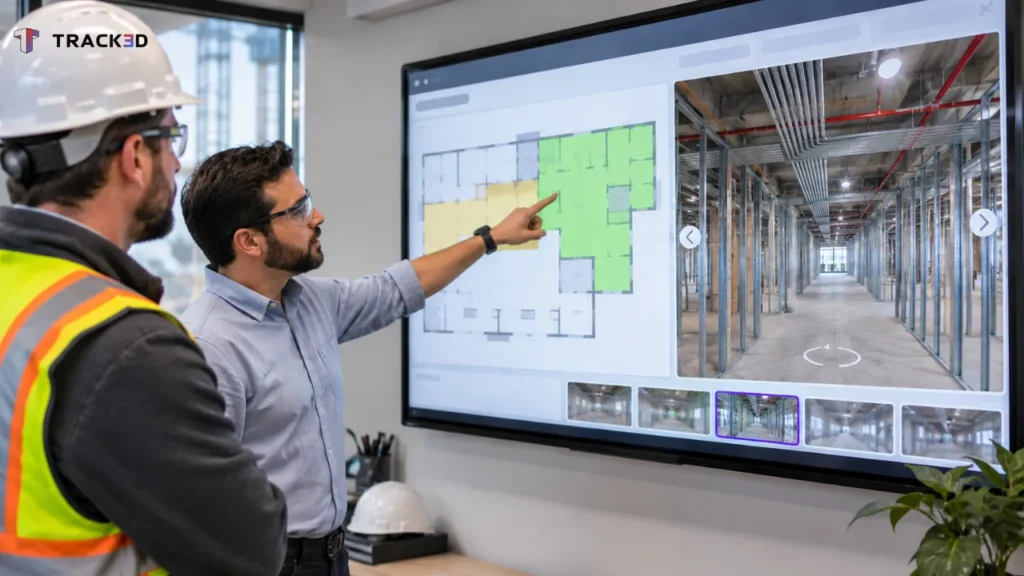
A measured installed quantity divided by the quantity from the drawings gives a number a project manager can defend. It removes the guesswork from the units method and gives the team one shared figure to compare against billing and the schedule.
On progress tracking projects, Track3D measures installed quantities and percent progress by floor, zone, trade and activity from 360 video walks, shown on the 2D drawings. Percent progress is the installed quantity over the quantity from project data setup, so the result depends on a complete set of drawings. Work covered before a walk cannot be seen, and a progress change between two dates needs walks on or near both dates.
Track3D produces a progress report PDF after every capture, and Progress Overview and Trends export to Excel. Prediction charts show planned, average, recent and required pace lines with install rate projections. At Hensel Phelps, the project team used Track3D for progress tracking and documented savings of $342,000. See how Track3D measures percent complete by floor, zone and trade.
Frequently asked questions
How do you calculate percent complete in construction?
Divide the actual work completed by the total work required, then multiply by 100. Teams measure work completed as installed units, costs incurred or finished milestones, and each choice can produce a different result.
What is the percentage of completion method?
The percentage of completion method recognizes revenue on a long-term contract in proportion to the work completed during each period. Most contractors estimate that proportion with the cost to cost method.
What is the cost to cost method?
The cost to cost method divides costs incurred to date by the estimated total cost of the contract. A project with $744,000 incurred against a $1,200,000 estimate is 62 percent complete under this method.
How do you calculate percent complete for a pay application?
Each line on the schedule of values gets its own percent complete, usually based on work in place. The general contractor multiplies that percentage by the scheduled value to set the amount billed for the period.
What is the difference between percent complete and earned value?
Percent complete is a ratio that describes how much of the work is finished. Earned value converts that ratio into money by multiplying it by the budget for the work, so teams can compare it with planned value and actual cost.