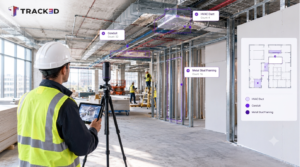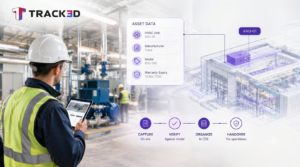
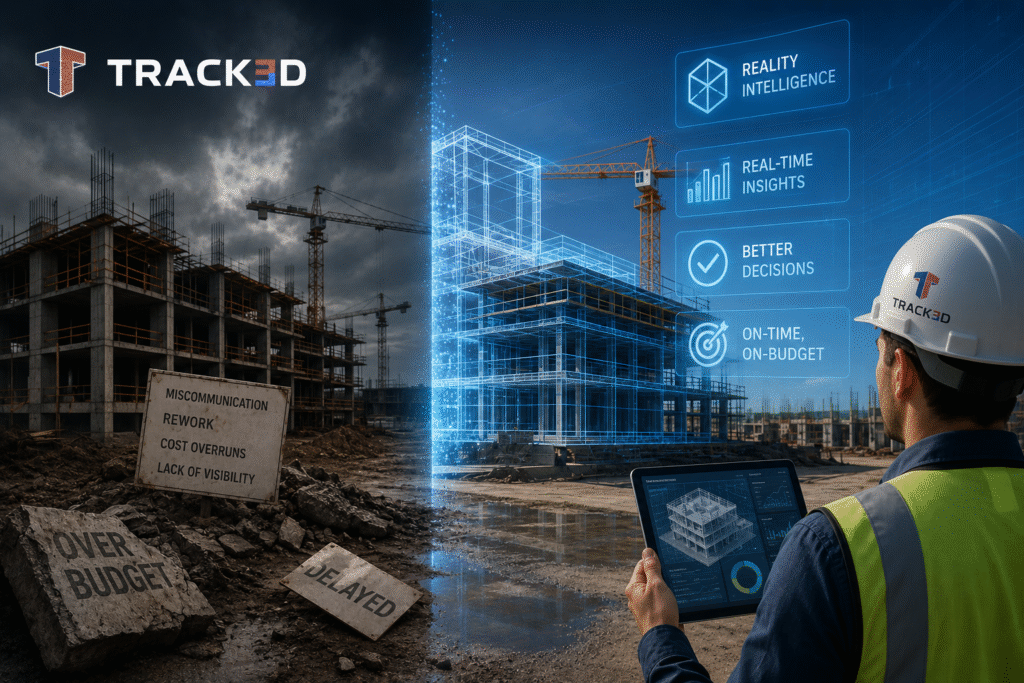
In the beginning, all construction projects seem perfectly aligned. Schedules are defined properly, teams are experienced and equipped to handle challenges, and execution seems to be in control. But as the project progresses, subtle deviations surface and things start to go wrong. This tells us that most construction projects don’t fail because of one major breakdown. Instead, they fail gradually because of small gaps in visibility, coordination, and decision-making that go unnoticed and compound over time. And Reality Intelligence is built to address just that!
In this guide, we explore the real reasons why construction projects fail, how Reality Intelligence helps change this dynamic, the tools and tech it uses, and what happens if you don’t implement it. Continue reading to find out more!
Key Takeaways
- Construction projects fail gradually due to small, unnoticed gaps and not because of one major issue.
- Capturing data isn’t enough anymore! Teams need actionable insights from the data.
- Lack of near real-time visibility leads to delayed decisions and bigger execution problems.
- Late issue detection significantly increases rework costs and schedule delays.
- Reactive damage control keeps projects in constant firefighting mode. Instead, teams need proactive risk management.
- Reality Intelligence uses AI to turn visual site data into automated progress intelligence.
- It enables early detection, proactive decisions, and better coordination.
The Real Reasons Why Construction Projects Fail
According to studies done by McKinsey, large construction projects typically take 20% longer to finish than the scheduled timeline and run up to 80% over the predetermined budget. Even though this statistic matches for most construction projects, people fail to understand that the causes rarely come out of nowhere. They build up eventually. For instance, consider the list below of aspects that cause most project failures:
1. Lack of Visibility: Teams Can’t See What’s Really Happening on Site
If the progress monitoring on your job site still depends on someone walking around, manually taking pictures, and writing reports, it will be slow, inconsistent, and highly subjective. Thus, when you can’t consistently track what’s installed on the job site, what’s lacking, and what measurements are accurate according to the plan, small delays and gaps become big ones. For example, a trade or zone that’s running 20% behind schedule in week 2 is a minor fix. But if not corrected, the same in week 10 is now a full-blown crisis.
2. Inefficient Problem-Tracking: When Problems Are Found Too Late To Fix
For nearly all construction projects, rework costs around 5 to 10% of the total project cost. To counter this, CMAA research found that avoidable rework can extend schedules by up to 19%. Meaning that in most cases, the issues existed early, and they were preventable, but they were just not caught early enough. Once other installations and work are done around it, it is expensive to break everything down and start again.
DeviationTrack does this automatically, comparing site conditions to the plan continuously.
For example, an MEP conflict spotted during coordination takes hours to resolve. However, the same conflict after drywall is closed can cost tens of thousands in demolition and reinstallation.
3. Lack of Understanding: Too Much Data, Not Enough Insight
If you’ve already integrated smart tools like 360-degree cameras, drones, and laser scanners, you know that the amount of data being captured is quite high. But the real question is how this data is being used. It should be smartly implemented and integrated into the workflow to answer routine questions about the job site status. Thus, what you need is a solution that generates insights from the data, recognizes patterns, and finds trends.
4. Reactive Management Instead of Proactive Decisions
This is the consequence of the abovementioned problems. When the progress insight comes too late, all decisions become reactive damage control, and the project constantly moves in emergency mode. However, what you need is faster feedback loops that enable proactive management. This will help you save money, time, and other resources.
Objective construction project monitoring surfaces small problems in days, not months.
5. Poor Communication and Coordination
When information does not flow cleanly between the office, the field, and subcontractors, decisions get made on stale data. Misaligned expectations lead to rework, disputes, and finger-pointing. Prevention tip: standardize how field updates reach decision-makers, and keep a single source of truth everyone trusts.
6. Unrealistic Schedules and Budgets
Projects that start with optimistic timelines or under-scoped budgets are set up to fail before the first shovel hits the ground. Prevention tip: build schedules from historical productivity data and add contingency for known risk areas.
When slippage does occur, delay analysis methods in construction help pinpoint the cause and accountability.
7. Rework and Quality Failures
Rework quietly eats margins and schedule. Catching defects late means tearing out completed work — the single most avoidable cost on many jobs. Prevention tip: inspect at each phase before work is concealed. See just how expensive this gets in our breakdown of the hidden costs of rework.
8. Complex Delivery Methods Without the Right Controls
Newer delivery approaches promise speed but introduce fresh failure modes when teams lack the controls to manage them. Modular is a good example — we unpack where it goes wrong in modular construction failures. Prevention tip: match your controls and documentation rigor to the complexity of the method you choose.
What Is Reality Intelligence and How Does It Work?
Reality Intelligence is an AI-powered approach that automatically transforms visual site data into quantified, schedule-aligned insights, enabling construction teams to identify issues earlier and make decisions faster.
It is designed to analyze conditions, measure completion against planned activities, identify production trends, and alert teams on emerging issues. The core idea of Reality Intelligence is that it must replace the hours of manual review in verifying the project status.
A traditional documentation platform shows you what the site looks like. On the other hand, Reality Intelligence tells you what it means for your schedule, budget, and the decisions you need to make right now.
Reality Intelligence works in three stages as follows:
- Stage 1: Capture: Visual data is collected from cameras, drones, and scanners and fed into a unified platform.
- Stage 2: Analyze: The system processes the visual data, identifies what elements of the job site have been installed, measures respective quantities, and compares the actual conditions against the schedule and BIM models.
- Stage 3: Deliver: The system generates insights through dashboards, automated alerts, and trend reports so the right people can make use of the data at the right time to make decisions.
Tools & Technologies Used For Reality Intelligence
Here is an at-a-glance summary of the different tools and technologies used by Reality Intelligence:
| Particulars | Tools and Tech | What do they do? |
| Reality Capture Tools | 360-degree cameras | document entire floors in minutes, from floor to ceiling. |
| Drones | provide aerial progress capture for exterior monitoring and large-scale installations | |
| Laser scanners | generate precise 3D point clouds for dimensional verification and as-built documentation. | |
| Mobile devices | enable quick capture of specific issues on the go. | |
| AI and Analysis Layer | Computer vision | detects and classifies installed elements by trade and type. |
| BIM integration | compares installed work against design intent and flags deviations early. | |
| Automated progress quantification | measures area, volume, and linear dimensions without manual counting. | |
| Insight and Reporting Layer | Cloud-based dashboards | give stakeholders a shared, objective view of site status. |
| Proactive alerting | flags deviations and at-risk activities without waiting for a manual review. | |
| Trend analysis | tracks installation rates and forecasts whether the current pace will meet milestones. |
How Does Reality Intelligence Address Failure Points?
Now that we know what Reality Intelligence is, the technology and tools it uses, let’s understand how it addresses the different failure points of the traditional monitoring systems.
- Reality Intelligence catches schedule drifts early.
The system monitors installation rates nonstop. Because of this, any activity that falls below the required pace gets flagged immediately. Compared to manual tracking systems, RI flags these issues 1 to 2 weeks earlier. This directly impacts the project because a problem caught early takes a few days to resolve, but the same problem after a few weeks takes overtime across multiple trades and forces sequencing changes and a formal recovery plan.
- Reality Intelligence stops rework before it compounds.
The AI-powered analysis compares captured site conditions to BIM models and identifies discrepancies before the next trade begins their work. This automatic system helps contractors, project managers, and superintendents protect their schedule and team coordination. For instance, the system can easily handle tasks like verifying whether electrical rough-in is complete before drywall proceeds, or that MEP installations match the latest designs before ceilings close, etc.
- Reality Intelligence helps transform coordination into decision-making.
Coordination in construction projects is more than just weekly meetings. It’s ensuring that teams actually work in unison and as one entity, rather than competing with each other. And that’s exactly what Reality Intelligence enables. It allows everyone to work with the same objective data so that coordination meetings shift from debating facts to deciding the next steps.
What Happens If You Don’t Have Reality Intelligence?
We’ve already discussed the benefits and necessity of Reality Intelligence in any construction project. But its true value can only be emphasized by exploring what happens in its absence. Thus, in this section, we discuss some of the common mistakes that teams make without Reality Intelligence:
- Waiting for the weekly report.
Understand that weekly reports only bring you information at certain intervals. However, construction is an incredibly dynamic field that demands constant supervision from the stakeholders. Thus, when you wait for weekly reports, any error on it has already been brewing on the site for 2 to 3 weeks. At this point in time, the report only contains documentation and not a warning. Moreover, the cheap options to fix the issue are no longer available.
What you need is instant information with near real-time accuracy.
- Treating documentation as the end goal.
Documentation is crucial for dispute resolution, remote access, and historical reference. It is 100% an indispensable component of any construction project. But it is only a tool. Documentation gives you the means to answer questions that arise every day regarding the job site. At the end of the day, all the biggest comprehensive records and archives are only going to be useful if they can provide actionable insights.
Thus, what your project needs is an analysis layer – an extra means of reading data that gives you insight that can drive decisions.
- Managing without data backing.
As a manager, intuition is important to a certain extent in order to understand the site conditions, your teams, and their coordination. But ultimately, to make decisions, you need exact measurements and accurate data. For instance, “It looks about 80% complete” and “847 of 1,000 linear feet are installed” are clearly not the same. But if you don’t pay heed to the difference, it will show up in a pay application dispute, a schedule recovery conversation, or an owner transparency meeting.
- Stacking too many disconnected tools.
When issues occur or discrepancies arise, the first solution for most superintendents and their teams is to add more tools. But that’s often not the right approach. If it’s a visibility problem, you need visibility solutions. Don’t try to solve it with a mix of reality capture, project management tools, an analytics layer, etc. Because then, you’ll end up with a system that needs manual data entry, reconciliation, and judgment calls.
Instead, what you need is a unified platform that can do what these different components do separately and provide a singular source of truth.
Final Thoughts
Construction projects rarely ever collapse overnight. More often than not, they’re a conclusion of several missed signals, delayed insights, and late decisions. Minor deviations in the beginning are caught too late and compound into cost overruns, rework, and schedule disruption. However, Reality Intelligence holds the key to solving this issue.
It helps to not only collect data from the job site but also use it effectively. It is designed to turn visual data into timely, actionable insights that enable the teams to act early, coordinate better, and manage proactively. Because of its value, Reality Intelligence is today changing how modern construction teams function, execute their projects, and deliver the final products.
Want to see how Reality Intelligence works in practice? Explore how Track3D helps construction teams move from reactive documentation to proactive site intelligence.
How to Prevent Construction Project Failure
Most failures trace back to the same root cause: teams acting on incomplete or outdated information. Preventing failure is less about heroics and more about tightening the feedback loop between what is happening on site and the decisions being made in the office. A practical playbook:
- Get objective site visibility so problems surface in days, not months.
- Track deviations against the plan continuously instead of at milestone reviews.
- Standardize documentation so nothing depends on one person’s memory.
- Inspect quality at every phase to keep rework from compounding.
- Build realistic plans grounded in historical productivity, not optimism.
Studies consistently find that the majority of large construction projects run over budget or behind schedule — and poor visibility into on-site progress is repeatedly cited as a leading driver.
Frequently Asked Questions
Q1. What is Reality Intelligence in construction?
Ans: Reality Intelligence is an AI-powered approach that converts visual data from the job site into automated, schedule-aligned progress insights. It analyzes what’s installed, measures current pace against the plan, and alerts teams to emerging issues before they compound.
Q2. How does Reality Intelligence help prevent construction failures?
Ans: Reality Intelligence helps teams to prevent construction failures by flagging at-risk activities one to two weeks earlier than manual monitoring when issues are still small enough to fix without major disruption.
Q3. Is Reality Intelligence different from reality capture?
Ans: Yes, reality capture is fairly different from Reality Intelligence!
Reality capture creates visual records, whereas Reality Intelligence adds an AI layer that quantifies progress, detects deviations, and correlates conditions with the schedule. The former shows you what the site looks like. And the latter tells you what it means.
Q4. What types of construction projects benefit most from Reality Intelligence?
Ans: Reality Intelligence is useful across a wide range of project types and sizes, from individual builds to large-scale multi-trade developments. On small projects, it reduces the burden of manual review and improves the standard of documentation. On larger multi-trade builds, Reality Intelligence is essential for coordinating across floors, zones, and dozens of active subcontractors. Thus, it is beneficial for commercial, healthcare, airports, education, residential, and infrastructure projects, etc.
At the end of the day, if your team is capturing site data and spending time manually interpreting it, Reality Intelligence can add value regardless of the scale of the project.
Q5. Do you still need experienced field professionals if you’re using Reality Intelligence?
Ans: Absolutely! Reality Intelligence enhances judgment; it doesn’t replace it. Superintendents still need to walk on sites. Project managers still need to make calls. Reality Intelligence is intended to make experienced people more effective.