
Construction quality assurance (QA) is the planned system of standards and processes that prevents defects. Quality control (QC) is the hands-on checking of installed work against those standards as the building goes up. QA writes the rules. QC tests the work against them.
Quality assurance and quality control get used as if they mean the same thing. On an active project, that ambiguity has consequences, because nobody is certain who authors the quality plan, who accepts the work or where the records are maintained. The gap usually shows up at the worst moment, during a final inspection or months after turnover.
Key Takeaways
- QA is about the process. It plans how quality will be achieved before and during the job.
- QC is about the work. It checks what was installed, task by task.
- The general contractor usually owns both on site, with the owner auditing from above.
- Trade partners run QC on their own scope first. Special inspectors verify specific work for the owner and the building official.
- Both depend on dated, located records of what was installed and when.
What Is the Difference Between QA and QC in Construction?
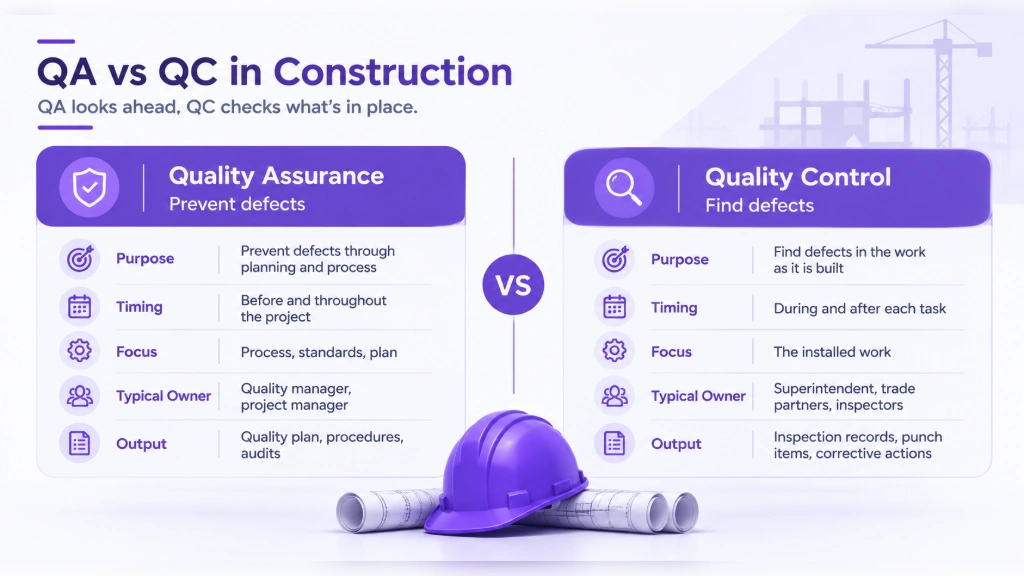
The simplest way to separate them is by timing and focus. QA looks forward. It focuses on preventing defects and asks how the team will get it right. QC looks at what is in place. It relies on inspecting and testing the work to confirm it is right.
| Topic | Quality assurance | Quality control |
| Purpose | Prevent defects through planning and process | Find defects in the work as it is built |
| Timing | Before and throughout the project | During and after each task |
| Focus | Process, standards, plan | The installed work |
| Typical owner | Quality manager, project manager | Superintendent, trade partners, inspectors |
| Output | Quality plan, procedures, audits | Inspection records, punch items, corrective actions |
Take firestopping as an example. QA decides that every penetration in a rated wall gets a listed firestop system and an inspection before the wall is closed. QC is the superintendent and the firestopping trade partner walking that wall and confirming each penetration matches the approved system.
One is a decision made at a desk. The other happens with a flashlight in a corridor. A project needs both, and it needs them owned by people who know which one they are doing.
Some owners make the split official. On many federal projects, the contractor runs the quality control program, and the government performs quality assurance over it. Owners on larger private jobs often do something similar. They hire construction quality assurance services from an outside firm to audit the contractor’s program on their behalf. That firm checks that the system works. It does not take over the contractor’s daily QC.
Who Is Responsible for Construction Quality Assurance?
Quality is a core project management responsibility, and the contract determines who carries each part of it. Most of the answers sit in the specifications, especially the quality requirements sections in Division 01. The table below shows a common split on a US commercial project. Treat it as a starting point, not a rule. Every contract assigns these roles a little differently.
| Role | QA responsibility | QC responsibility |
| Owner | Sets quality requirements in the contract and specs. Pays for independent testing and special inspection. | Accepts completed work. Rarely inspects day to day. |
| Owner’s rep | Reviews the contractor’s quality plan and audits how it runs. | Spot checks work and attends major inspections. |
| General contractor | Writes and runs the project quality plan. Holds every trade partner to it. | Owns QC for all work on site, including trade partner work. |
| Quality manager | Builds procedures, trains the team, runs audits and tracks corrective actions. | Reviews QC results for trends. Can stop work when the process breaks down. |
| Superintendent | Follows the plan and schedules hold points in the lookahead. | Runs daily QC and checks work before it gets covered. |
| Trade partner | Submits QC procedures for its own scope. | Inspects its own work first, then fixes and documents issues. |
| Special inspector | Gives the owner and building official an independent check, as the building code requires for certain work. | Inspects listed work such as structural welding, high strength bolting and some concrete placements. |
A few patterns show up across most projects.
The general contractor carries the most weight. It writes the plan and is accountable to ensure quality on every scope, even work it does not self perform.
The quality manager owns the system, not every inspection. On smaller jobs this role often falls to the project manager. That arrangement works, provided someone has dedicated time to administer the program.
Special inspectors work for the owner, not the contractor. The building code keeps them independent for a reason. Their reports go to the owner and the building official.
The most common gap sits between the superintendent and the trade partner. Each one assumes the other checked the work. The remedy is straightforward. Assign an accountable person to every hold point and record that assignment in the plan.
What a Construction Quality Assurance Plan Contains
A quality plan does not need to be lengthy, but it must be clear enough that superintendents reference it in the field. Most quality assurance construction plans cover the same ground.
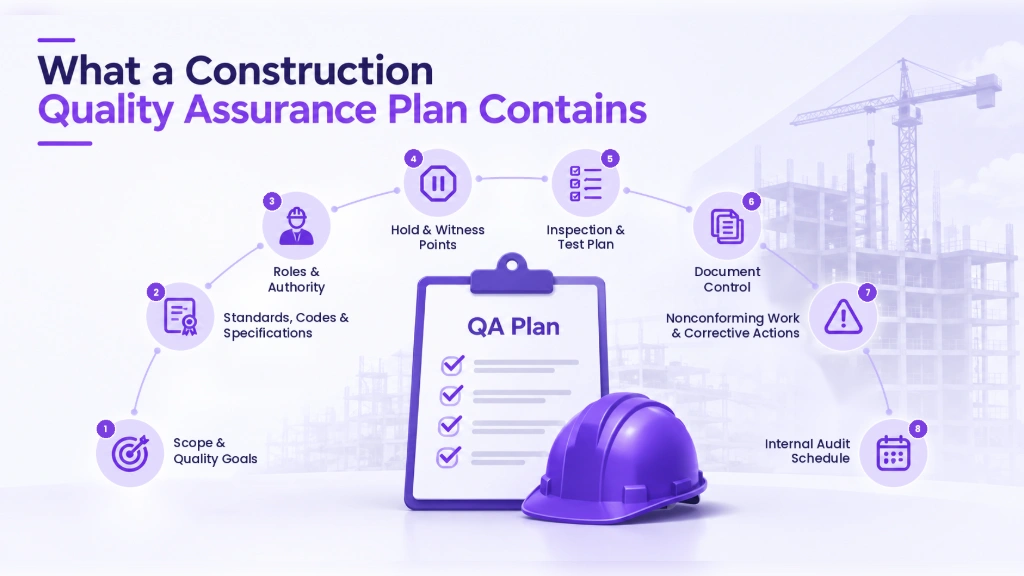
- The scope of work the plan covers and the quality goals for the project.
- The standards, codes and specification sections that define acceptable work.
- Who has authority to accept work, reject work and stop work.
- Hold points and witness points, where work cannot proceed until someone signs off.
- An inspection and test plan that lists the inspections and tests, when they happen and who runs them.
- Document control, so everyone builds from current drawings and approved submittals.
- A process for nonconforming work and corrective actions, including how fixes get verified.
- A schedule for internal audits of the plan itself.
That is quality assurance in construction in its most practical form. A 200 page plan sitting in a binder in the site trailer is QA in name only. A 15 page plan the team actually uses will do more.
The owner’s rep will usually review the plan and return comments before work starts. That review is the owner’s main QA lever, so it is worth getting the hold points right at that stage.
For a phase-by-phase view of what to audit, see our construction QA/QC audit checklist.
Where QC Happens on Site
Quality control in construction happens at three moments on a typical project.
- At hold points. Work stops until a named person inspects and signs off. Think rebar before a pour or in-wall rough-in before drywall.
- During the work. In-process checks catch problems while they are still cheap to fix. A foreman checking the first few anchors beats finding a whole wall of bad ones later.
- At completion. Final checks and punch lists confirm that each area is ready for turnover.
The details of each step belong in the QC program and its quality control checklists, not the QA plan. Our guide to construction quality control covers the process in depth. For the inspection itself, see construction site inspection. For the closeout stage, our construction punch list guide walks through how to run one.
Records That Support Both QA and QC
QA and QC converge in the project record. An audit is only as credible as the documentation behind it. A QC sign-off is only useful if someone can find it later.
The records that hold up best share two traits. They are dated, and they are tied to a location. “Fireproofing done on level 3” is a memory. A set of images from gridline C4 on level 3, captured on a known date before the ceiling went in, is evidence.
This matters most for work that gets covered. Once drywall, ceilings or concrete go in, the only way to see what sits behind them is the record you made beforehand. That is why many teams treat pre-cover documentation as part of their quality plan, not an extra. More of them now capture it with digital tools instead of scattered phone photos.
Good records also settle questions faster. When an owner’s rep asks how a penetration was sealed, a located image answers it in seconds. Without one, the conversation turns into opening up finished work or trading recollections. Clear records help prevent costly rework because the team can see what was installed before anyone cuts into a finished wall.
Signs QA and QC Roles Are Blurred on Your Project
Role confusion rarely surfaces all at once. It accumulates through small, recurring habits like these.
- The quality plan was written for the bid and nobody has opened it since mobilization.
- Superintendents describe their daily walks as “QA.” That usually means nobody is auditing the system above them.
- Trade partners wait for the general contractor to find their issues instead of checking their own work first.
- Hold points exist on paper but have no named inspector, so work gets covered before anyone looks.
- Inspection results sit in personal phones, texts and email threads instead of one shared place.
- The same issue keeps coming back on different floors, and no corrective action ever gets written.
Each of these is correctable within a week. Begin by comparing the written plan against how the project actually operates. Then assign a name to every hold point and agree on where the records go. Those two changes close most of the gap between QA and QC. They will do more for quality outcomes than another binder on the shelf.
Where Track3D Fits
Track3D gives quality teams a dated, located record of installed work. Teams walk the site with a 360 camera and the Track3D mobile app, and each capture is organized by location and date on the project’s floor plans. Capture Coverage shades the floor plan to show which areas a walk covered, so gaps in the record are easy to spot before work gets closed in. Team members can pin notes, voice notes and tags to the exact spot and link them to Procore Inspections, Observations and Issues, or to Autodesk ACC Issues and RFIs.
Track3D construction quality assurance record showing a 360 site capture pinned to its floor plan location.
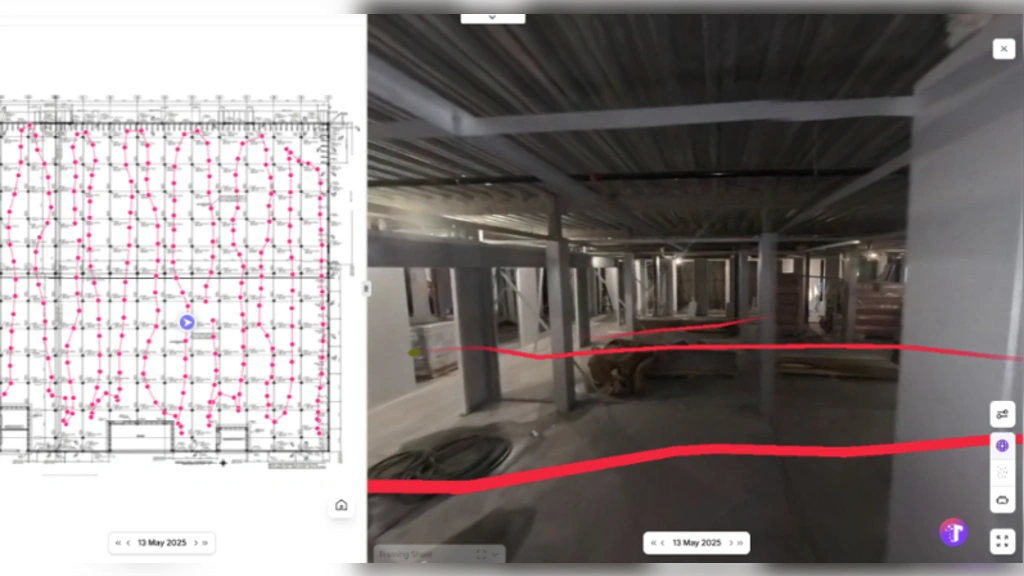
A person still decides whether the work passes. Track3D keeps the proof in one place. Rycon Construction reported $75,000 in rework avoided because of this kind of continuous documentation.
Getting construction quality assurance right comes down to clear roles and good records. Decide who owns the plan, who checks the work and where the proof is kept before the first trade mobilizes. The final product is better for it, and turnover gets a lot less tense.
See How Track3D Documents Installed Work by Location
See how Track3D documents installed work by location.
Frequently Asked Questions
What is the difference between QA and QC in construction?
QA is the planned system that prevents defects. It covers standards, procedures and audits. QC is the checking of installed work during and after each task to confirm it meets the standards. QA focuses on the process and QC focuses on the work.
Who is responsible for quality assurance on a construction project?
The general contractor usually writes and runs the quality plan, often through a quality manager. The owner sets the requirements in the contract and audits the program, sometimes through an owner’s rep or an outside firm. The exact split depends on the contract and specifications.
What is a construction quality assurance plan?
It is a project document that explains how the team will deliver work that meets the contract. It names the standards, the people with authority, the hold points, the inspection plan, document control and the process for corrective actions.
What is a hold point in construction quality control?
A hold point is a stage where work cannot continue until a named person inspects and accepts it. Common examples include rebar before a concrete pour and in-wall work before the walls are closed.
Do small projects need a QA plan?
Yes, although the plan can be brief. A few pages that name who checks what, the hold points and where records are kept will prevent most of the confusion that causes rework. Small teams often combine the QA and QC roles, which is fine when the responsibilities are still written down.