
Construction disputes begin when parties on construction projects disagree about payment, delay, defects or scope and cannot settle it themselves. At that point, records made at the time of the work carry the most weight, while memories and rebuilt timelines carry far less.
The situation is familiar to most project managers. A claim arrives months after the team completes the work, and everyone remembers the project a little differently.
The team usually has daily logs, a long email trail, and a photo library with thousands of images. What the team often cannot do is show what the crew installed at a specific location on a specific date.
This guide explains which records matter most and why date and location increase their value. It ends with a dispute-readiness checklist your team can start using this week.
Key Takeaways
- Most construction disputes depend on what each party can show rather than what each party remembers.
- Daily logs, RFIs, change documents, meeting minutes and site images all add to the project record, and each has a common weak spot.
- A site image with no date or location proves very little, while a dated, located image shows what went in and when.
- A steady routine that starts at kickoff works better than rebuilding the record after a claim arrives.
- Your legal counsel decides how records are used in a dispute, so involve them early.
Where Construction Disputes Start
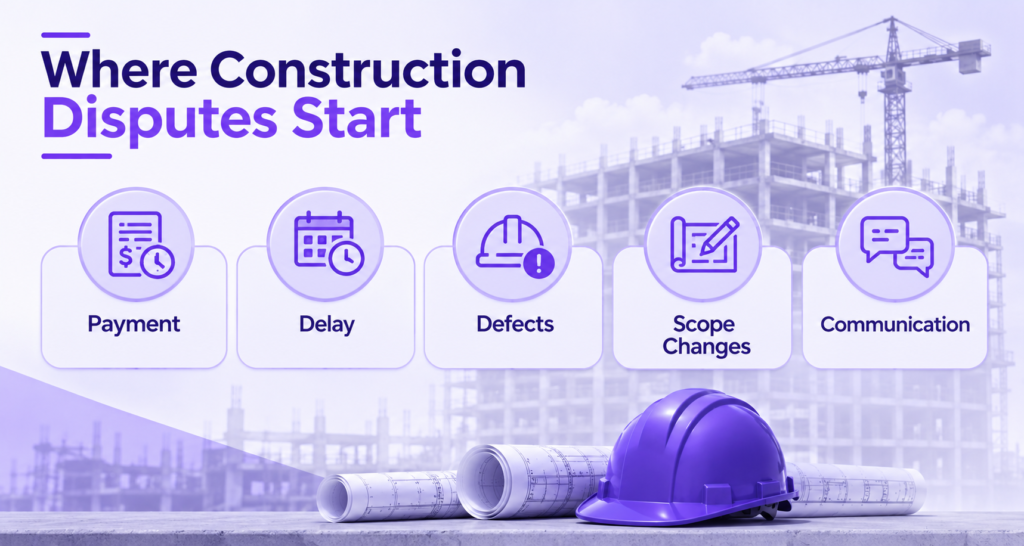
Most disputes arising on construction projects trace back to a few recurring causes. These causes appear on projects of every size, from tenant improvements to complex construction programs, and they affect owners, contractors and trade partners alike.
- Payment. An owner may question or withhold a pay application because the owner’s view of percent complete differs from the contractor’s view. Retainage and back charges often add to the friction.
- Delay. When a milestone slips and project delays accumulate, each party usually blames the other. Weather, late RFI responses, late material deliveries, and access restrictions often become part of the same argument. Our guide to the types of construction delays explains each type in more detail.
- Defects. An owner may claim that work was installed incorrectly, while the contractor or trade partner maintains that it matched the drawings at installation. By the time anyone checks, the work is often hidden behind finished walls.
- Scope changes. Field staff sometimes direct extra work before the paperwork is done. Later, the parties disagree about whether the work was a change or part of the original contract.
- Communication. Decisions made in hallways or on phone calls often never reach the written record, and those missing decisions can lead to disputes months later. This cause sits behind most of the others.
Industry research supports this pattern. The Arcadis 2025 Construction Disputes Report lists a lack of proper documentation among the most cited sources of conflict, and the Construction Management Association of America published a summary of its findings.
The Records That Matter in Construction Disputes
No single record decides a dispute. Minor disagreements become costly disputes when the records contradict each other or leave gaps.
The strongest position comes from records that confirm each other. A daily log entry, an RFI response, and a dated image of the same wall together carry far more weight than any one of them alone.
The table below lists the records most teams already keep, what each one shows and where each one tends to fall short.
| Record | What it shows | Common gap |
| Daily logs | Crews, weather, work performed, deliveries and delays on a given day | Completed late in the day, with limited detail about location |
| RFIs | The question raised, the answer provided, and the dates of each | The answer is not connected to the field condition that prompted it |
| Change orders and directives | Approved changes to scope, price and time | Work begins before the documents are signed |
| Written notices | When one party informed the other of a delay, change, or problem | Sent late or not in the format the contract requires |
| Meeting minutes | Decisions, commitments and the people who made them | Not distributed, or not corrected when they contained errors |
| Dated site images with location | The condition of the work at a specific place and time | Missing location data, partial coverage, scattered storage |
| Progress records | The quantity of work in place by a given date | Based on estimates rather than site observation |
Most of the gaps in the last column are about timing and context. The record usually exists, but the team created it too late or cannot connect it to a specific location.
Why Location and Date Matter
Consider two images of the same ductwork installation.
The first is a phone photo stored in a shared folder. It shows ductwork and a ceiling grid, but nobody can confirm which floor it shows. Its file date may reflect when someone took the photo or when someone uploaded it.
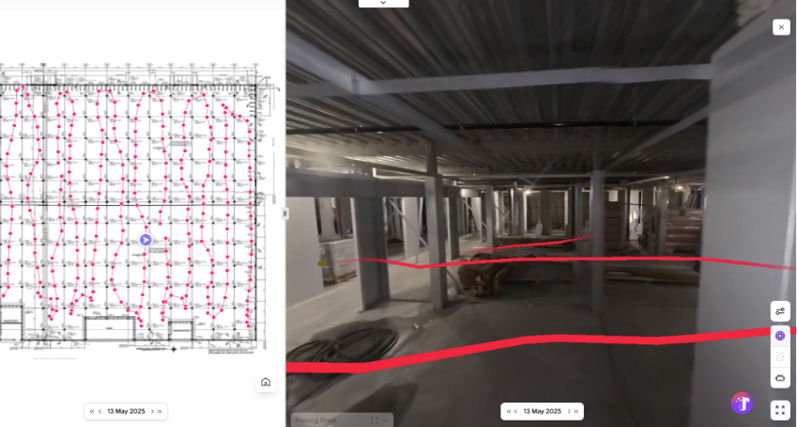
The second is a capture pinned to gridline D6 on level 4 of the floor plan, recorded on a known date before the crew closed the ceiling. Anyone on the project can open the drawing, click the spot and see the work as it was that day.
Both images show the same installation, but only the second one answers the questions that arise in construction disputes. Those questions are usually about where and when someone took the image and what the area looked like before and after.
Location and date also make records easier to find. A team that needs twenty minutes to find a single photo will eventually stop searching. A team that can locate any area on the drawings within seconds is more likely to check the record before a disagreement grows.
Coverage matters just as much. Images taken only where someone noticed a problem leave gaps everywhere else. A record that covers the entire floor on a consistent schedule can show good work as well as poor work, which matters when someone questions work that was done right.
How to Control Construction Disputes With a Dispute-Readiness Checklist
The best time to prepare for a dispute is before any disagreement exists. No checklist can prevent disputes entirely, but a steady routine keeps minor issues from growing. Add the following items to your project management startup plan and assign each one to a specific person.
- Read the notice, change and claim sections of the contract at kickoff so the team knows the deadlines and required formats.
- Name an owner for each record type, including daily logs, RFIs, change documents, meeting minutes and site images.
- Document existing conditions before mobilization, including adjacent property, access routes and any existing structures.
- Set a capture schedule for the whole site, such as a weekly walk, and maintain it through closeout.
- Capture in-wall, above-ceiling, and below-slab work before crews conceal it.
- Complete daily logs on the same day and record where the work took place as well as what the work involved.
- Pin notes to a location and date as soon as an issue appears rather than waiting for the next meeting.
- Link site images to the related RFIs and change documents while the details are still fresh.
- Review each walk for coverage gaps and address them during the next walk.
- Keep original files in one shared place and set a retention period that covers closeout, warranty and what your contract requires.
None of these steps takes much time on its own. Their value comes from steady, weekly practice, because a record pulled together after a claim arrives is usually thin.
At project completion, include the visual record with the rest of your closeout documents. Claims sometimes surface long after the team has moved to another project.
Construction Disputes Resolution Options
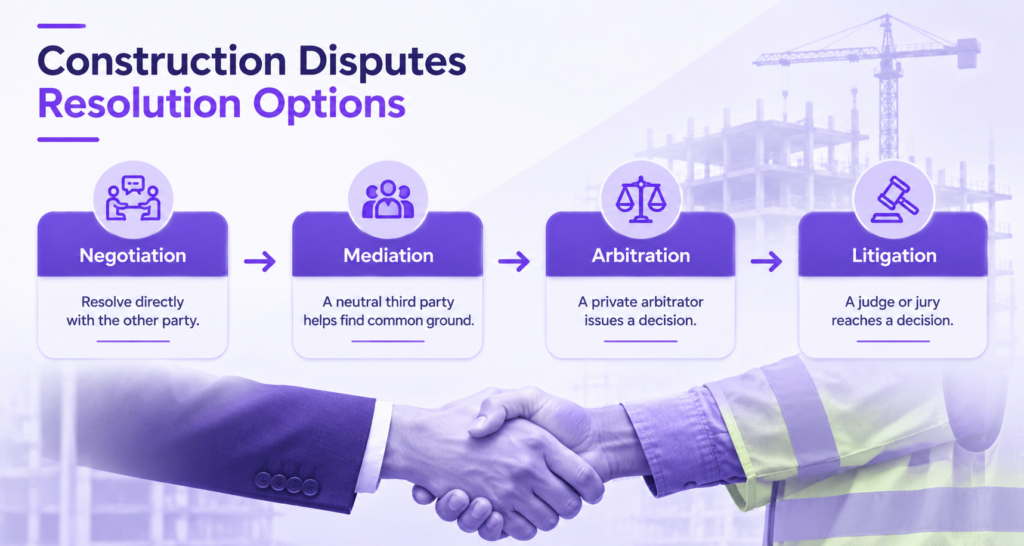
Resolving construction disputes usually follows the process defined in your contract. Most contracts specify a dispute resolution method and an order of steps, typically negotiation, mediation, arbitration and then litigation. Your contract and your legal counsel determine which path applies.
- Negotiation. The parties attempt to resolve the issue directly, usually beginning with the project teams and escalating to executives if necessary. Negotiation is the fastest and most cost-effective option when both parties can review the same facts.
- Mediation. A mediator is a neutral third party who helps the parties reach their own agreement. The mediator does not decide the outcome, although a clear factual record often helps the discussion progress.
- Arbitration. A private arbitrator or panel hears the evidence and issues a decision. Many construction contracts name arbitration as the final step instead of court.
- Litigation. The dispute proceeds to court, where a judge or jury reaches a decision. Litigation is generally the slowest and most expensive option.
Mediation and arbitration are both forms of alternative dispute resolution, commonly abbreviated as ADR.
Every conflict resolution path depends on evidence, so construction disputes resolution relies on a strong project record. The documentation your team creates during construction is the same documentation that each of these processes will request.
This article provides general information and is not legal advice. Consult your legal counsel about your specific contract and project.
How Track3D Helps the Record
Track3D organizes 360 captures from its mobile app by location and date on the project’s floor plans. Capture Coverage shades the floor plan to show which areas each walk covered, which makes gaps in the record easier to spot. Notes attach to the exact location, and Daily Notes combine into an AI-powered Daily Note Report that is sent to project admins each evening by default. After closeout, the Offline Deliverable keeps captures, pinpoints and floor plans available for review.
Rycon Construction reported that its team could locate any site condition in about 2 minutes, compared with 15 to 30 minutes in its previous photo library. Rycon also reported $75,000 in rework avoided. How that record is used in a dispute remains a decision for your legal counsel.
See How Track3D Builds a Dated, Located Record of Your Site
See how Track3D builds a dated, located record of your site.
Frequently Asked Questions
What are the most common construction disputes?
The most common construction disputes involve payment, delay, defective work and scope changes. Poor communication and gaps in the record often sit behind all of them.
How do you avoid construction disputes?
Teams cannot avoid every disagreement, but they can prevent many from escalating. Review the contract’s notice and change provisions early, assign owners for each record type and document the site on a consistent schedule. Reliable records help the parties agree on the facts more quickly.
What records help in a construction dispute?
Daily logs, RFIs, change orders, written notices, meeting minutes, progress records and dated site images with location all help. These records are strongest when they are consistent with each other and created at the time of the work.
How are construction disputes resolved?
Most construction disputes move through negotiation first, followed by mediation and then arbitration or litigation if necessary. Your contract usually defines these steps and their order, so review it with your legal counsel.
Are photos useful evidence in a construction dispute?
Whether a court or arbitrator admits a photo as evidence is a legal question that your counsel should answer for your project. Your team controls how the record is created, and dated, located, original images that cover the entire area give counsel more information to work with.
Construction disputes are easier to manage when the relevant facts are already documented. Build the record throughout the project, connect every image to a location and a date, and retain it through closeout so that every party can review the same information.