

Innovations have always been a staple part of the construction industry. Even modern projects deploy drones, 360° cameras, BIM, AI scheduling, and reality capture. These innovations would have been out of the question ten years ago. Thus, we have made quite some progress.
However, visit any average construction site, and you’ll notice traditional paper checklists, WhatsApp pictures of updates, spreadsheets, and handwritten reports being used alongside the cutting-edge technologies. This paradox tells a lot about the current situation in the industry.
A recent study reveals that investments in digital technology among contractors only keep increasing, with project management software, reality capture, and AI showing the highest rates of adoption growth. However, despite all the investments, many companies do not receive maximum benefit due to the uneven adoption rate by the field teams. In the modern environment, technology per se is not an issue anymore. The problem is to ensure that people know how to use it.
This is exactly the essence of construction technology adoption. Rather than just simply buying new software, it focuses on helping project teams replace time-consuming manual processes with tools. These tools genuinely make their jobs easier without disrupting the work already happening on site.
The correct adoption process leads to more accurate documentation, easy availability of project information, and saves time spent by teams looking for answers. When they get it wrong, even the best software ends up sitting unused.
Want to learn more? Read on!
Key Takeaways
- Construction technology adoption works when it streamlines current processes rather than creating new ones.
- The greatest barriers to adoption always involve people and processes, not the technology itself.
- Beginning with a single process is more effective than implementing the technology
companywide from the start. - Field involvement is just as important as leadership support.
- Platforms like Track3D fit naturally into documentation habits crews already use, making adoption easier.
Where Construction Technology Adoption Stands Today
Construction has always been practical about change. Contractors rarely adopt something simply because it’s new. They adopt it when it solves a real problem. This is the reason the construction technology journey has looked different from manufacturing, finance, or healthcare. These industries usually implement process standardisation before adopting any systems. The construction industry, however, has to work under constantly changing crews, subcontractors, sites, and requirements.
That is why adoption is gradual. You’ll often see one project using drone mapping while another nearby still relies entirely on manual progress photos. One superintendent may document everything through a digital platform, while another prefers notebooks and phone pictures.
Neither approach exists because people dislike technology. They have emerged because there are processes established by all teams that enable them to complete projects despite being under pressure. According to the research by Deloitte’s 2025 Engineering & Construction Outlook, investment in technology keeps growing in the industry, specifically in AI, robotics, and connected jobsite technology. However, the study notes that the main issue facing many contractors is the implementation of technology rather than its availability.
It is a crucial point. The focus of the debate has moved from “should we invest in technology?” to “how do we ensure that people use it?”
How Most Construction Teams Still Document Projects
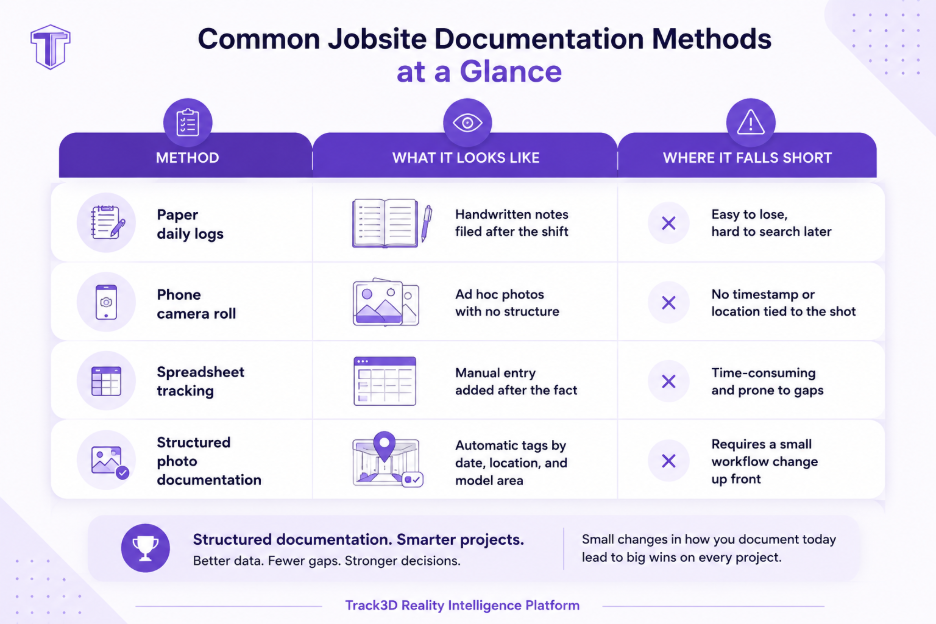
Every project needs documentation. Progress needs recording. Issues need tracking. Inspections need evidence. Clients expect updates. The difference lies in how teams capture that information.
| Documentation Method | Typical Workflow | Common Limitation |
| Paper daily logs | Handwritten notes after each shift | Difficult to search, easy to lose |
| Phone photo albums | Photos stored on personal devices | No structure, location or project context |
| Spreadsheets | Manual updates by supervisors | Time-consuming and prone to missed entries |
| Structured digital documentation | Photos automatically organised by location and date | Requires some initial process change |
Most companies already use a combination of these methods.
The challenge is that information often ends up scattered across notebooks, phones, emails, cloud folders, and spreadsheets. Finding one photo from six weeks ago can easily become a thirty-minute task. That doesn’t just waste time. It creates uncertainty when clients ask for proof, disputes arise, or teams need to confirm what happened on a particular day.
Structured documentation solves much of that problem because information stays connected to the project instead of individual people.
The Hidden Obstacles to Using Construction Technology
Ask any five project managers about what went wrong with their software implementation process, and you are likely to get five very different answers.
“Didn’t have enough time to train on it.”
“Crews were not using it.”
“It increased the workload.”
“It didn’t align with our workflow.”
“The project was completed before we got used to it.”
While these reasons may seem diverse, one thing becomes clear from all of them. The technology was not implemented in a way that aligns with how people already do things. A construction project will not halt just because a new technology comes.
Schedules remain tight.
Deliveries still need coordinating.
RFIs still need answering.
Inspections still happen.
Adding another login, another form, or another daily task can feel like extra work rather than support. That’s why many adoption efforts lose momentum after the first few weeks. People naturally return to the methods they already trust. According to research by Autodesk in their 2025 State of Design & Make report, while digital investments are still a key area of focus, work force preparedness and change management still remain some of the top barriers to technology adoption.
In other words, purchasing software is the easy part. Helping teams embrace it takes far more planning.
The Adoption Challenges That Show Up Again and Again
Across projects of every size, several patterns appear repeatedly:
- New technology gets added on top of inefficient workflows instead of replacing them.
- Teams expect immediate productivity improvements, even though learning any new system takes time.
- Field crews aren’t involved when software decisions are made.
- Success isn’t clearly defined before rollout begins.
- Small frustrations during the first few weeks get mistaken for signs that the software doesn’t work.
None of these problems are unique to construction. They’re simply more visible because construction operates under constant deadline pressure. When every day affects the programme and budget, patience becomes difficult.
Why Construction Industry Technology Adoption Moves Slowly
Construction is often described as slow to adopt technology. In reality, it’s careful. Every new workflow introduces some level of risk. If payroll software fails, employees might receive late payments. If scheduling software fails on an active project, entire trades can lose productive days. That difference changes how contractors evaluate technology.
Before committing to a new platform, they want confidence that it won’t interrupt work already in progress. This is why many companies prefer small pilot projects before wider implementation.
One successful rollout creates trust. Trust leads to adoption. Adoption leads to measurable value. Trying to force company-wide transformation before earning that trust usually produces the opposite result. Instead of enthusiasm, teams become resistant. And once confidence is lost, rebuilding it becomes much harder than getting adoption right the first time.
Why Digital Transformation in Construction Feels Risky
Technology changes are rarely just about software. They’re about changing habits that people have built over years of working on live projects. That’s why even a tool with obvious benefits can receive mixed reactions at first.
Think about a superintendent who has documented site progress the same way for 15 years. They know exactly where their notes are, how they organise photos, and what information clients usually ask for. Asking them to switch to a new platform isn’t simply introducing software. It’s asking them to trust a different way of working.
This reluctance makes sense.
Construction projects offer very little scope for any mistakes or experimentation. Missing out on an inspection or an update can cost a lot of money. When individuals feel personally accountable to get a project completed, they stick to the ways they know best as opposed to venturing out into unknown territory.
The process of digital transformation becomes much simpler when technology helps continue the existing work process instead of changing everything overnight. The chances of the adoption of technology are a lot higher when it seems like a seamless addition to their work processes.
The Hidden Cost of Delaying Technology Adoption
Many companies focus on the cost of buying new technology. Far fewer think about the cost of waiting. Those costs don’t usually appear as one large expense. Instead, they build up slowly through everyday inefficiencies that become accepted as “the way we’ve always worked.”
Consider what happens during a typical project. A project engineer spends half an hour searching for photos from an inspection completed two months ago. A superintendent drives back to site because documentation is incomplete. An owner asks for proof that work was completed before another trade started, but nobody can quickly find the right records. Each delay feels small. These efforts take up many hours throughout the entire project process.
As reported by Autodesk in its 2025 State of Design & Make study, firms that have greater levels of digital maturity show higher levels of performance, better collaboration and more confidence in achieving their business objectives than those that rely heavily on manual processes. But the most expensive thing about delay is not the software you haven’t bought.
It’s the productivity you never recover.
What Changes When Construction Technology Adoption Goes Right
Once teams become comfortable with a new workflow, the benefits usually appear in places people didn’t initially expect.
- Documentation becomes easier to find because photos, reports, and inspections all live in one organised system.
- Progress meetings become shorter because everyone works from the same information.
- Claims and disputes become easier to resolve because evidence is already available instead of being gathered weeks later.
- Clients receive faster updates.
- Site managers spend less time chasing information.
- Project teams spend more time solving problems instead of searching for them.
Importantly, these improvements rarely happen because technology works harder than people. They happen because people spend less time doing repetitive administrative work.
Common Mistakes Teams Make During Technology Adoption
A large number of technology implementations fail due to factors that have almost nothing to do with the software at all. The following table illustrates some of the mistakes commonly made by contractors and how they can be avoided.
| Common Mistake | Why It Creates Problems | Better Approach |
| Rolling out across every project immediately | Teams become overwhelmed before learning the system | Start with one pilot project |
| Choosing software without field input | Low adoption from crews expected to use it daily | Involve site teams during evaluation |
| Expecting immediate productivity gains | Learning curves are mistaken for failure | Allow time for adoption before measuring results |
| Ignoring existing workflows | New software feels like extra work | Build around current site habits where possible |
| Measuring logins instead of business outcomes | Activity gets confused with value | Track documentation quality, time saved and dispute reduction |
Most of these mistakes are preventable. Successful adoption isn’t usually about finding the perfect platform. It’s about introducing the right platform at the right pace.
Why Leadership Matters More Than the Software
One factor often overlooked during technology adoption is leadership behaviour.
If project leaders continue asking for paper reports while introducing digital documentation, teams receive mixed messages. Most will naturally return to the older process because that’s still what leadership expects.
The opposite is also true. When project managers use dashboards during meetings, review digital progress records, and make decisions using information captured in the new system, adoption happens much faster.
Individuals find it easier to follow action rather than policy. Technology integrates into day-to-day operations when the leader always acts as if it is the natural order of things.
When a Full Rollout Doesn’t Apply
Not every contractor needs to transform every workflow immediately. In fact, trying to do too much at once often creates unnecessary resistance. Short-duration projects may not generate enough documentation to justify a full implementation. Smaller teams still building consistent documentation habits might benefit more from improving those habits before introducing additional technology.
Sometimes the smartest decision is to begin with a single workflow. That could be progress photos. It could be claim documentation. Or it could simply be creating one reliable record of site conditions. Once that system is in place, it is much easier to build on it for progress management, quality management, or automatic reporting since there is a foundation in place already. Effective implementation will follow the rhythm of the team.
A Simpler Path to Construction Technology Adoption

The most successful contractors rarely change everything at once. This is done by taking incremental steps towards improvement. An effective roadmap will typically include the following:
- Pinpoint one process that is responsible for delays.
- Choose technology that works with existing processes, not something completely new.
- Include field teams early so practical feedback shapes implementation.
- Measure one meaningful result, such as faster documentation or fewer missing records.
- Expand gradually once teams become comfortable with the process.
This approach reduces resistance because every improvement solves a problem people already recognise. Instead of feeling like another software rollout, adoption feels like making everyday work a little easier.
How Do You Know Adoption Is Actually Working?
Many companies measure software adoption by counting logins. That tells only part of the story. A better approach is to track improvements that affect project delivery. Some useful indicators include:
| KPI | What It Shows |
| Documentation completed on time | Consistency of field reporting |
| Time spent preparing progress updates | Administrative efficiency |
| Missing project records | Documentation quality |
| Claim resolution time | Speed of finding supporting evidence |
| Active field participation | Real adoption across project teams |
When these measures improve over several months, technology is beginning to deliver genuine operational value.
How Track3D Fits Into This Shift
Construction technology adoption works best when it feels familiar. That’s the thinking behind Track3D’s Reality Intelligence platform.
Instead of asking crews to completely change how they document work, Track3D builds on something many teams already do every day (capturing site photos using a phone or a 360° camera). Those captures are automatically organised by date, location, and model area, creating structured project records without adding extra administrative work.
Teams often begin with a single use case, such as documenting existing conditions or supporting claims. Once they see the value of having organised visual records, many naturally expand into progress tracking, quality verification, and broader project visibility. The transition feels gradual because the workflow already feels familiar.
Ready to Take the First Step?
Construction technology adoption doesn’t have to begin with a company-wide transformation. It often starts with solving one problem that’s already slowing your team down. Once people experience a simpler way of documenting work, sharing progress, or resolving issues, confidence grows naturally.
And this is how long-term adoption happens.
If you’re looking to improve project visibility without disrupting day-to-day operations, Track3D’s Reality Intelligence platform is designed to fit alongside the workflows your teams already know. Want to know more about this? Connect with us today!
FAQs
Q1: What is construction technology adoption?
A. Construction technology adoption is the replacement of manual workflows by means of reality capture, BIM, progress tracking and other digital tools. Its purpose is to improve efficiency without hindering project delivery.
Q2: What are the biggest construction tech adoption barriers?
A. Training time constraints, reluctance to change accustomed working processes, concerns regarding project disturbance, and poor planning of implementation are among the most prevalent barriers.
Q2: Why does construction industry technology adoption move slowly?
A. Being time-sensitive, construction projects do not leave much space for experimentation. Therefore, technology adoption in construction tends to proceed gradually to minimize risks.
Q3: How does Track3D make digital transformation in construction easier?
A. Track3D uses the existing documentation routines of contractors. It automatically organizes pictures captured by phones and 360° cameras and converts them into progress tracking and claims documentation.
Q4: Does construction technology adoption require a big budget?
A. It does not necessarily have to be. Construction companies often start using technology in one workflow or even only in one project and then expand its application to other projects.
Q5: What is the difference between construction technology adoption and digital transformation in construction?
A. While technology adoption involves the introduction of specific tools, processes, and workflows, digital transformation is a comprehensive change that integrates multiple tools, processes, and teams within projects.